Earth Island Journal published Margaret’s article, “God in the Machine,” in its Autumn 2019 issue. Click here to read it.
Author Archives: mbj
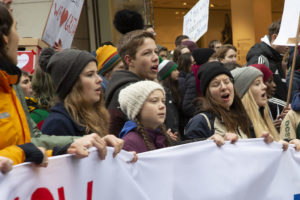
Our planet keeps setting records for heat. This week – at long last – a different record was set: the biggest day of climate protest in world history.
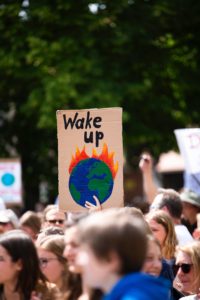
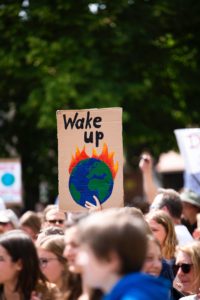
On September 20, 2019, more than 4 million people around the world went on strike to demand bold action to stop the climate crisis. Global Climate Strikes, inspired by Swedish teenager Greta Thunberg, were carried out in more than 150 countries, from Australia and the Pacific Islands to India, Turkey, Europe, and across the United States. Countless people of faith, including Episcopalians, took part, and I am thrilled to say that Episcopal bishops, led by Presiding Bishop Michael Curry, walked out of their House of Bishops meeting in Minneapolis to join the climate strike and issue a statement of support.

On September 19, the day before the Global Climate Strike, I returned home from an intensive mission trip along the coast of California, where I preached, led retreats and workshops, and spoke in multiple cities about the climate crisis. It was the first time I’d met people who had so recently and directly experienced the disastrous effects of climate change, from massive heat waves, droughts and wildfires to torrential rainfall and mudslides. I didn’t need to say very much about the urgency of the situation – I could tell from the alarming stories they shared and the concern in their faces that they already understood: we need as a species to change course fast. From Santa Barbara to Cupertino I urged everyone I met to join the weeklong Global Climate Strike.
Back in western Massachusetts on September 20, I spoke at two Climate Strike events in my corner of the world, Springfield and Northampton. Below are the notes for my remarks.
————————
Springfield Climate Vigil: Standing for life
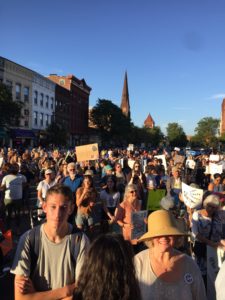
Under a hot sun, sixty or seventy people gathered at Court Square, Springfield, MA, for a climate solidarity vigil filled with music, speaking, and prayer. Organized by Verne McArthur, the vigil featured speakers including Buddhist teacher Jin Haeng Kyle Wiswall, Springfield City Councilor-at-Large Jesse Lederman, Deacon Bill Toller (who read a statement by U.S. Roman Catholic bishops on the need for climate action), Rev. Jason Seymour (Unitarian Universalist Society of Greater Springfield), Sister Melinda Pellerin-Duck (Sisters of St. Joseph of Springfield), and me. Rev. Marisa Brown Ludwig joined Verne in leading the singing. Here is what I said:
I am grateful to be standing with you! In my tradition there is a story of God’s people standing at a crossroads. They have a choice to make, and Moses says to them: “Today I have set before you life and death, blessings and curses. Choose life so that you and your descendants may live.”

We, too, stand at a crossroads. We are living at a pivotal moment in human history, where the choices we make going forward will make all the difference to the wellbeing of our children and our children’s children, and to the life – or death – of billions of people and non-human species around the world.
We know we have a choice. Today, at this crossroads, we stand for life.
You know that we face a long struggle ahead. The U.N. Intergovernmental Panel on Climate Change has told us that we need to transform our society at a rate and scale that are historically unprecedented. This task will demand all our reserves of strength and courage. We need spiritual resilience. So it’s good to know where we are rooted and where we find strength.
Where does our strength come from? We begin by knowing where we stand.
We stand on Mother Earth. I invite you to feel your feet on the ground and to feel the good Earth holding you up. We can imagine our roots going down deep into the Earth, and from deep within Mother Earth we are drawing up strength.
We also stand with trees and all green-growing things.
We stand with other creatures – our brother-sister beings;
with children and young people who long to inherit a habitable planet; and
with the marginalized and poor, the people most vulnerable to climate change.
We stand with everyone who is suffering right now from floods, droughts, and storms,
and with the millions of people worldwide who are rising up to say that they won’t settle
for a death-dealing way of life.
We stand for a better future.
We stand for the possibility that love, not hate, will have the last word.
We stand for the possibility that our species will learn wisdom and compassion, generosity and self-control, so that we become at last what we were made to be: a blessing on the Earth.
And we stand in something, too. What do we stand in?
We stand in love.
We stand in the divine love that is always being poured into our hearts,
in the love that will never let us go and that will be with us till our journey’s end.
We stand in the love that nothing, not even death, can destroy.
We stand in the love whose power, working through us, can do infinitely more than we can ask or imagine.
You and I – we stand for life. Thank you!
————————

Climate Emergency March for a Just Future, Northampton: A blessing
Late in the afternoon, many hundreds of people marched from Sheldon Field to downtown Northampton for a rally at City Hall. Organized by Marty Nathan (Climate Action NOW of Western Massachusetts), the rally featured music (led by Peter Blood and Paul Kaplan, and by Expandable Brass Band) and a range of speakers, including State Senator Jo Comerford, City Council President Ryan O’Donnell, Barb Madeloni (Labor Notes and past President, Massachusetts Teachers Association), Victor Davila (Neighbor to Neighbor Springfield), Maeve McCurdy (Divest Smith), State. Rep. Lindsay Sabadosa, Patrick Burke (SEIU and Hampshire Labor Council), Andrea Schmid (Pioneer Valley Workers Center), and Kate Parrott (teacher at JFK Middle School).
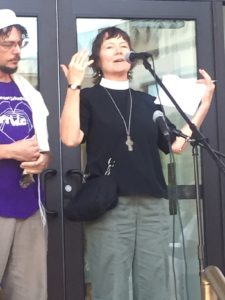
Rabbi David Seidenberg (Prayerground Minyan) and I offered closing blessings. After each of us had prayed, the Rabbi blew his shofar to complete the rally. My blessing, more or less as delivered, is below.
Friends, we have good work to do and we face great challenges ahead. We need to root ourselves in our deep sources of wisdom, strength, and courage. This is a good time to turn to a power greater than ourselves, one that we know by many names: Great Spirit, loving Mystery, Creator and Sustainer of life. Dante called it “the love that moves the sun and the other stars.” Trusting in that sacred power, we can do infinitely more than we can ask or imagine.
I’d like to offer a blessing that I adapted from a Franciscan prayer1 that may be familiar to some of you. I invite you to join me in a spirit of prayer.

May God bless us with discomfort
At easy answers, half-truths, and superficial relationships,
So that we may live deep within our heart.
May God bless us with anger
At injustice, oppression, and exploitation of people and the Earth,
So that we may work for justice, freedom, and peace, and pass along to the next generation a habitable world.
May God bless us with tears
To shed for people and all our brother-sister beings who suffer from the effects of climate change,
So that we may reach out our hands to comfort them
And turn their pain into joy, and our grief into action.
And may God bless us with enough foolishness
To believe that we can make a difference in the world,
So that we can do what others claim cannot be done
To bring justice and kindness to children, to the poor, and to the whole of God’s Creation.
Amen.
1. The source of this prayer is unclear. One Website attributes it to Craig Groeschel: https://www.goodreads.com/quotes/280711-may-god-bless-you-with-discomfort-at-easy-answers-half
The original version reads:
May God bless you with discomfort
At easy answers, half-truths, and superficial relationships,
So that you may live deep within your heart.
May God bless you with anger
At injustice, oppression and exploitation of people,
So that you may work for justice, freedom and peace.
May God bless you with tears
To shed for those who suffer pain, rejection, hunger, and war,
So that you may reach out your hand to comfort them
And turn their pain into joy.
And may God bless you with enough foolishness
To believe that you can make a difference in the world,
So that you can do what others claim cannot be done
To bring justice and kindness to all our children and the poor.
Choose life for you and your children!
What a joy to be with you! I serve as Missioner for Creation Care in both the Episcopal Diocese of Western Massachusetts and the United Church of Christ in Massachusetts. In this ecumenical role I travel from place to place, sometimes (as you can see) far beyond Massachusetts, speaking about the Gospel call to protect God’s Creation. If you’d like to hear what I’m up to, please take a look at my Website, RevivingCreation.org. I know you’re already taking steps as individuals and as a congregation to safeguard what our Prayer Book calls “this fragile Earth, our island home,” so even though we’ve never met, I feel as if I’m among friends.
We have a fine text to reflect on this morning, the passage in Deuteronomy where Moses speaks to his community and gives them a choice. “I have set before you today life and prosperity, death and adversity. If you obey the commandments of God, by loving God and walking in God’s ways, then you shall live and God will bless you. But if your heart turns away and you do not hear, but are led astray to bow down to other gods and serve them, I declare to you today that you shall perish. Today I have set before you life and death, blessings and curses. Choose life so that you and your descendants may live.”1


1. Paraphrase of Deuteronomy 30:15-20. 2. Bill McKibben, Falter: Has the Human Game Begun to Play Itself Out? (New York: Henry Holt and Company, 2019), 32-33. 3. McKibben, 12. 4. David Wallace-Wells, The Uninhabitable Earth (New York: Tim Duggan Books, Penguin Random House, 2019), 3. 5. Hafiz, quoted by Jack Kornfield, The Art of Forgiveness, Lovingkindness, and Peace (New York: Bantam Books, 2002), 83.
The Rev. Dr. Margaret Bullitt-Jonas preached on July 14, 2019, at St. John’s Episcopal Church, Williamstown, MA, on “A plumb line in our midst: When we stop pretending about climate change.”
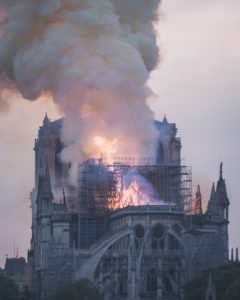
Shocked and helpless, I watched the live-stream as Notre Dame Cathedral went up in flames. Fire spread across the roof and the church’s mighty spire toppled and fell. Crowds gathered in Paris that spring night to weep and pray, to sing hymns and bear witness. Meanwhile, hundreds of fire fighters struggled to extinguish the fire, and another hundred removed artwork and sacred relics. I felt as if I were holding my breath with millions of others around the world as we waited to learn the fate of what some people consider a spiritual and cultural treasure.

Firefighters risking everything eventually brought the flames under control, and, some twelve hours after it began, the fire was snuffed out. We awoke the next morning to study the ruins and to give thanks for what was still standing: bell towers, pipe organs, and rose windows.
Rebuilding began.
But Notre Dame is not the world’s only holy place: every culture has equally precious places that mediate the transcendent. Every mosque and temple is sacred, every shrine and synagogue, and every storefront church.
And so, too, are the lands and waters of indigenous peoples sacred. Where is the protest and grief as these lands are destroyed?
The fire in Notre Dame – literally, “Our Lady” – is over. But the fire on Mother Earth rages on.
The cathedral of life is being torched before our eyes. Year by year, temperatures worldwide continue to rise, setting new records for heat. Ice caps are melting; glaciers are thinning; even the deep oceans are warming. We who are middle-aged were born into a planetary cathedral blessed with a glorious profusion of alpine meadows and coral reefs, ice shelves and wetlands, soaring forests and expansive estuaries – a beautiful, complex, fragile, and resilient sanctuary that allowed life to flourish. But that living architecture is being rapidly dismantled as the climate crisis heats up. More than half the world’s population of animals has vanished since 1970, in part because of climate change.
The web of life is going up in smoke, as the climate grows increasingly inhospitable to all life, including humans. And the people who are least responsible for climate change – low-income communities, indigenous communities, people of color, and the historically marginalized – are suffering first and hardest.
Climate arson
The Intergovernmental Panel on Climate Change (IPCC) warns that we have only a small window of time – perhaps twelve years – in which to transform our economies and make a decisive change of course away from fossil fuels and toward clean, renewable sources of energy.
Otherwise, the Earth could scorch and the cathedral of life could collapse. But already, around the world, the effects of climate change are disastrous: rising seas, massive droughts, extreme weather events, the spread of vector-borne diseases, and millions of climate migrants forced to leave their homelands.
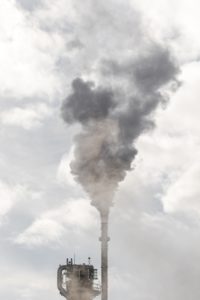
As of this writing, the cause of the fire in Notre Dame is still unknown. By contrast, the cause of our planetary fire is well understood. For more than 30 years scientists have been sounding the alarm about the dangerous effects of burning coal, gas, and oil.

And Exxon has known this for even longer – since the 1960’s. Did it change its business model? No. Did it chart a new course and invest in clean, renewable energy? No. Instead, Exxon and other Big Polluters funded climate deniers and think-tanks that deny climate science; blocked protections that would promote clean, safe, renewable energy; confused the public by spreading misinformation; and poured billions of dollars into the effort to persuade us that fossil fuels are the answer to our energy needs.
It was a global effort to block policy – national and international – that would address the climate crisis. In fact, according to a startling new report, lobby groups representing some of the world’s biggest fossil fuel corporations have been crowding UN climate talks for decades and using the negotiations to push their agenda.
Despite Big Polluters’ extensive campaign of climate disinformation, people in the U.S. are finally beginning to see through the lies. As a result, the fossil fuel industry is taking a new tack: greenwashing. Eager to be perceived as environmentally friendly and as contributing to the common good, Exxon and other fossil fuel corporations present themselves as “energy” companies that are as devoted to providing power from sunshine and wind as they are to burning fossil fuels. (For a while, BP even tried to persuade the public that its brand was “Beyond Petroleum.”)
In actuality, developing power from sun and wind is only a miniscule part of coal and oil and gas reserves of the fossil-fuel companies, and the countries that act like fossil-fuel companies. They already hold perhaps five times the amount of coal, gas, and oil that, if burned, would further fuel the already raging climate chaos. And they continue to explore aggressively for more oil and gas. They have every intention of burning it.
If fossil fuel corporations are successful in carrying out their business plans, which require unlimited expansion of markets and ever-increasing extraction and burning of fossil fuels, they will destroy life as it has evolved on this planet, including humans.
Determined to douse the fire
I watched helplessly as Notre Dame Cathedral caught fire, but we don’t have to be helpless spectators of climate change. We don’t have to settle for standing wretchedly on the sidelines, wringing our hands. Instead, we can take responsibility for protecting our earthly cathedral, both as individuals and as members of society.
As individuals, we can learn to live more gently and lovingly in the cathedral of life. We can do everything possible to cut back sharply on our use of fossil fuels and to make wiser choices around energy.
As members of society, we can make an even greater difference. The climate emergency requires more than incremental or individual solutions: it requires bold, decisive action and systemic change. The time has come to rein in the corporate and political powers that are making huge profits by treating people and planet alike as disposable. Unless we stop them, they will extract and burn every last ounce of coal and every last drop of oil and gas until the Earth is laid waste.

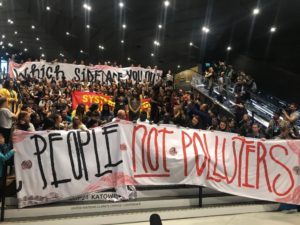
That’s where the crucial work of the non-profit organization Corporate Accountability comes in: it campaigns to hold Big Polluters accountable for knowingly fueling and denying climate change. Along with a majority of the American public, Corporate Accountability understands that the fossil fuel industry bears a burden of responsibility for the harm caused by global warming and should pay for the damages.
Uplifted by a vision of a more just and life-giving society in which all people can thrive, Corporate Accountability is organizing to stop Big Polluters from writing the rules and is holding them accountable for the crisis they have fueled.
It’s time to become as focused as a fire fighter and to figure out not only how to douse the flames but also how to stop the band of arsonists that continues to fuel the fire.
Let’s say you know an arsonist – someone who is lighting and pouring gasoline on countless fires, but denying any responsibility for the havoc they cause. And let’s say you are a firefighter who is struggling to extinguish one of those fires. What if that arsonist dressed himself up like a firefighter, approached you, and earnestly claimed to be “part of the solution”? Would you let him anywhere near the building you were trying to save? Of course not! You’d probably grab his arm, hold him back, and cry out for someone to take him to court.
That’s exactly what Corporate Accountability is doing: organizing to move attorneys general around the country to investigate Exxon for its decades of climate deception. An arsonist posing as a firefighter is still an arsonist and needs to be restrained. What’s more, an arsonist who has raked in billions of dollars from setting a cathedral alight must be required to pay for the damage.
The climate crisis threatens everything we love. With that great love pouring into our hearts – our love for our children, our love for birdsong and whale-song, our love for clean air and clean water and for all the conditions that allow life to flourish on this planet – it’s an honor to stand with Corporate Accountability. I hope that you will join me in supporting their mission to confront the fossil fuel industry and hold it accountable. We intend to do everything in our power to save the living cathedral that God entrusted to our care.
##
This essay is also posted at Corporate Accountability’s Website here.
A plumb line in our midst: When we stop pretending about climate change
“This is what the Lord God showed me: the Lord was standing beside a wall built with a plumb line, with a plumb line in his hand. And the Lord said to me, ‘Amos, what do you see?’ And I said, ‘A plumb line’” (Amos 7:7).That interested me, this image of God standing beside a wall, holding up a plumb line to see whether or not the wall was straight and could stand. So I went on the Internet and learned that plumb lines are useful in a great many fields. A plumb line, or something like it, can be essential if you want to build a house or build a ship, or if you want to make a level wall or draw a good map. Carpenters use plumb lines, and so do stonemasons, astronomers and geographers.


How To Preach on the Green New Deal: Margaret contributed one of the tips to this resource for preaching
Below is a statement about biomass that I gave at a public hearing held by The Massachusetts Department of Energy Resources (DOER) in Springfield on June 5, 2019.
My name is Rev. Dr. Margaret Bullitt-Jonas. I’m an Episcopal priest with an ecumenical job. I serve as Missioner for Creation Care for the 375 churches of the Massachusetts Conference of the United Church of Christ, and also for the Episcopal Diocese of Western Massachusetts, which stretches from Worcester to the border of New York State and whose diocesan headquarters are located right here in Springfield.

Arlington Street Church [Unitarian Universalist], Boston), Rev. Dr. Margaret Bullitt-Jonas, & Rev. Leslie K. Sterling (Rector, St. Bartholomew’s Episcopal Church, Cambridge) prepare to testify at DOER hearing. Photo credit: Rene Theberge.
Forests are sacred spaces, not spaces to make a fortune. Trees matter. They sequester carbon, and the latest IPCC report makes it abundantly clear that in order to avert climate chaos we must protect and enlarge our forests, not cut them down. It’s absurd to claim that burning intact trees is carbon neutral because new trees will grow back some day.
The truth is that logging releases an immediate pulse of carbon into the atmosphere that will take years for young trees to absorb – and there’s no way to re-freeze the polar caps and the glaciers that will have vanished in the meantime.
It’s also absurd to claim that incinerating trees is a form of clean energy, for inefficient biomass power plants actually release more CO2 per unit of energy than coal-fired power plants do. If humanity manages to survive on this planet, it will be thanks in part to the forests that we leave intact and to the new forests that we plant.
Trees are essential to human health and survival. Trees are also essential to the human spirit. Biblical scholars point out that there is a tree on the first page of Genesis and on the last page of Revelation – the first and last pages of the Bible. There is a tree in the first psalm, and the Bible refers to its wisdom as a Tree of Life (Proverbs 3:18). Jesus calls himself the true vine (John 15:1).
Love calls me – the God of life calls me – to stand with trees, to stand with all our brother-sister beings that are so swiftly being destroyed by an economic system that heedlessly devours the web of life that God entrusted to our care.
I call upon Governor Baker and his administration to drop plans to count incineration as renewable energy. I call upon Governor Baker and his administration to stop renewable energy subsidies for all biomass and trash incineration in our state.
For trees and the Bible, read Matthew Sleeth, Reforesting Faith: What Trees Teach Us About the Nature of God and His Love for Us (Colorado Springs: WaterBrook, 2019).
For information on biomass in Massachusetts, visit Partnership for Policy Integrity.
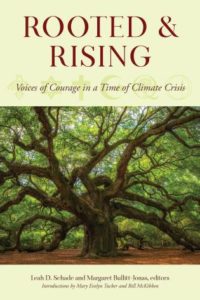
ROOTED & RISING: VOICES OF COURAGE IN A TIME OF CLIMATE CRISIS is now available for pre-order! Click here to reserve your copy.
Love in a time of climate emergency
We have a wonderful text to reflect on this morning, a passage from the Gospel of John. The scene is the Last Supper, and Jesus is beginning to say goodbye. He knows that his life is about to be cut short and that the next day he will die. So Jesus gathers with his friends for a final meal, and in an act of humble service, he washes their feet. Then, as Judas steps out into the night to betray him, Jesus turns to the gathered circle and says those familiar words: “Little children, I am with you only a little longer. You will look for me; and as I said to the Jews so now I say to you, ‘Where I am going, you cannot come.’ I give you a new commandment, that you love one another. Just as I have loved you, you also should love one another. By this everyone will know that you are my disciples, if you have love for one another” (John 13:13-35).
These are urgent and tender words, the words of someone facing death and eager to convey what really matters. “Little children, love one another.” I’m told that in John the Evangelist’s old age, that was the basic message he brought to one community of faith after another: “Little children, love one another.” After spending time with Jesus, and after years of meditating on Jesus’ life and teaching, on Jesus’ crucifixion and resurrection, the aging evangelist could find no more direct route into the heart of the Gospel than simply to say, “Little children, love one another.”
This brings to mind a poem by Michael Leunig:1
There are only two feelings. Love and fear.
There are only two languages. Love and fear.
There are only two activities. Love and fear.
There are only two motives, two procedures,
two frameworks, two results.
Love and fear.
Love and fear.
As followers of Jesus, we may be called to love, but I don’t for a moment believe that we’re not also well acquainted with fear. I remember my childhood fears, such as my fear of the monsters lurking under the bed, and how important it was not to let even one toe stick out beyond the edge of the mattress. I remember my fear that when my parents went out at night, they might not come back. I remember my fear of the swarm of bees that nested near the front door; my fear, during piano recitals, that I might forget which note came next; my fear that I might be chosen last for the softball team, or, what’s worse, that the ball might actually come hurtling in my direction and – dreadful thought – all my team-mates would count on me to catch it.
The fears of a child gradually morph into the fears of an adult, and even though we grownups may go to a great deal of trouble not to appear anxious or afraid, most us face some kind of fear every day. Fears come in all shapes and sizes. What are you afraid of? Chances are excellent that several of us fear the same thing. And we know what that’s like: how, when frightened, we hold our breath, our bellies clench and our hearts race.
There’s a lot of fear going around these days, and we have reason to worry. In addition to our personal fears, we feel a collective shudder about the state of the world, from the assault on women’s reproductive rights to the harsh treatment of immigrants. For me, it’s the ecological crisis that wakes me up at night, for scientists are reporting with increasing concern that the web of life is unraveling before our eyes and that human civilization is at risk of collapse. Just think of it: the number of animals around the world has plummeted by over half in less than 50 years, mostly by the development of great swaths of land and the destruction of habitat. Human activity has wiped out 60% of the world’s mammals, reptiles, amphibians, birds, and fish since 1970. Alarmed scientists are describing what they call a “biological annihilation,” and one expert commented: “This is far more than just being about losing the wonders of nature, desperately sad though that is…This is actually now jeopardizing the future of people. Nature is not a ‘nice to have’ – it is our life-support system.” A few weeks ago, a sweeping new report from the U.N. spoke about the possible extinction of as many as one million plant and animal species in the near future.
And then there’s the climate crisis. Burning fossil fuels like coal, gas, and oil is pushing the planet to break new records for heat, causing droughts, floods, and monster hurricanes, drowning cities, and accelerating wildfires. The people hurt first and hardest by the effects of a changing climate are the poor, and unless we change course fast, we will not be able to leave our children and our children’s children a habitable world. The U.N.’s Intergovernmental Panel on Climate Change warns that we have only a very short span of time – maybe 12 years – in which to avert a catastrophic level of global warming worldwide.

I will end with a story about love and fear.4 Back in 2001 I screwed up my courage and decided to carry out my first act of civil disobedience. That’s how I met your former pastor, Andrea Ayvazian: in Washington, DC, where she was helping to organize a new interfaith group, Religious Witness for the Earth, that was planning to protest President Bush’s intention to drill for more oil in the Arctic.
Here’s what happened: On the first day we learned about oil drilling and the Arctic, about climate change and fossil fuels. On the second we lobbied our members of Congress and studied the disciplines of non-violent civil disobedience. On the third, about a hundred of us marched down Independence Avenue in religious vestments, carrying banners and singing. When we reached the Department of Energy, an enormous stone structure surrounded by police, we held a brief worship service. So far, everything was legal. Then came the part that wasn’t. I’ll read from an essay I wrote about what that was like.
The worship service was coming to an end. We sang “Amazing Grace,” and then the twenty-two of us who had decided to risk arrest joined hands and walked slowly to the doors of the Department of Energy.
I felt us cross an invisible boundary. With the others, I stepped over a threshold I could not see. I walked out of my ordinary life.
I am neither a law-breaker nor a thrill-seeker. More often than not, I follow the rules – even enforce them. I fasten my seat belt, don’t cheat on taxes, write thank you notes, and stand up when the band plays our national anthem. But here I was, intentionally and publicly breaking the law. As if some inner revolution had quietly taken place, the old “me” was no longer in charge. Whatever security I’d felt in operating within the rules was gone. That’s partly why I felt so frightened as I left the safety of the circle and moved toward the door: I hardly recognized myself. I hardly knew who I was.
§§
We stand or kneel in prayer, our backs to the building.
The pavement under my knees is hard. At home, I often sit on a meditation cushion to pray. Today there is no cushion, just the weight of my body against stone. I lift up my hands. I’m dressed for Holy Communion. I might as well hold out my arms as I do at Communion.
Instead of pews filled with parishioners, I see ranks of police and a cluster of supporters. I am afraid. I’ve never been arrested before. Years ago, as a VISTA volunteer in Mayor Rizzo’s Philadelphia I heard countless stories of police brutality. It’s not that I really expect the same thing to happen to me – the punch in the gut, the assault behind closed doors. Still, my body tenses as I place myself against the cops, the Feds, the law.
I close my eyes. One by one we pray aloud, words thrown into space, words hurled against stone.
Is this whole thing ridiculous? I briefly open my eyes and notice a well-dressed man watching us. He strokes his tie, leans over and says something to a fellow nearby. The two of them chuckle. I have no idea what they’re talking about but I wonder if they think we look absurd. I suppose we do. Here we are with our jerry-rigged signs, our predictably earnest songs and prayers of protest, a foolhardy band straight out of the ‘60’s.
Defensively, I imagine confronting that mocking man with the arsenal of our credentials. “We’re no rag-tag bunch,” I want to tell him. “We’re people with doctorates and master’s degrees – nurses and ministers, writers and accountants. Thoughtful people, educated people, professionals.”
I am distracted from prayer by this indignant outburst. “Let it go,” wisdom tells me. “None of that matters — your degrees, your skills, your status in the world. The privileges of race and class mean nothing now. You’re a woman on your knees, that’s who you are — one human being pleading with God.”
I turn my attention back to prayer and continue to stretch out my arms. Suddenly I realize that behind the tension, behind the fear and self-consciousness, something else is welling up. I am jubilant.
“Lift up your hearts,” I might as well be saying to the people before me, beaming as broadly as I do at Communion.
“We lift them to the Lord,” would come the response.
How did I miss it? After years of going to church, after years of celebrating Communion, only now, as I kneel on pavement and face a phalanx of cops, do I understand so clearly that praising God can be an act of political resistance. That worship is an act of human liberation. The twenty-two of us come from different faith traditions, but each of us is rooted in a reality that transcends the rules and structures of this world. Tap into that transcendent truth, let the divine longing for a community of justice and mercy become your own deepest longing, and who knows what energy for life will be released?
I feel as defiant as a maple seedling that pushes up through asphalt. It is God I love, and God’s green earth. I want to bear witness to that love even in the face of hatred or indifference, even if the cost is great.
So what if our numbers are small? So what if, in the eyes of the police, in the eyes of the world, we have no power? I’m beginning to sense the power that is ours to wield, the power of self-offering. We may have nothing else, but we do have this, the power to say, “This is where I stand. This is what I love. Here is something for which I’m willing to put my body on the line.”
I never knew that stepping beyond the borders of what I find comfortable could make me so happy. That shifting from self-preservation to self-offering could awaken so much joy.
Love and fear. Love and fear. I invite you to take a moment to remember a time when you took a brave step toward fullness of life, a time when you made a decision to do the right thing, even though you knew it would be difficult or costly. Who inspired you to be bolder than you thought? With whom do you hold hands, literally or figuratively, when you step out to make a difference in the world? And if you knew you could not fail – if you were set free from fear – what would you do for the healing of our world?
Let’s take a moment in silence, and then I invite your response.
1. Michael Leunig, A Common Prayer (NY: HarperCollins, 1991).
2. David Wallace-Wells, The Uninhabitable Earth (New York: Tim Duggan Books, Penguin Random House, 2019).
3. Hafiz, quoted by Jack Kornfield, The Art of Forgiveness, Lovingkindness, and Peace (New York: Bantam Books, 2002), 83.
4. This story is adapted from part of my chapter, “When Heaven Happens,” in the anthology Heaven, ed. Roger Ferlo (New York: Seabury Books, 2007), 78-81.