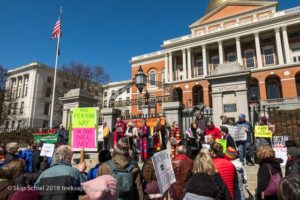
Margaret is quoted in a report by Anglican News on Massachusetts faith leaders and scientists joining forces in a climate change emergency appeal (May 31, 2018).
Author Archives: mbj
The Faith & Science Joint Appeal for Climate Action was released in Boston on May 23, 2018, and on May 29, Episcopal News Service published Margaret’s article about science and religion joining forces to fight climate change.
[Episcopal News Service] Bishop Alan Gates of the Episcopal Diocese of Massachusetts and Bishop Doug Fisher of the Episcopal Diocese of Western Massachusetts joined Cardinal Seán O’Malley of the Archdiocese of Boston and other local faith leaders and scientists on May 23 for the release of a joint appeal for action on climate change.
More than 500 leaders from religious and scientific communities in Massachusetts have endorsed the Faith and Science Joint Appeal for Climate Action, which declares, “Climate change is an ecological and moral emergency that impacts all other aspects of our shared lives and requires us to work together to protect our common home.”
The statement says, “All of us … must do our utmost to reduce greenhouse gas emissions and to protect our communities from the catastrophic impacts of climate change. We especially call upon our political representatives to address the climate crisis with the boldness and urgency it requires, with substantive and immediate action.”
The release of the joint appeal is a significant first step in an extraordinary, even unprecedented, alliance between religion and science. Initiated by Phil Duffy, president of the Woods Hole Research Center, who reached out to O’Malley, this emerging coalition of faith leaders and scientists intends to give a robust push to the effort of preserving a livable planet.
As I wrote in a February blog post after attending the first meeting of religious leaders and scientists, which was held at the Pastoral Center of the Archdiocese of Boston, “Such a partnership has enormous potential in this perilous time. In fact, such a partnership may be not just desirable, but even essential. Given the massive disruption of our global climate that is now underway, we need to hear from scientists, who have made it abundantly clear that continuing to burn fossil fuels will lead in a very short time to climate catastrophe. We also need to hear from spiritual and religious leaders, who can give us the inspiration, motivation, and moral courage to change course and to create a more just and life-sustaining society.”
The joint appeal was released on the third anniversary of the publication of “Laudato Si’: On Care for Our Common Home,” the landmark encyclical written by Pope Francis. “Laudato Si’” is addressed to “every person living on this planet” and calls for our urgent response to “the cry of the Earth and the cry of the poor.”
Fisher commented that, “As followers of Jesus, we seek to build a society that is marked by mercy, justice, and hope. The only way to love God and our neighbor is to preserve the conditions that allow life on Earth to flourish, which begins with a habitable climate. Our emerging coalition of faith and science illuminates a basic truth: climate disruption is not only a scientific issue, but also a deeply spiritual and moral issue.”
Gates commented, “This coalition is a strong rebuttal of three all-too-commonly-held fallacies: that faith and science do not align (they do!); that climate change is a partisan political issue (it is not!); and that we have plenty of time to figure out solutions to this crisis (we don’t!). I am grateful for the opportunity to move beyond these misjudgments and get on with the work that our stewardship of God’s Creation demands.”
Another religious leader who attended the May 23 press conference stepped forward to offer a few impromptu, impassioned remarks. The Rev. Jim Antal, who leads the Massachusetts Conference, United Church of Christ (and who, with Fisher, oversees my ecumenical appointment as missioner for creation care), pointed out that religious communities have plenty of room for improvement when it comes to raising awareness about the urgency of stabilizing our planetary climate. How often do we preach about climate change? How often do we give our congregations opportunities to learn climate science and to discuss the issue from a religious and spiritual perspective? He cited the latest research from the Yale Program on Climate Communication (“Climate Change and the American Mind: March 2018”), which shows that although 70 percent of Americans understand that climate change is real and largely caused by human activities, 65 percent of Americans never talk about it. And only 13 percent consider climate change to be a religious issue.
Now that the joint appeal has been issued, members of our emerging coalition of faith and science are meeting May 30 to discuss next steps. I view this initiative as strong encouragement to Episcopal congregations to learn about climate science, to engage in conversations about climate change as a moral and spiritual concern, and to take effective action. In order to protect “our common home” and to break our dependence on fossil fuels, Americans need both head and heart. Facts and reason alone will not motivate us to change course; we also need stories, prayer, and ceremonies, the power of imagination and a vision of hope. Together with scientists, we can speak with one voice about the sacredness of God’s Creation and the moral imperative to protect it.
To read the article at ENS (“In new coalition of religious leaders and scientists, Massachusetts bishops declare climate change an emergency”), visit here.
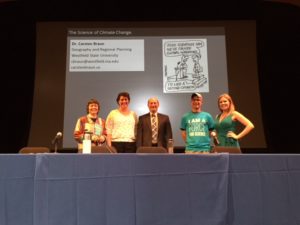
It’s unusual to see a scientist, a politician, an economist, and a religious leader sitting together at one table to discuss climate change. Yet that’s just what happened at a public forum at Westfield State University entitled “Carbon Pricing – A Key Component in Solving a Warming Climate.” The four speakers included Dr. Carsten Braun (a climate scientist at Westfield State), State Rep. Jen Benson (D-Lunenburg, the lead co-sponsor of bill H.1726, which places a price on carbon in Massachusetts), Dr. Marc Breslow (Director of Policy & Research at ClimateXChange), and me.

The conversation was lively. Striding up and down the aisle of the auditorium, Dr. Braun began by reflecting on a photograph of a barren, lifeless landscape, which turned out to be Mars. Far off in the dark sky was the tiniest of dots: planet Earth. On that tiny dot was everyone and everything we love, a living, precious, blue-green planet.
Mars is unsuited to human life. In the movie “The Martian,” the character played by Matt Damon is stranded on the red planet and must fight to survive until he can be rescued. By contrast, as Dr. Braun observed, if we render planet Earth uninhabitable, we have no rescue coming. Nothing will save humanity from the ravages of global warming unless we take concerted action to save ourselves.
He showed us graphs and charts that predict what lies ahead. The best-case scenario puts the average atmospheric level of carbon dioxide at 550 ppm by 2100; the worst-case scenario puts it at 940 ppm. The trajectory is frightening, but the good news, he said, is that by taking action, “we get to choose the future.” (For scientific information on climate, he recommends ClimateCentral.org. For making the transition to clean, renewable energy, he recommends TheSolutionsProject.org.)
Dr. Braun urged us to move from knowledge to action, quoting the late chemist F. Sherwood Rowland: “What is the use of having developed a science well enough to make predictions if, in the end, all we’re willing to do is stand around and wait for them to come true?”
A scientist was followed by a politician. Rep. Benson discussed how her carbon pricing bill, H. 1726, would reduce carbon pollution, rebate 80% of the revenue, and reinvest the remaining 20% into a Green Infrastructure Fund for clean energy, public transit, and climate adaptation projects. Next came an economist, Dr. Marc Breslow, who explained that the price of a product should include the damage to society that it causes – such as its harm to public health and to the environment. What’s more, studies show that a well-designed carbon-pricing plan would not only reduce dirty emissions but also enable low-income and moderate-income households to come out ahead financially.
When it was my turn to speak, I argued for the spiritual and moral call to put a price on carbon, based on a talk that I gave four years ago at a similar carbon-pricing panel in Amherst. Some things clearly need to be said more than once! My reflections are below.
At the end of the evening, I expressed my agreement with the scientist, Dr. Braun: we earthlings should not count on being rescued from the climate crisis by some extraterrestrial or supernatural entity. Yet I do believe that human beings have the God-given capacity to access a loving Presence and source of wisdom that is greater than we ourselves. I hope that we will remember to heal and tend not only our outer landscape, but also our inner landscape, for, through prayer and spiritual practice, we can tap into a boundless love whose strength will never fail us, a divine love that gives us the moral courage to change course. Our task is to be good ancestors.
I don’t know if we will succeed in stabilizing the climate in time to maintain a habitable world for future generations. But I do know that I want to get up every morning, willing to do whatever I can to heal the web of life, and aiming to be what God intended for us to be: a blessing on Earth.
It’s a joy to be here tonight, and I am honored to be speaking alongside these expert colleagues who have addressed the science of climate change and the economic, environmental and societal benefits of a carbon fee and rebate.
I’d like to pull back the lens and to comment briefly on what I understand to be the larger spiritual and ethical context in which we’re holding this conversation.
I invite you to take a moment to feel your feet on the ground. Beneath the floor is the earth. Let yourself feel the support of the good earth beneath your feet. Feel the sensations of your feet on the floor, and let the good earth hold you up. Feel how solid your body is, as solid as the earth… I invite you take a couple of good, deep breaths. As you take in the sweet air and then let it go, feel the air passing into and out of your lungs. Notice that you are exchanging the elements of life with plants and green-growing things… You are giving the breath of life to trees. Trees are giving the breath of life to you. Take a moment to experience yourself as a living creature, connected in a dynamic, living relationship with the earth and air and all living beings.

As we sit here with our feet on the ground, breathing with awareness, we may notice that none of us owns our breath. Our breath does not belong to us. We can’t hold on to it or save it up for later. We simply receive it freely and then let it go. Moment by moment, each breath is given to us. Breath by breath, we receive the gift of life. All of it is gift – everything we see and hear and taste and touch. This is where amazement springs up, along with wonder, gratefulness and awe. Here we are! Breathing!
Gratitude is the wellspring of all spiritual traditions, and from gratitude flows the perception that everything is precious. Everything is sacred. We belong to a sacred Mystery that is much larger than we are. We are part of a much larger whole. In our stressed and busy lives it’s easy to forget that we are part of something greater than ourselves, which is why so many of us come home to ourselves when we spend time outdoors – when we climb a mountain and get the big view, or when we pause in the midst of a busy day to listen to a warbler or gaze at a blooming dogwood tree.
When we are spiritually awake we feel our connection, our kinship, with other living beings, human and other than human. We recognize that we’re in this together, that all of us are part of one single, precious, and intricate web of life. Perceiving the world like this elicits a certain tenderness: we want to nurture and protect the mysterious gift of inhabiting a living planet. That’s the spiritual wisdom we can learn from being aware of our feet on the ground and our lungs filling and emptying with air.
But our bodies also teach us about the ethical dimension, the justice dimension of the world. The good earth beneath our feet is the same earth that fossil fuel companies are blowing apart by mountaintop removal in order to extract coal; the same earth that is being violently injected with tons of chemicals that crack apart shale, release fracked gas and methane, and poison rivers and streams; the same earth that is flooding in some places, going dry in others, and manifesting unpredictable, violent extremes of weather because of the abrupt changes inflicted by global warming.
The life-giving air that fills our lungs is the same air into which fossil fuel companies are pouring greenhouse gases as if the atmosphere were an open sewer; the same air that contains more carbon dioxide than it has for millions of years; the same air whose delicate balance is being disrupted and destroyed.
Our own bodies connect us to the wounding of the world and to the cries of the poor, who are affected first and hardest by climate change, and who are already suffering from its effects, including extreme storms and rapidly rising seas, food and water shortages and infectious diseases.
That is the spiritual and ethical context in which I welcome a carbon tax and rebate. Putting a stable, rising, and meaningful price on carbon, and distributing the fee in a way that is fair and doesn’t harm the poor, is an essential step in making a swift and just transition to clean renewable energy. My friends who advocate for carbon pricing point out that carbon pricing is not a silver bullet – by itself it can’t resolve the climate crisis. But carbon pricing is an essential piece of the jigsaw puzzle. It is one of the most promising tools we have for changing consumers’ behavior, reducing our use of dirty energy, creating green jobs, and stabilizing the climate.
Here’s the bottom line: we need to protect the web of life, which is unraveling before our eyes. We need to move quickly to build a just and sustainable future for our children and our children’s children. We need to plant our feet firmly on this beautiful earth, to take a good deep breath of air, and to press together for a strong, fair, and equitable carbon fee and rebate plan. I hope that Massachusetts will lead the way.
The Rev. Dr. Jim Antal is retiring as President and Minister of the Massachusetts Conference, United Church of Christ. I will miss him! Here’s what I said at his retirement celebration in Worcester.

What a blessing to be here as we honor our friend Jim. I’ve been invited to speak about his leadership in protecting God’s Creation and taking action on climate change.
Not everyone who wanted to be here today was able to make it. Someone who dearly wanted to come sent a letter that he asked me to share, and I brought it with me. The missing person is Scott Pruitt.
Jim, you need to know that he wanted to have a few words with you and to share his feelings about your climate ministry. He delivered his letter in a 12-foot limousine that gets 5 miles per gallon. Here’s what he wrote.
Dear Reverend Dr. Antal,
You know how hard I’m working to dismantle every regulation that protects the integrity of our environment. You know how hard I’m trying to convince the American public that science doesn’t matter, climate change is nothing to worry about, and God put all that wonderful coal, gas, and oil in the ground so that we could dig it up and burn it, and, incidentally, so that some of us could get rich.
Reverend, I must tell you that you are a thorn in my side, a burr under my saddle, and a monkey on my back. If my work comes to nothing, it will be because you, and people like you, rose up to stop me. I fear your energy, your eloquence, your moral conviction, and your persistence. But there is one thing about you for which I am grateful: you make my speeches easy to write. I read what you say, and then I say the exact opposite.
Sincerely yours,
Scott Pruitt

Thanks for sharing, Scott.
Here’s what I want to say: eleven years ago, in 2007, I met Jim on a sidewalk somewhere between Newton and Cambridge, near the end of the Interfaith Walk for Climate Rescue, a 9-day walk from Northampton to Boston that I helped organize to raise awareness about the climate crisis. The march ended with an interfaith service at Old South Church, and when the congregation stepped into Copley Square, we held what was until then the biggest climate rally in U.S. history.
I love it that Jim and I made friends on a climate walk. As we walked along together, we immediately launched into a spirited conversation about everything from the nature of hope to the moral call to care for the Earth. I wondered to myself: Who is this brilliant guy with the big-picture mind, the passionate dedication to solving the climate crisis, and such an extraordinary zest for life? His laugh could light up a room.

In the years since then, Jim has been an intrepid ally, friend, and visionary thinker in countless other climate actions. We dangled our legs over the side of a pipeline trench in West Roxbury as we prayed and sang before the police handcuffed us and took us away. On another occasion, Jim declared “A New Awakening,” and we co-led workshops on prophetic preaching about climate. We spoke on panels. We marched in D.C. We visited the State Department to weigh in on the upcoming climate talks at the U.N.
In 2012, when Mitt Romney was running for President against Barack Obama, we joined Bill McKibben in delivering to Romney’s local headquarters more than 52,000 signatures on a climate letter. In 2013, we co-organized the Climate Revival in downtown Boston. In 2017, when Trump announced his intention to pull out of the Paris Climate Accord, we co-wrote an ecumenical statement of Christian protest, “An Opportunity for Which the Church Was Born” – that title came from Jim.
This is only a glimpse of Jim’s leadership on climate. I should mention, by the way, that he was a key player in persuading the United Church of Christ to become the first denomination to move toward divestment from fossil fuels.
Jim, you are an incomparable friend and an incomparable leader on climate. Thank you for hearing the cry of the Earth, the cry of the poor, and the cry of future generations. I couldn’t say it better than Bill McKibben, who wrote, in the foreword to your new book, Climate Church, Climate World: “…For as long as there has been a serious climate movement in the United States, Jim Antal has been at the forefront… He is on the short list of heroes who have given their all.”
Maybe one day Scott Pruitt will stop by your house in a Tesla – or on a bike! – shake your hand, and thank you for converting his heart. If he asks to plug his Tesla into your outlet, I know you will be generous and say yes. Until then, I’ll be with you in the struggle. Let’s keep walking.
Margaret is extensively quoted in “Responding to Small Island States Imperiled by Human-Forced Climate Change: An Ethical Imperative for Christians,” by Jame Schaefer, Anglican Theological Review, Winter 2018 issue (Volume 100, Number 1). A sample: “God’s love and presence are everywhere—not just in church, not just inside a sanctuary built by human hands, but also outside, in the sea and sky, in the humble tomato plant valiantly trying to grow in my shady garden. The crucified, risen and ascended Christ fills all things, sustains all things, and redeems all things.”
To download the article, click here: Responding to Small Island Nations.
The Rev. Dr. Margaret Bullitt-Jonas preached on April 15, 2018 at Federated Church of Orleans, on Cape Cod, Massachusetts: “You are witnesses of these things.”
“You are witnesses of these things”
Today we are deep into the Great Fifty Days of Easter, and I want to share a story told by an Episcopal bishop about leading worship one Easter morning. Bishop Mark Macdonald was preaching to a congregation in the middle of Navajo Nation. When the time came to read the Gospel account of Jesus’ resurrection, Bishop Macdonald stood up and began reading in Navajo: “It was early in the morning…” Almost before the words were out of his mouth, “the oldest person there, an elder who understood no English, said loudly (in Navajo), ‘Yes!’”


1. Mark Macdonald, “Finding Communion with Creation,” in Holy Ground: A Gathering of Voices on Caring for Creation, edited by Lyndsay Moseley and the staff of Sierra Club Books, San Francisco: Sierra Club Books, 2008, pp. 150-151. Macdonald is the former bishop of Alaska, and now serves as the National Indigenous Bishop of the Anglican Church of Canada. 2. Ibid, p. 151. 3. “Mystic Christ,” by Fr. John Giuliani, Bridge Building Images, Inc.
We carried out Exodus from Fossil Fuel: An Interfaith Witness for Climate Action at the Massachusetts Statehouse on Monday in Holy Week, shortly before Passover, on March 26, 2018. Deep thanks to Andrew Mudge of Blackkettle Films, who donated his time and skills to make this inspiring 4-minute video.
Click here to watch the video on YouTube.

Hot off the presses! Margaret contributed an essay to a collection of essays published in Spring 2018 by SEARCH: A Church of Ireland Journal, on the topic: The Episcopal Church — Standing Up to Climate Change Denial.
Margaret contributed to a collection of essays, “The Episcopal Church — standing up to climate change denial?”, assembled by Margaret Daly Denton and published in SEARCH: A Church of Ireland Journal, Spring 2018. The other contributors are Presiding Bishop Michael B. Curry, the Rev. Fletcher Harper (GreenFaith), and Nathan Empsall (Yale Divinity School seminarian).
To download the essay, click on the title: TEC Standing up to Climate Change Denial.
The Website for SEARCH: A Church of Ireland Journal is here.