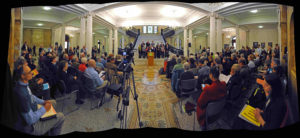
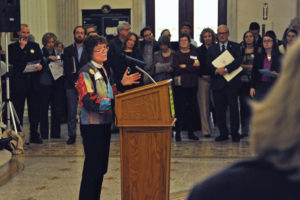
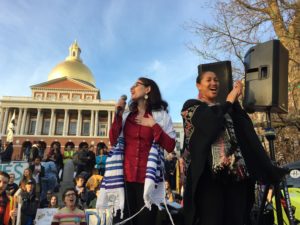
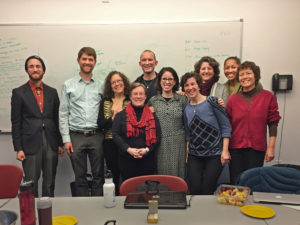
With Rabbi Katy Z. Allen, Margaret writes an op ed for MetroWest Daily News, “To love God and neighbor, put a price on carbon pollution” (October 22, 2017)
Author Archives: mbj
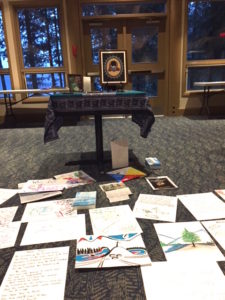
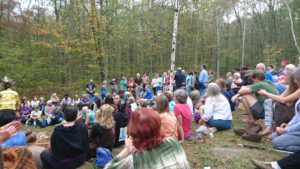
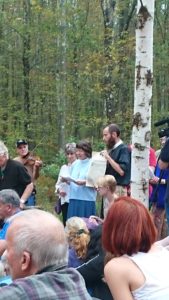
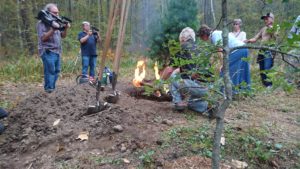
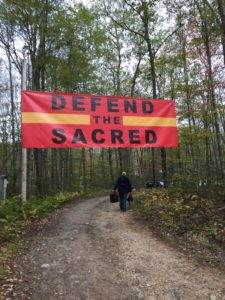
Margaret leads a Christian ceremony of repentance for the Doctrine of Discovery, which is then burned and buried under a pine tree, as part of an Iroquois Peace Tree ceremony. The ceremony took place on October 7, 2017, at Agape Community in Hardwick, MA, where Chief Arvol Looking Horse, Beatrice Menase Kwe Jackson, and other Native American leaders and elders gathered with hundreds of people for “Listening to Native Voices: Standing Rock is Everywhere.”
Hundreds of people – including leaders and elders of Native American tribes from across the U.S. – assembled yesterday under a large tent at Agape, a Christian community in the woods of central Massachusetts that is dedicated to social justice, non-violence, and sustainable living. We were there to mark the 35th annual celebration of St. Francis Day at Agape, and it was a thrilling, even transformative day, a day of listening, drumming, and sacred ceremony, a day of mourning and celebration.

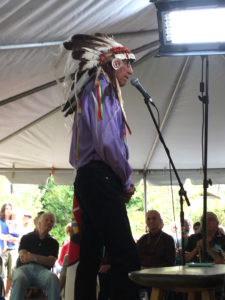
The keynote speaker was Chief Arvol Looking Horse, whom I had last seen in December, when I accepted the invitation that he extended to religious people across the country to come to Standing Rock for an interfaith day of prayer. A descendant of Sitting Bull, Chief Arvol Looking Horse was chosen at the age of 12 to become the 19th Generation Keeper of the Sacred White Buffalo Calf Pipe. Now in his 60’s, Chief Arvol carries his long, lanky frame with the sorrow and dignity of a person who has looked deeply into suffering and who finds hope in the wellspring of sacred ceremony and practice.
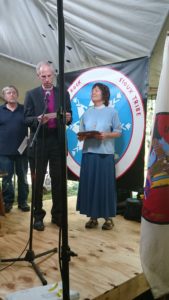
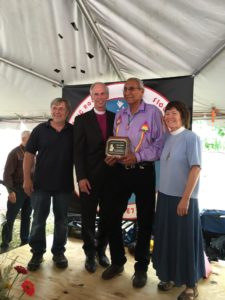
I was honored to join two other Christians representing the National Religious Coalition on Creation Care in giving the Chief an award. Bishop Doug Fisher of the Episcopal Diocese of Western Massachusetts, and my husband Robert Jonas, founder of the Christian-Buddhist prayer sanctuary, The Empty Bell, joined me in making brief remarks. We noted that members of the National Religious Coalition on Creation Care (NRCCC) come from the Abrahamic faiths, including Jews, Muslims, and Christians from various traditions – Roman Catholic, Protestant, Evangelical, and Orthodox. Every year, the NRCCC bestows The Steward of God’s Creation Award on an individual who exhibits “courage and commitment in the caring and keeping of the earth in a heroic, distinguished and effective manner.”
The crowd erupted in applause when my husband announced, “This year, for the first time, NRCCC wishes to give its award not to a single person but to an entire people. In recognition of the spiritual and moral leadership of the Standing Rock Sioux Reservation and the Lakota, Dakota, and Nakota Nations, the National Religious Coalition on Creation Care would like to present its 2017 Steward of God’s Creation award to the Sioux Nation.”

Bishop Fisher and I exchanged a glance. The mood was joyful. Should we change the mood and press on with our planned remarks? We made the decision swiftly and without a word: Yes, we would keep going and say the hard stuff.
Bishop Fisher delivered his remarks with clarity and conviction: “We are painfully aware of the history of Christian participation in the oppression, marginalization, and murder of First Nations peoples. We recognize the tragic consequences of the Doctrine of Discovery, which gave the Church’s blessing when colonialists claimed the lands of indigenous peoples as their own. The Episcopal Church has formally repudiated and renounced the Doctrine of Discovery, as have several other Christian groups. Like Pope Francis, we grieve the ‘grave sins’ and ‘crimes’ of colonialism that were ‘committed against the Native people of America in the name of God.’
He went on to say, “Today the members of NRCCC come to you in humility, wanting you to know that we see your steadfast courage and that we cherish your spiritual vision of an earth-centered, earth-honoring life. Yours is a vision that we want to lift up across this country and around the world. It is an honor to give you this award.”

Then Chief Looking Horse stepped to the stage and accepted on behalf of the Sioux Nation the 2017 Steward of God’s Creation Award, which reads: “Presented in acknowledgment of your inspired courage, leadership and non-violence in protecting God’s sacred land and water.”
Later that day, Christians had another opportunity to express our deep respect for indigenous peoples and our deep repentance for the ways that Christianity has been used to commit and condone genocide. Racism has been justly called “America’s original sin,” and it began with the decimation of our land’s Native peoples. As Martin Luther King, Jr., wrote in Why We Can’t Wait (1963),
“Our nation was born in genocide when it embraced the doctrine that the original American, the Indian, was an inferior race… From the sixteenth century forward, blood flowed in battles of racial supremacy. We are perhaps the only nation which tried as a matter of national policy to wipe out its Indigenous population. Moreover, we elevated that tragic experience into a noble crusade. Indeed, even today we have not permitted ourselves to reject or feel remorse for this shameful episode.”
Well, today was the day we would permit ourselves “to reject or feel remorse for this shameful episode,” an “episode” of racist domination that continues into the present, though more covertly.
After participating in a sacred water ceremony led by Beatrice Menase Kwe Jackson, the crowd gathered around the sacred fire and listened to a Mohawk explain the ceremony of the Great Tree of Peace. According to Iroquois tradition, the cycle of conflict between separate Nations was broken when a Peacemaker – whose actual name is sometimes considered too sacred to utter – persuaded the Mohawks, Oneidas, Onondagas, Cayugas, and Senecas to unite as the Five Nations Confederacy. As a pledge of their intention to live in peace, the Nations buried their weapons under a tall pine tree.
We intended to carry out a similar ceremony of confession and reconciliation that very afternoon, this time between Christians and First Nation peoples. Facing the crowd, I stood on the edge of the small amphitheater, with six Christians of various denominations standing beside me. Behind us was a deep pit in the ground and a young white pine tree, its roots wrapped in burlap, which was ready to be planted.

Since there was no microphone, I called out loudly:
This small circle of Christians has gathered to pray for peace. We are painfully aware of the ways that Christianity has been used over the centuries as a weapon to justify violence against indigenous peoples and violence against Mother Earth.
We are here to express our remorse and regret for this painful history.
We are here to dedicate ourselves to a renewed quest for peace with Earth, peace with our neighbors, and peace above all with our First Nations brothers and sisters.
We are here to lay our weapons down.
Today we intend to burn the Doctrine of Discovery. The Doctrine of Discovery is a principle of law developed in the 15th and 16th centuries by Popes and European Kings, and eventually applied by our own Supreme Court. The doctrine held that Christian sovereigns and their representative explorers could take possession of lands that were held by non-Christians, and could do so with the full blessing and sanction of the Church. Much of the ongoing injustice and colonization suffered by Native Americans in this country over the past 500 years can be traced back to the Doctrine of Discovery.
Christians are awakening to the injustice being carried out under the banner of our faith. Many Christian groups have repudiated and renounced the Doctrine of Discovery, among them the Episcopal Church, the United Church of Christ, and the Executive Committee of the World Council of Churches. Two years ago, on a trip to Bolivia, Pope Francis apologized for what he called the “grave sins” and “crimes” of colonialism that were “committed against the Native people of America in the name of God.”
The time has come for all Christians and all people of faith and good will to renounce this doctrine and its violation of the inherent rights that individuals and peoples have received from God.

Today we will deliver a copy of the document to the sacred fire and place its ashes at the base of our peace tree as a symbol of our intention to lay our weapons down.
Before we do, I invite everyone here, especially those who are Christian, to take a few moments to examine our own hearts, for it is in our hearts that we carry the seeds of violence that lead to injustices like the Doctrine of Discovery. It is in our hearts that we also carry the seeds of peace. So let us look well to our hearts, and open them to the Holy Spirit who searches for truth deep within us.
I invite you to join me in a spirit of prayer.
One by one, each Christian speaker offered a prayer, and the crowd responded by chanting, “Lord, hear our prayer.”
Gracious God, we have not loved you with our whole heart, and mind, and strength. We have not loved our neighbors as ourselves. In your mercy,
Lord, hear our prayer.
We confess to you, Lord, all our past unfaithfulness, pride, and hypocrisy. In your mercy,
Lord, hear our prayer.
We confess our self-indulgent appetites, our greed, the idol we make of our wealth, and our economic exploitation of other people. In your mercy,
Lord, hear our prayer.
We confess our blindness to human need and suffering, and our indifference to injustice and cruelty, especially the oppression and genocide of Native peoples. In your mercy,
Lord, hear our prayer.
We confess our waste and pollution of your creation and our addiction to fossil fuel that disrupts our climate and threatens our very life on earth. We confess our lack of concern for those who come after us. In your mercy,
Lord, hear our prayer.
Accept our repentance, Lord, and give us grace to amend our lives, that we may do justice, and love kindness, and walk humbly with our God. In your mercy,
Lord, hear our prayer.
After praying Amen, I said, “Now with sacred fire we will burn the Doctrine of Discovery. As we watch and listen to the burning, we ask God to burn away everything in our hearts that is not love.”

The Rev. Nathan Beale unfurled and lifted up the Doctrine of Discovery, which was printed in Spanish on yellow parchment-like paper. Brayton Shanley, one of the founders of Agape, walked down the hill to the sacred fire, lit a torch, and walked back up. The three of us bent over the pit. A violin played. I watched as the fire bit into the paper, dissolving and destroying it before our eyes. It melted away into ash, and out of the corner of my eye I saw my fellow Episcopal priest, Nathan Beale, make the sign of the cross. I wished I’d thought to make that prayerful gesture, but it was too late: I’d already pumped my two fists in the air as a gesture of triumph: the sacred fire had consumed the Doctrine of Discovery.

I trust that both gestures are a faithful response whenever we lay our weapons down.
“Plant the tree!” Brayton cried, and at once several men set themselves to hoisting the pine tree and maneuvering its root ball into the pit. Down into the ground it went, to be fed from below by the ashes of a doctrine that was wielded as a weapon. May all our renounced and buried weapons turn into good compost, so that many trees of life can spring up and bear fruit!
After the peace tree was planted, hundreds of people streamed up the hill. One by one they knelt down to place a bit of sacred tobacco at the base of the tree, praying to release trauma and receive healing. Whatever race they belonged to, whatever language they spoke, whatever religion they held dear, I trusted that we shared a common intention: to become peacemakers and to head together toward healing and fullness of life.
VIDEOS of the day
Robert A. Jonas filmed the Christian ceremony of repenting the Doctrine of Discovery, setting it on fire, and burying its ashes under a pine tree. The 12-minute video is here.
David Legg created a photographic record of the day’s events, featuring flute music by his Native American friend, Standing Bear, and singing by Elisabeth von Trapp. The 11-minute video is here.
For the interfaith climate movement in Massachusetts, this is a day for lament, gratitude, hope, and praise.
Lament
It’s official: Massachusetts Interfaith Coalition for Climate Action – MAICCA, for short – is suspending operations, at least for now. The news went public yesterday. After a nearly three-year run, our Leadership Team concluded, after careful reflection, conversation, and prayer, to suspend future activities of MAICCA for the time being.

As we explained in our announcement:
…(O)ur nation’s political and spiritual landscape changed profoundly in 2017. Navigating the storms has been a struggle, especially for immigrants, low-income communities, racial and gender minorities, the historically under-served, and those most vulnerable to environmental threats and climate change. To our dismay, we have watched the White House and Congress rapidly dismantling environmental protections and policies that safeguard clean air and water, public health, wilderness, and a habitable planet.
In this tumultuous time, Pope Francis’ call to hear the “cry of the earth and the cry of the poor” has grown ever more urgent, and MAICCA has wrestled with how best to respond. The members of our leadership team have sought to discern how each of us is called to engage in the work of climate justice in this unique and difficult period of history.
We still believe fervently that religious and spiritual communities and collective faithful action have a critical role to play in responding to the climate crisis and helping build a just and livable future for our planet and its inhabitants.
At the same time, our leadership team has concluded that we as individuals and as a community are in a different place than we were when we gave rise to MAICCA, and that for the time being, MAICCA may no longer be the best venue for our shared work. We have decided to suspend plans for future MAICCA campaigns and programs. For now, MAICCA is on hiatus. In acknowledging that this particular chapter of MAICCA’s existence has come to an end, we hope to open the way for new partnerships and coalitions to emerge.

Gratitude
We look back with gratitude to the many people who joined our work. And what a variety of splendid events we created and took part in! As we wrote to our members and friends in the farewell letter:
You may have shared in spirited prayer and singing with nearly 600 people at “Answering the Call,” our launch event in Wellesley in October 2015. Less than a month later, you may have joined our Legislative Action Day, rallying on the Grand Staircase at the State House and meeting with your legislators to push for a clean and just energy future. Maybe you joined us in Boston for the “Jobs, Justice, and Climate” march and rally in December 2015, the biggest climate rally in the city’s history. Maybe you walked and prayed with us in West Roxbury in May 2016, when clergy and people of many faiths were arrested in acts of civil disobedience to protest construction of the fracked gas pipeline. Maybe you prayed with us at our interfaith gathering before the People’s Climate Movement March in Boston this past April, or participated in the Climate Justice Simulation in Jamaica Plain in May. Maybe you connected with MAICCA at one of our educational events, joined a delegation at one of MAICCA’s waves of meetings with local legislators, or read our newsletter.
However you engaged with MAICCA, thank you for adding your voice to the growing, multi-faith movement in Massachusetts to call for solutions to the climate crisis that are rooted in racial, social, and economic justice.
Hope
Among the many things we are thankful for is the clarity that emerged in the course of discussing our future. Four members of MAICCA’s Leadership Team – Amy Benjamin, Rabbi Shoshana Meira Friedman, Lise Olney, and Evan Seitz – developed a beautiful vision of the purpose and value of interfaith climate action, which they laid out as follows:
We believe that interfaith climate action is unique and vital to this moment and to the environmental movement.
We believe that a faith-based climate organization needs to:
- Contribute meaningfully to the goals of the climate movement,
- Be sustainable and active over the long term, and
- Engage in powerful faith-framed climate activism as a way of responding to the climate crisis and of transforming ourselves, our communities, and our world.

Our vision of Interfaith Climate Action has three critical components:
ACTION
- We partner with other organizations and grow a diverse base to build power and implement campaigns to work for legislative & infrastructure progress in Massachusetts.
- We participate/lead marches and other public actions for climate justice, winnable or not. We bring prayer, art, song, silent witness, and bold direct action to these moments.
- We use congregations as the nodes of organizing, looking for those inspired to act and be transformed by their activism. We trust that when small groups of people take principled action, others will be inspired to join.
SACRED PURPOSE
- Because faith calls and compels us to act, our actions are not dependent on success, but on doing the work.
- We affirm the dignity of all human beings, and recognize the intersections between climate, the climate crises, and systems that uphold social, racial, and economic injustice.
- We lift up a prophetic voice that puts forth a vision for climate justice beyond what is currently politically feasible.
- We intentionally come to our activism as a mode of transforming ourselves as well as the world.
- We lead from love, not fear or anger. We do not shy from holding the grief of confronting this moment.
WISDOM TRADITIONS
- We each go deep into our own individual religious/spiritual traditions, through ritual and study, in order to mine the wisdom, guidance, inspiration, resilience, and lessons that we need as activists.
- We come together across religious/spiritual traditions and cultures to learn from each other and be strengthened and nourished by each other’s traditions.
- We enliven our traditions and we transform our spiritual and/or religious lives by enacting our faith through our activism.
Amy Benjamin tells me that the “three critical components” cited above were inspired by the work of Sid Schwartz and the New Paradigm Spiritual Communities Initiative, introduced to her by Rabbi David Jaffe and other leaders of “Kehillot” (covenantal communities) at a 2016 retreat, and now renamed: Kenissa: Communities of Meaning Network.
I hope that these three elements – actively contributing to the world’s justice, peace, and beauty; serving a sacred purpose; and drawing from the deep wisdom of our spiritual traditions – will inform and guide interfaith climate justice work in the years ahead.
I consider this vision of interfaith climate action – so charged with hope – to be a vision worthy of our trust. The vision is coming to us from the future: we can see it up ahead, we are aiming for it, and it draws us forward. In the end, MAICCA was not the vehicle to fully implement this vision, but we dare to believe that we played a part in creating the conditions that will eventually bring that vision into reality.

Praise
Our farewell letter ended on a note of praise to God:
We give thanks for the Spirit that led us to form MAICCA. We trust that the same Spirit is guiding us now as MAICCA’s present incarnation comes to an end. We look forward with joy to seeing how the Spirit will guide us in the years ahead.
In this precarious and turbulent time, how does MAICCA’s stepping back invite you to step forward? How is the Spirit speaking to you? We hope that you, our friends and allies, will amplify and build on the climate justice work already being carried out within your faith tradition and that you will bring your unique gifts and leadership potential to the climate movement.
We will be standing beside you!
A sampling of climate justice groups in Massachusetts:
- 350Mass for a Better Future, the grassroots climate justice network that now has 16 nodes across the Commonwealth
- Climate Action Now, the grassroots climate justice network centered in the Pioneer Valley of western Massachusetts
- Elders Climate Action, MA Chapter, connecting elder activists in Massachusetts
- Mass Power Forward Coalition, working on a wide variety of clean energy and anti-fossil fuels initiatives
- Mass Campaign for a Clean Energy Future, a coalition of organizations in Massachusetts dedicated to putting a fair price on carbon
- Massachusetts Interfaith Power & Light, helping congregations “go green” and advocate for climate solutions
- Mothers Out Front, mobilizing mothers, grandmothers, and other caregivers to ensure a swift, just transition away from fossil fuels and toward clean renewable energy
- SAICAN (Springfield Area Interfaith Climate Action Network), a growing interfaith climate action network in and around Springfield
A sampling of climate justice initiatives in Massachusetts that spring from a particular faith tradition:
- The American Baptist Churches of Massachusetts (TABCOM) Creation Care Ministries
- The Boston Catholic Climate Covenant
- Episcopal Diocese of Massachusetts: Creation Care Initiative and Episcopalians Caring for Creation (on Facebook)
- Episcopal Diocese of Western Massachusetts: Creation Care and Creation Care on Facebook
- Jewish Climate Action Network (JCAN)
- Lutherans Restoring Creation
- MA Conference, United Church of Christ: Environmental Ministries Task Team
- UU Mass Action
Margaret’s op-ed, “Harvey reinforces urgency of climate crisis,” is featured in Daily Hampshire Gazette, September 5, 2017.
Like many Americans, I have been gripped by news of the disaster now unfolding along our nation’s Gulf Coast. As torrential rains bear down on Texas and Louisiana and the floods swell, people are struggling to survive and struggling to rescue family-members, neighbors, and pets. Stories of tragedy and terror, courage and loss have unfolded all week: trapped in his car, an elderly man is rescued from rising waters by a human chain; swept away in the flood, a mother, carrying her toddler on her back, is found dead, floating face down; the three-year-old girl, still clinging to her mother, is pulled to safety.

Stories like these pull us into prayer – grief for those who perished, anguish for those in harm’s way, gratitude for the people saving everyone they can, and a rising tide of anger and resolve: we will not stand idly by as people drown and are dislocated in extreme storms like these.
Part of a faithful response is concrete and immediate: if we live nearby and have a boat or clothes to spare, we can offer what we have. Wherever we live, if we have money to spare, we can donate to a disaster relief organization, including faith-rooted groups such as Episcopal Relief and Development and Church World Service.
Another part of a faithful response is to take a good, long look at what led to this catastrophe. Did climate change intensify the storm? The answer, say leading climate scientists, is yes. Oceans absorb some of the excess heat trapped in the air by burning fossil fuels. Unusually warm waters in the Gulf of Mexico fed the tropical storm, which took only about 48 hours to intensify from a tropical depression to a Category 4 hurricane. What might have been a run-of-the-mill hurricane turned into a monster storm. As Kevin Trenberth of the National Center for Atmospheric Research told The Atlantic, “It may have been a strong storm, and it may have caused a lot of problems anyway—but [human-caused climate change] amplifies the damage considerably.”
Climate scientist Michael E. Mann of Pennsylvania State University likewise confirmed the connections between climate change and Harvey’s destructive power. In his article entitled, “It’s a fact: climate change made Hurricane Harvey more deadly,” Mann pointed out that, while climate change did not “cause” Harvey, “Harvey was almost certainly more intense than it would have been in the absence of human-caused warming, which means stronger winds, more wind damage and a larger storm surge.”
This week, author and social activist Naomi Klein also pointed out that Harvey “didn’t come out the blue”: it was just the kind of extreme weather event that climate scientists have long been predicting. Surely now is the time, she argues, to have a serious policy debate in this country about the host of questions that Harvey raises: What kind of energy should we rely on (a question, she points out, “with jarring implications for the dominant industry in the region being hit hardest: oil and gas”)? What kind of safety net do we need to provide for the poor, the ill, and the elderly, given their vulnerability in times of disaster and given the certainty that storms like Harvey are only a harbinger of the climate-related storms that lie ahead?
Journalist Wen Stephenson is also attuned to the links between climate change and social justice. In an article with the bold headline, “Houston’s Human Catastrophe Started Long Before the Storm,” he writes: “Our unfolding climate catastrophe… is rooted in social and economic inequalities that render most vulnerable the most marginalized and powerless… Decades of neglect, inequality, and disenfranchisement – to say nothing of heedless development and a lack of flood planning tantamount to criminal negligence – mean that Houstonians of all backgrounds, but especially the poorest and most vulnerable communities, primarily communities of color, have been left utterly undefended.”
Climate change has never been only about polar bears. Stabilizing the climate is about social, racial, and economic justice, too – about treating Earth and each other with reverence and respect. How many more floods need to drown or displace our citizens and destroy our homes before we wake up to the climate crisis and take urgent steps to keep fossil fuels in the ground? How many more vulnerable communities are we willing to sacrifice in order to keep dumping greenhouse gases into the atmosphere and keep enriching fossil fuel industry billionaires?
Meanwhile, as Harvey brings devastation to our Gulf Coast, a record-breaking strong monsoon season in Southeast Asia has caused over 1200 deaths this summer. Thanks to Harvey, Americans are newly aware of the suffering caused by floods exacerbated by climate change. Perhaps now we can look with greater empathy at similar images coming from India, Nepal, and Bangladesh – images of other mothers wading through flooded areas, carrying their children in their arms; images of other homes destroyed and other communities cut off, with no food and clean water for days.

Perhaps now, after seeing what Harvey is doing to Houston, we can look ahead and grasp more clearly – more viscerally – what it means when scientists predict that sea level rise will flood hundreds of American cities in the near future. A new report published by The Union of Concerned Scientists shows that by the end of the century, chronic flooding – defined as flooding so unmanageable that it drives people to move away – “will be occurring from Maine to Texas and along parts of the West Coast. It will affect as many as 670 coastal communities, including Cambridge, Massachusetts; Oakland, California; Miami and St. Petersburg, Florida; and four of the five boroughs of New York City.”
Cambridge, Massachusetts? I was born and grew up there. By the end of the century? I do the arithmetic, figuring the ages of my children and grandchildren. I imagine the social chaos, the streams of refugees, the abandoned buildings.
Will we look back on Harvey (and Katrina and Sandy) as the first in a relentless wave of storms that eventually brought down many of America’s great cities? Or will we look back on Harvey as the storm that finally got the attention of the American public and showed us the urgent need to take action on climate?
Climate change is neither distant nor abstract. It is real, present, and personal. Our country’s President denies the existence and human causes of climate change, and his environmental policies surely make matters worse, but people of faith, and people of good will, refuse to abandon the Earth entrusted to our care.
Tomorrow, on September 1, Christians will mark a World Day of Prayer for the Care of Creation. Whatever your faith tradition, I invite you to join in this planet-wide pause to hold our troubled world in our hearts. I invite you to go outside and appreciate the living world around you – the trees, soil, water, birds, and clouds. I invite you to acknowledge your own grief, anger, and fear about the Earth’s unraveling web of life, and I invite you to seek the guidance, resolve, and courage that come from listening to our deepest inner wisdom, the place where Love dwells.

For millions of Christians worldwide, September 1 marks the first day of the Season of Creation, a season dedicated to lifting up the sacredness of the natural world. Creation Season generally ends on October 4, the Feast of St. Francis of Assisi, the man often called the patron saint of ecology. (For resources to mark this day of prayer and the whole Creation Season, visit Creation Justice Ministries.)
Here in Massachusetts, Episcopal congregations will mark their own Season of Creation, from October 4 through the end of November. In the Diocese of Western Massachusetts, we have assembled a mass of resources to help individuals and communities of faith to mark Creation Season. I hope that you will take a look, and decide how you and your community of faith will act, advocate, learn, and pray on behalf of God’s good Earth. How will you celebrate Creation Season this year? Will you design an outdoor worship service at a place of environmental degradation? Offer prayers to bless solar panels? Preach about the climate crisis? Carry out non-violent civil disobedience to protest a new gas pipeline? Organize a study group?
How will the extraordinary suffering and tragedy of Harvey – much of it endured beyond the reach of TV cameras and crew – strengthen your intention to become an agent of healing and hope?
An excerpt of this essay with published by Daily Hampshire Gazette on Sept. 5, 2017: “Columnist Margaret Bullitt-Jonas: Harvey reinforces urgency of climate-change crisis“
An ecumenical statement from Episcopal Diocese of Western Massachusetts and Massachusetts Conference, United Church of Christ, responding to the President’s decision to withdraw from the Paris Climate Accord.
To download a pdf, click: An Opportunity for which the Church Was Born.
President Trump’s decision to abandon the Paris Climate Accord violates the values and vision that are basic to Christian faith. Our Judaeo-Christian heritage teaches that the Earth and its web of life are precious in God’s sight (Genesis 1-2:3), that the Earth belongs not to us but to God (Psalm 24), and that we are entrusted with loving the Earth as God loves it (Genesis 2:15). As followers of Jesus, we are committed to God’s mission of reconciling people with each other and with the whole of creation.
Withdrawing from the Paris Climate Accord is a tragic mistake, and we applaud the Parliament of the World’s Religions strong condemnation of the President’s decision. We concur that this decision is scientifically, economically, medically, politically and morally wrong. With heartache we recognize the devastating toll of suffering that will be exacted by this Administration’s refusal to address the climate crisis. We are appalled by the Administration’s unwillingness to join with other nations in protecting and stabilizing the atmosphere upon which our species – and so many other forms of life – depend.
Even as we grieve the death-dealing trajectory of this decision, we rejoice that many people and institutions are taking creative steps locally, regionally, and nationally to build a more just and sustainable future. For example, we applaud the mayors of 30 American cities, governors of numerous states and leaders of hundreds of American companies who are committed to reducing greenhouse gas emissions.
This historic moment provides Christian communities with a powerful opportunity to bear witness to the sacredness of God’s creation and the urgent call to preserve it. This is our chance to be the church. Episcopalians and other members of the Anglican Communion recognize Five Marks of Mission. The Fifth Mark is “to strive to safeguard the integrity of creation and sustain and renew the life of the earth.” The United Church of Christ affirms this vocation in its new mission initiative known as the three great loves, one of which is love of creation. If we listen carefully, the voice of our still-speaking God resounds above the jeers and cheers in response to Trump’s decision. God is calling our congregations and clergy to rise to the occasion and to become bold witnesses to the creative power of God.
Now is the time to bear witness to the Christ who rises from the tomb and who proclaims that life and not death will have the last word.
We call upon our congregations and clergy to embrace this moment of opportunity in three ways:
- Accept the mantle of moral leadership
Now is the time for clergy to speak from their pulpits about the moral obligation of our
generation to protect God’s creation. Let the world know that whatever the current American administration may say or do, the Jesus movement will not back away from God’s call to protect our common home.
- Incarnate change
Now is the time for congregations and for every person of faith to set a moral example through our own words and actions. As individuals and as communities, we can commit to making decisions of integrity in our energy choices, and to holding our leaders accountable to do the same.
- Proclaim truth in the public square
Now is the time for communities of faith to be bold and courageous in proclaiming truth in the public square. It is now abundantly clear that the Federal Government will not address the greatest moral challenge that the world has ever faced. It is up to us.
Let us commit to resist all expansion of fossil fuel infrastructure and demand new sources of renewable energy that are accessible to all communities. As people of faith, we can and we must change America’s understanding of the story that our generation is writing. We must begin a new story – a story that is not dependent on fossil fuel or on wealth for the few and misery for the many.
In the streets, at the State House, with our phones and emails, by committing our time, financial resources and prayers – it is up to us – we the people – to bend the moral arc of justice. And we will.
Faithfully yours,
The Rev. Dr. Jim Antal
Conference Minister and President
Massachusetts Conference, United Church of Christ
The Rt. Rev. Dr. Douglas John Fisher
Bishop
Episcopal Diocese of Western Massachusetts
The Rev. Dr. Margaret Bullitt-Jonas
Missioner for Creation Care
Episcopal Diocese of Western Massachusetts & Massachusetts Conference, United Church of Christ
For appropriate liturgical and other resources: http://april2016.uccpages.org/
This statement sprang from a discussion among The Rev. Dr. Jim Antal (Conference Minister and President, Massachusetts Conference, United Church of Christ), The Rt. Rev. Dr. Douglas John Fisher (Bishop, Episcopal Diocese of Western Massachusetts), and The Rev. Dr. Margaret Bullitt-Jonas (Missioner for Creation Care, Episcopal Diocese of Western Massachusetts & Massachusetts Conference, United Church of Christ). We are glad to make it available to the wider Church.
Secular or Spirit-led activism?
“Do not let your hearts be troubled. Believe in God, believe also in me.” (John 14:1)It is a joy to be with you again. I had the pleasure of serving as your Priest Associate for nine years, and it is wonderful to be back. Thank you, Tom, for inviting me to preach. I feel a bit like the apostles whom Jesus sent out to heal and preach and teach, and who returned to Jesus to report back on what they had learned and how things were going. I will spare you a long report on what I’ve been up to over the past three-and-a-half years as Missioner for Creation Care in this diocese and in the Mass. Conference of the United Church of Christ. My Website, RevivingCreation.org, will tell you anything you want to know. But I will say that this has been a lively and rewarding time of building up the God-centered, Spirit-led movement to protect the web of life and to create a more just and sustainable future. I’ve been traveling around, preaching, speaking and leading retreats, aiming to mobilize a wave of religious activism to find solutions to the climate crisis. It’s been heartening to catch glimpses of the many ways that members of this congregation share in this mission with me. Just two weeks ago I met up with four of you – along with more than 200,000 other dedicated souls – at the People’s Climate March in Washington, D.C., and many others of you took part in local events on the same day here in the Valley. Thank you for that witness.


Suppose you deeply loved this planet and were also deeply concerned for its future. And suppose you wanted to hold an event to give voice to those feelings. What would you call it?
Let’s say it was a large, outdoor, interfaith festival of music and prayer to celebrate the Earth. Let’s say you had everything planned — a date: Sunday, June 11. A time: 2 p.m. A place: a big open tent behind Congregation B’nai Israel in Northampton.
Let’s say you had a clear vision for the event: a family-friendly gathering for everyone who loves the Earth and wants to come together for one hour to pray and sing, to acknowledge our fears and concerns about the planet’s health — especially its climate — and to strengthen our spirits as we work for a more just and sustainable future.
Let’s say you had lined up two excellent guest speakers: the mighty Rev. Mariama White-Hammond, Associate Minister for Ecological Justice at Bethel African Methodist Episcopal Church in Boston, and Jay O’Hara, the Quaker activist featured on Democracy Now!, who was arrested in 2013 when he used a lobster boat to prevent delivery of 40,000 tons of coal.
Let’s say you had attracted plenty of local talent to help lead the service: faith leaders from a variety of traditions and a diverse group of local musicians.
In fact, all of that was set up. Nearly everything was in place. Only one thing remained: deciding what to call the event. For a while, that riddle beset us, the event’s organizers. We chewed on possible names, trading ideas. Eventually, two words emerged: reverence and resistance.
Why reverence? Because we hope to cultivate in ourselves and in each other a deep respect for Earth and all its inhabitants, human and other-than-human. Because we want to remember that the land is holy, the water is holy, the air is holy and life itself is a precious gift. Because we recognize that society too often treats people (especially poor people and people of color) — and the whole natural world — as if they were objects to dominate and exploit, instead of beings with intrinsic dignity and worth. Because we live in a society that too often pretends that human beings are separate from the web of life, not accountable to any law higher than the supposed laws of economics, and without a purpose greater than grabbing for riches, status and power.
Reverence takes many forms. We are reverent when we walk the Earth mindfully, blessing it with every step. We are reverent when we pay attention to the beauty, mystery and suffering in the world around us. We are reverent when we reduce our carbon footprint, walk and bike more often, or ditch the dryer and hang our laundry on a line. We are reverent when we try to encounter each person, each creature, each moment, with sincere interest and an open heart. We are reverent when we refrain from speaking harshly or with contempt, for reverence teaches us compassion.
Reverence is a stance of the spirit and a conscious practice: We intend to honor each other and the Earth. We intend to treat each other and the world around us with kindness and respect.
Why resistance? Because people of faith have a long history of rising up against injustice and speaking out against policies and practices that oppress, abuse or cause harm. Because when we put our beliefs into action and stand in direct opposition to an unjust status quo, we follow in the footsteps of prophets and leaders of every spiritual tradition. Because we refuse to stand idly by while political powers ramp up their efforts to devastate the Earth. Because we live in a climate emergency: Unless we rapidly reduce consumption of fossil fuels and make a swift, bold transition to clean, renewable sources of energy like sun and wind, we will leave a ruined and possibly uninhabitable world to our children and their children.
Resistance takes many forms. We resist climate catastrophe when we risk arrest and take non-violent action to stop new pipelines; when we lobby for a fair and rising tax on carbon; when we urge colleges and other nonprofits to divest from fossil fuels. We resist climate catastrophe when we support our local land trusts and farms, plant trees and community gardens, and reuse, recycle, share what we have and buy less stuff. We resist climate catastrophe when we march and join rallies, engage in public fasts and prayer vigils, contact politicians, vote and even run for office ourselves — all for the sake of directing society away from the cliff of continuing business as usual and toward a more sustainable path.
Resistance is a stance of the spirit and a conscious practice: We intend to protect each other and the Earth. We intend to stand up for life over death, for love over hate.
Our planning group eventually came up with a name for the event. We’re calling it “Public Prayers for the Planet: Reverence and Resistance.” On June 11, we hope to strengthen the religious and spiritual movement to avert climate catastrophe and to protect the web of life. We hope you’ll join us.
The Rev. Margaret Bullitt-Jonas of Northampton serves as Missioner for Creation Care in both the Episcopal Diocese of Massachusetts and the Mass. Conference, United Church of Christ. Her website is RevivingCreation.org.
Earth Matters, written by staff and associates of the Hitchcock Center for the Environment at 845 West St, Amherst, appears every other week. For more information go to www.hitchcockcenter.org, call 256-6006 or write to column@hitchcockcenter.org.
This article, dated Friday, May 5, appeared in Daily Hampshire Gazette on Saturday, May 6, 2017, and may be viewed here.
March for jobs, justice, and climate: Were not our hearts burning within us?
They said to each other, “Were not our hearts burning within us while he was talking to us on the road, while he was opening the scriptures to us?” (Luke 24:32)
I bring you greetings from Massachusetts, where I serve as Missioner for Creation Care in the Episcopal Diocese of Western Massachusetts and in the Massachusetts Conference of the United Church of Christ. I took a train to get to Washington, D.C., this weekend, but I feel as if I sailed here on the living waters of the Holy Spirit. I was carried here, called here, moved to come here by a power greater than myself. Like John Wesley, my heart felt “strangely warmed” and called by the Spirit to be here at this critical time in world history.
Yesterday’s historic “March for Jobs, Justice and Climate” drew me, and many of you, and something like 200,000 other people to converge on our nation’s capital to express our shared love of life and our fierce intention to fight for a habitable planet, a just society, and a healthy future for our kids. We were like a mighty river, pouring through the streets in all our variety and diversity, a wave of people standing up for life, including people who had never done anything like this before, people who had never protested in the streets, had never taken part in public witness, yet who now felt moved to connect with others and to say that now is the time for our country to change course. Now is the time for fossil fuels to stay in the ground. Where does such a beautiful wave of faith, hope, and love come from? Where does it begin? A mighty river has to begin somewhere, and if we hike upstream and follow a river back to its headwaters, we probably discover that even a great river starts as something very small – maybe nothing more than a trickle, a bit of moisture on the ground, a trace of dampness in the soil. Yet eventually that rivulet of water becomes a power to be reckoned with. A great wave of Easter hope poured like a river through the first followers of Jesus – a mighty surge of confidence that the crucified Jesus had risen from the dead, that he was alive through the power of the Spirit, and that life, and not death, would have the last word. But that great wave of hope likewise began in a very small and humble way. We learn this, for instance, in today’s Gospel story. Two dejected followers of Jesus are walking to Emmaus. This is not a big march, but a mournful amble by two people who feel lost. Cleopas and his unnamed companion – who might be his wife, but who might also represent you or me – the two of them are walking together, talking about their confusion and sorrow. The person they had loved and followed, and who had ignited their hopes, has been executed. Jesus has been handed over, condemned to death, and crucified. The powers that be have triumphed. Injustice has won the day. I wonder how deep their despair went. Along with the grief that someone they loved had been tortured and murdered, did they also wonder if they had been fools to follow him in the first place? Did his message of God’s mercy, justice, and love now seem absurd? The movement that had formed around the power of Jesus’ love, teachings, and presence seemed to have been defeated forever. The government, like unjust governments everywhere, had tried to destroy the Jesus movement by arresting and killing its leader, figuring that without its leader, the movement would lose heart and dissipate like water into sand.
To make matters worse, fossil fuel groups are working very hard and spending millions of dollars to keep the American public confused. The same folks who once spread doubt about the risk of smoking tobacco are now throwing their weight behind efforts to mislead the public about the reality of climate change.[1] We learned this week that a think tank known for attacking climate science is mailing out books to public school teachers across the United States, books which contend that climate scientists have not reached a consensus on the causes and the urgency of global warming – when of course they have.
Given the climate emergency in which we find ourselves, and the political and corporate powers lined up to deny there’s a problem and eager to maintain business as usual, do I ever find myself walking beside Cleopas on that sorrowful road to Emmaus? You bet I do. It is easy to feel overwhelmed and to get stuck in fear or inertia, uncertain about what to do and doubtful that it’s worth doing anything, anyway, since, after all, maybe it’s too late, maybe we’re too far gone, and what difference can one person make? Paralyzed by fear, we can get caught in something like a death spiral, in what U.N. Secretary General Ban-ki Moon has denounced as a “global suicide pact.”
But then something happens: “Jesus himself came near and went with them” (Luke 24:15). The Lord of life is walking beside his grieving, frightened friends. What’s so poignant and even funny about this part of the story is that the sorrowing disciples don’t recognize the stranger beside them. They even rebuke him for apparently not knowing that Jesus has just been crucified and that strange reports are circulating that he has risen from the dead. But though they are not yet aware of it, the risen Christ is with them, walking beside them, patiently listening to their sorrows.
Maybe that is how our own awareness of Christ’s resurrection begins. As we pour out our grief about the climate crisis, as we pour out our protest that the web of life is unraveling, we sense that a sacred Someone is listening to us. That is how the risen Christ often comes: he draws near, he walks beside us, he listens to us – and we begin to realize that we are not alone. A divine presence and power is with us.
Or maybe, like Cleopas and his companion, we begin to sense the risen Christ as we study Scripture and come to understand, as the first disciples did, that these sacred texts speak of a suffering love that the powers of this world can never destroy.
But in order to come fully into our lives, it seems that the risen Christ needs to know that we actively want his presence – that we are willing to reach out and ask him to stay. That’s what happens in our Gospel story. Christ starts walking ahead of Cleopas and his companion, and going on, as if leaving them behind. They call out to him strongly, “Stay with us” (Luke 24:28-29). And this is just what he does: “He went in to stay with them” (Luke 24:29).
Maybe we sense the risen Christ most vividly right here at this table, when we share in the sacrament of Communion, when we take, bless, break, and share the bread. That is when the eyes of Cleopas and his companion are opened: they recognize the risen Christ, and in that moment of recognition, he vanishes. Why does he vanish? Because the disciples have been transformed. Because they have fully taken in his presence. Because their own Christ selves have been awakened, and they are now seeing with the eyes of Christ, feeling with the heart of Christ, serving with the hands of Christ.
“Were not our hearts burning within us?” (Luke 24:32), they say to each other, as they reflect on what just happened. They have received what we might call a unitive vision, an experience of union with God. They see now that their lives are filled with meaning and purpose. They know now that they belong to a sacred mystery that is larger than themselves: to a love that will never let them go. Although they are still mortal and frail, just two small people in a big, chaotic world, they understand now that they are part of a long story of salvation to which they can contribute, every moment of their lives, by choosing compassion over hate, kindness over cruelty, love over fear. This insight is a great gift. And it is also a choice and a discipline that we try to renew every day and in every aspect of our lives
Tired as they are that night, the two disciples get up and head straight back to Jerusalem to share this astonishing news with their friends – only to discover, to their further amazement, that their companions have independently had the same experience: a divine love has been set loose in the world, a love that nothing, not even death, can destroy.
That is the wave of Easter hope that filled the early disciples and that set them on fire to bear witness to the risen Christ and to resist the forces of death in the world around them. That wave of Easter hope fills us and carries us now – every one of us who feels impelled to join our Creator in re-weaving the web of life and in building a gentler and more just society.

1.Naomi Oreskes and Erik M. M. Conway, Merchants of Doubt: How a Handful of Scientists Obscured the Truth on Issues from Tobacco Smoke to Global Warming; see also Ross Gelbspan, The Heat is On; and Union of Concerned Scientists’ 2007 report on ExxonMobil.