Just published! Thirsty, and You Gave Me Drinkis a new collection of homilies and reflections for Cycle C, edited by Jim Knipper, to which Rev. Margaret contributed a sermon on Luke 14:1, 7-14. Other contributors include Richard Rohr, Brian McLaren, Mark Bozzutti-Jones, Jan Richardson, and many more. Proceeds from the sale of every book go to non-profits that give drink to those who thirst. Choose from the soft-covered book, the Kindle version, and the Apple iBook version.
“Standing Up When Things Fall Apart” is a sermon for the First Sunday of Advent, delivered to Church of Reconciliation, San Antonio, Texas (November 28, 2021).
“… The Bible’s end-time passages and their frightening imagery of chaos and distress were not given to us so that we can indulge in wasteful and disheartening political rhetoric, in helplessness, resignation, or fatalism, but just the opposite: in order to sustain our courage, hope, and perseverance even in the midst of crisis.”
Friends, I am blessed to be with you this morning. Thank you for inviting me to preach. I was hoping to join you in person because I’d planned to come to San Antonio to speak at the annual meeting of the American Academy of Religion. But because of the pandemic, my presentation went virtual, so here I am at home, bringing greetings from the East Coast, where I serve the two Episcopal dioceses in Massachusetts as well as the United Church of Christ in southern New England. In this ecumenical role, I speak to people of faith about our call to cherish and protect God’s creation. If you’d like to know more about what I’m up to, please visit my Website, RevivingCreation.org. I want to give a special shoutout to members of your Creation Care team – thank you for your leadership. If there’s anything I can do to support you, please let me know.
I can’t think of a better day to be with you than today, as we launch the season of Advent and begin a new church year. During these four weeks leading up to Christmas, we prepare to celebrate the first coming of Christ, when God became incarnate in Jesus’ birth in Bethlehem. And we prepare for his second coming, too. We look ahead to that last, great day sometime in the future when Christ will come again, when everything will be gathered up in love, when all that is broken will be healed, all that is estranged will be reconciled and forgiven, and the Lord of life will return at last to reign in glory.
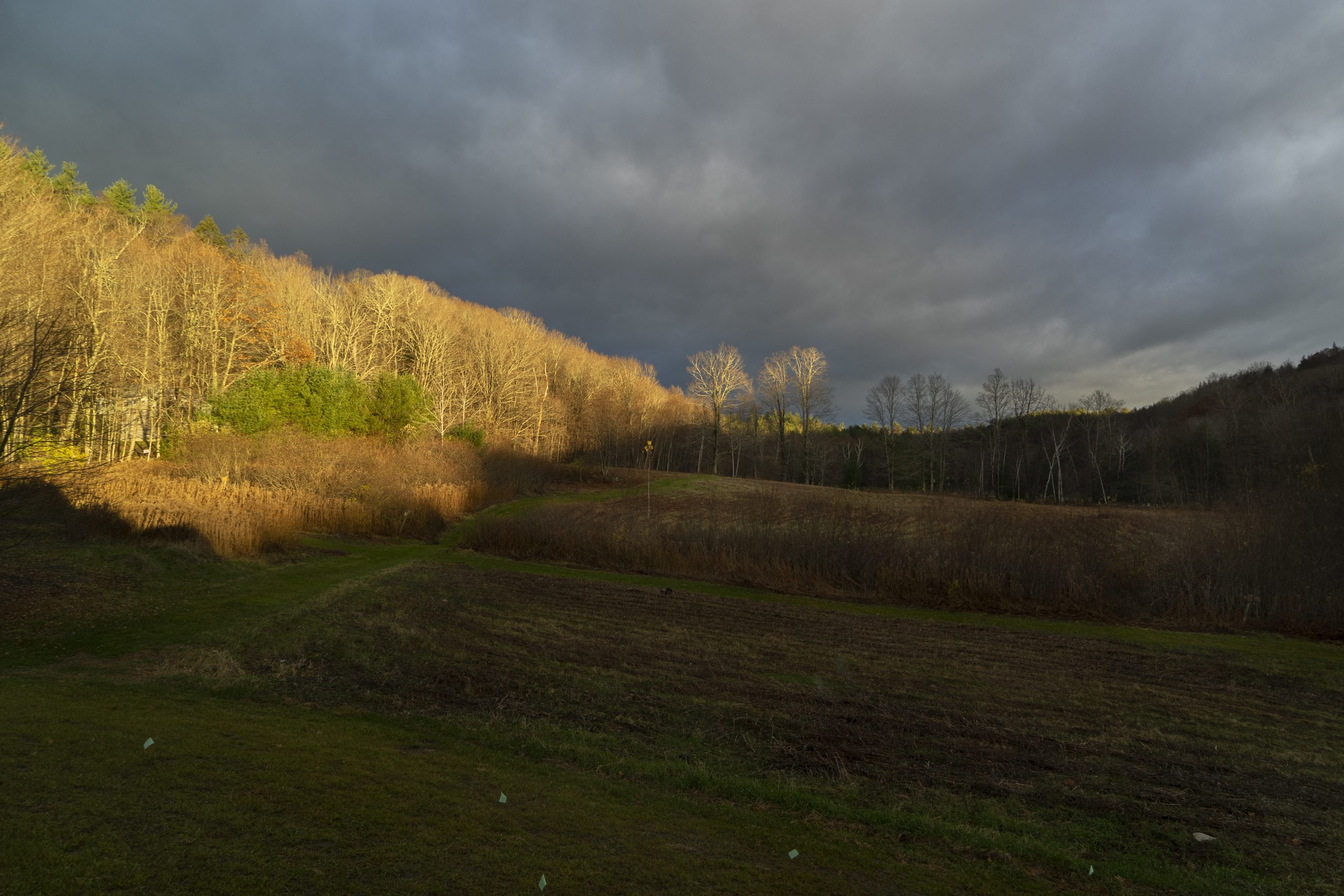
Late November Sunrise, Ashfield Photo credit: Robert A. JonasChristianity is full of hope about where we are ultimately heading – into the loving arms of God. But it is also bracingly realistic about the suffering and turmoil that will take place in the meantime. Today on the first Sunday of Advent, as we do every year, we must grapple with the Bible’s portrayal of the end-times, which include frightening predictions of social breakdown and cosmic turmoil. As we heard two weeks ago in the Gospel of Mark, Jesus foretells “wars and rumors of wars” (Mark 13:7); he speaks of earthquakes, famines, and persecution. In today’s passage from the Gospel of Luke, Jesus says that when the Son of Man comes at the end of time, “There will be signs in the sun, the moon, and the stars, and on the earth distress among nations confused by the roaring of the sea and the waves. People will faint from fear and foreboding of what is coming upon the world, for the powers of the heavens will be shaken” (Luke 21:25-26).
It’s scary stuff. And it resonates with our own experience of a shaking world. Snow in Houston. Triple digit temperatures in the Pacific Northwest. Withered crops and empty reservoirs in the American Southwest. Shorelines dissolving in Florida. Flash floods rising so quickly that people drown in their basement apartments. Wildfires so hot that they generate their own storms. Oceans emptying of life and filling with plastic. Changes in the jet stream. Changes in the Gulf stream.
The signs of a changing climate are visible everywhere. Around the world, throngs of people are already on the move, because drought or crop failure or fires or storms have dislodged them from their homes.
Indeed, the once-stable web of life is unraveling before our eyes. Huge populations of creatures have vanished in less than 50 years. Human activity has wiped out 60% of the world’s mammals, reptiles, amphibians, birds, and fish since 1970.1 With dismay, scientists are describing what they call a “biological annihilation.”2 And about one million plant and animal species are at risk of extinction, many within decades.
The world is reeling, so I come to today’s Gospel passage with relief – it tells the truth. It speaks to our condition. The Bible has wisdom to convey in apocalyptic times like these. What is “apocalypse”? It comes from the Greek word “kalypto,” which means “to cover” or “to hide.” “Apocalypse” refers to a great unveiling, a lifting of the veil of illusion. In that sense, surely, we live in apocalyptic times: something like scales have fallen from our eyes and everything that was hidden is being laid bare.
For instance, now we know that we can’t take the natural world for granted. Now we see the miracle of what we once thought would be ours forever: predictable seasons, moderate weather, thriving coral reefs, ice sheets as big as a continent. Now we know that the stable natural world into which you and I were born is coming apart, and – to quote a conservation wildlife photographer – that “even the lowliest ants or butterflies can no longer be taken for granted ever again.”3
Do apocalyptic, end-time passages like these mean that we should passively accept natural disasters that result from human-caused climate change as somehow preordained and part of God’s plan? That’s what some Christians would have us believe, but I don’t see it that way. I don’t for one minute believe that God wants human beings to burn the Earth to a crisp. I don’t for one minute believe that biblical end-time passages give human beings a license to rip apart the web of life and to destroy the world that our Creator proclaimed “very good” (Genesis 1:31). On the contrary, I believe that God’s creative, holy presence fills our precious, living planet, and that all of it belongs to God – meadows, rivers, soils and seeds, animals and oceans. As the psalmist says, “The earth is the Lord’s and all that is in it” (Psalm 24:1). And the very first task given to human beings is to care for the earth, to serve as custodians and stewards.
As I see it, the Bible’s end-time passages and their frightening imagery of chaos and distress were not given to us so that we can indulge in wasteful and disheartening political rhetoric, in helplessness, resignation, or fatalism, but just the opposite: in order to sustain our courage, hope, and perseverance even in the midst of crisis.
Icy twigs, Ashfield Photo credit: Robert A. JonasIn this time of climate emergency, I hear three messages in today’s Gospel. The first is: Don’t be surprised by suffering. Jesus warned of social breakdown and conflict. He anticipated natural and even cosmic disruption. Don’t be surprised by suffering, our Gospel text reminds us. Don’t take your suffering or the world’s suffering to mean that God is powerless or that God doesn’t care or that God has abandoned us. Everything we are experiencing is held within the gaze – indeed, within the embrace – of a loving God. So, don’t be surprised.
A second message: Don’t be afraid. Although many people “will faint from fear and foreboding of what is coming upon the world,” followers of Jesus should take heart. “Now when these things begin to take place,” says Jesus, “stand up and raise your heads, because your redemption is drawing near” (Luke 21:28). “Stand up!” he says. “And raise your heads!” What bracing words these are when we may feel like curling up in a ball and ducking our head under a pillow! It’s easy to feel hopeless about ecological collapse and climate change. It’s easy to feel helpless and overwhelmed. What can I possibly do? We may say to ourselves. What difference can I possibly make? But here comes Jesus, telling us to stand up and not be afraid, for our redemption is drawing near. He is very close (Luke 21:27).
And here comes message number three: Don’t fall asleep. Stay awake, says Jesus. “Be alert at all times” (Luke 21:36). Look for the small but telling signs that God is in our midst, bringing forth something new. Just as the branch of a fig tree becomes tender and puts forth its first, soft leaves, assuring us that summer’s abundance is near, so Jesus urges us to notice that even in the midst of chaos, violence, and endings, God’s kingdom is drawing near. In the very midst of endings, something new is being born.
As I hear it, Jesus is calling us to stand up and take part in that birth – the birth of a new community, the birth of a new society that lives more lightly on God’s good Earth and that treats human beings and other-than-human beings with reverence, compassion, and respect. In this perilous time, God calls us to stand up, raise our heads, and bear witness in word and deed to God’s never-failing love, which embraces the whole creation.
And when it comes to healing, there is so much we can do! Earlier this year the Episcopal bishops in Massachusetts declared a climate emergency. Our two dioceses have begun to work together in a more coordinated way as we discuss how we can pray, learn, act, and advocate on behalf of God’s creation. The Diocese of Western Massachusetts has web pages on Creation care loaded with ideas about ways to make a difference. Some actions are simple, like eating less meat and moving to a plant-based diet, recycling more, driving less, protecting trees, and reducing our use of fossil fuels in every way we can. Other actions are bigger and bolder and address systemic change. That’s important, because the scope and speed of the climate crisis require more than changes in individual behavior – they require massive, collective action and a push for policies that help us move away quickly from fossil fuels and that encourage clean renewable energy like sun and wind. A just and equitable transition to a new economy means creating lots of good green jobs for folks now working in the fossil fuel industry, and it means ensuring that historically marginalized and low-income communities – the people hurt first and hardest by climate change – have a voice at the table where decisions are made. If humanity is going to keep living on a reasonably habitable planet, then this transition must happen now. It’s up to us to insist that political leaders lead the transition – especially in places where so much of the economy and so many jobs are dependent on fossil fuels.
Here’s the last thing I’ll say. After COP26, the U.N. climate summit that just finished in Glasgow, every member of the Episcopal delegation made it clear that “protecting the Earth and preventing human suffering are not merely political talking points but central tenets of the Episcopal faith.”4 I was especially touched by the words of the Rev. Rachel Taber-Hamilton, a delegate from the Diocese of Olympia and a member of the Shackan First Nation people. She said: “The faith of re-greening the world must become as central to our theology, and to our worship, as crucifixion and resurrection… We must give nothing less than all we have and all we are in order to assure new life if generations are to follow us at all. The world to come that we pray for in our Sunday worship is ours to entomb or to liberate.”5
I pray that our Church – the Church of Reconciliation and our Church as a whole – will become a beacon of light and a leader of bold climate action. As we step into this Advent season and into a new year, may Jesus keep us steadfast in faith and abounding in love for one another and for all, until his coming in glory. Amen.
________________________________________________________________________________
NOTE: To subscribe to my monthly newsletter, Creation Care Network e-news, please click here. A video of “Standing Up When Things Fall Apart” is posted at my YouTube channel.
________________________________________________________________________________
1. “A Warning Sign from Our Planet: Nature Needs Life Support,” Living Planet Report 2018, World Wildlife Fund, Oct. 30, 2018
2. Gerardo Ceballos, Paul R. Ehrlich, and Rodolfo Dirzo, “Biological annihilation via the ongoing sixth mass extinction signaled by vertebrate population losses and declines,” PNAS (Proceedings of the National Academy of Sciences of the United States of America), July 25, 2017.
3. Cyril Christo, “Climate change is really Apocalypse Now,” The Hill, July 17, 2021.
4. Egan Millard, “Episcopal delegates to COP26 climate conference share lessons of hope and struggle with the church,” Episcopal News Service, November 19, 2021.
5. The Rev. Rachel Taber-Hamilton, quoted by Millard, “Episcopal delegates to COP26.”
In October 2021, Daily Hampshire Gazette (Northampton, MA) published Margaret’s op-ed, “Fasting and Climate Change.“
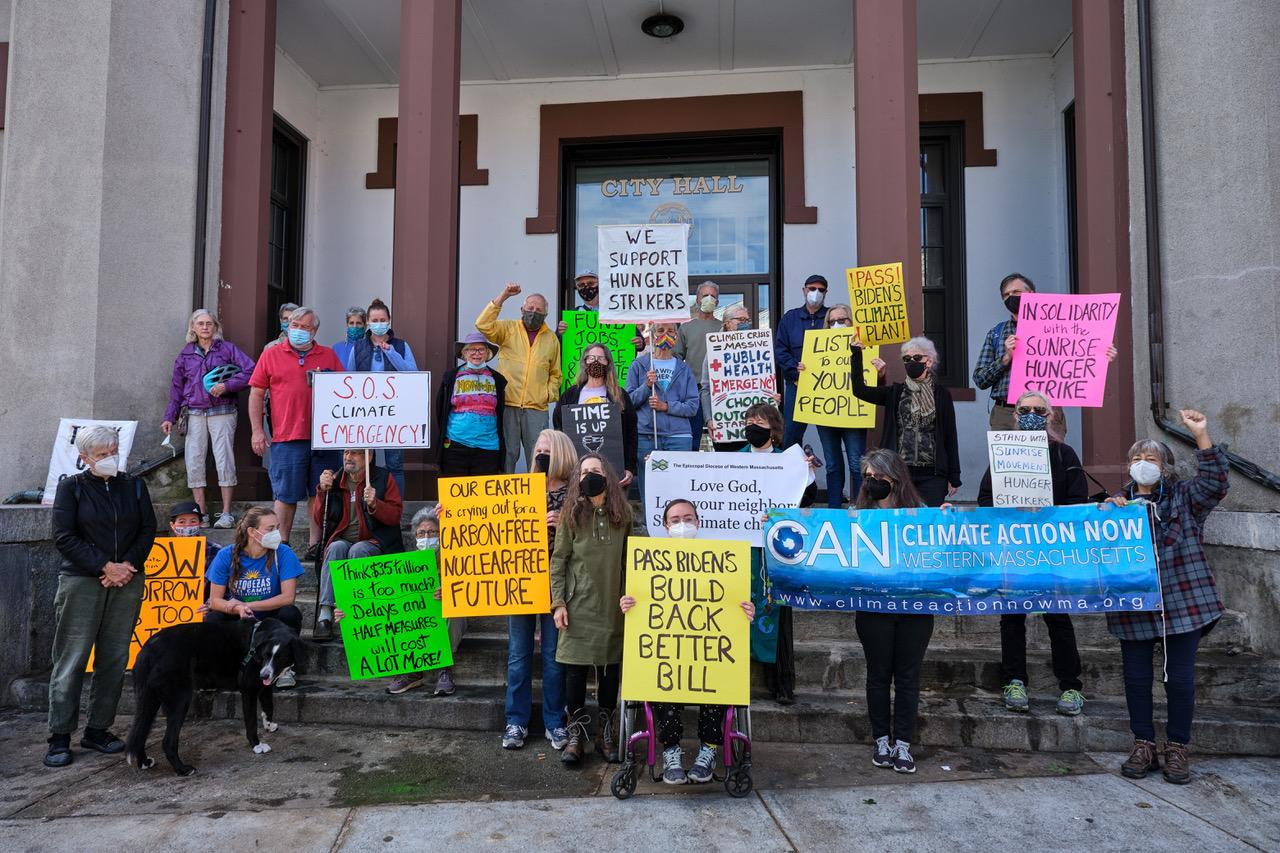
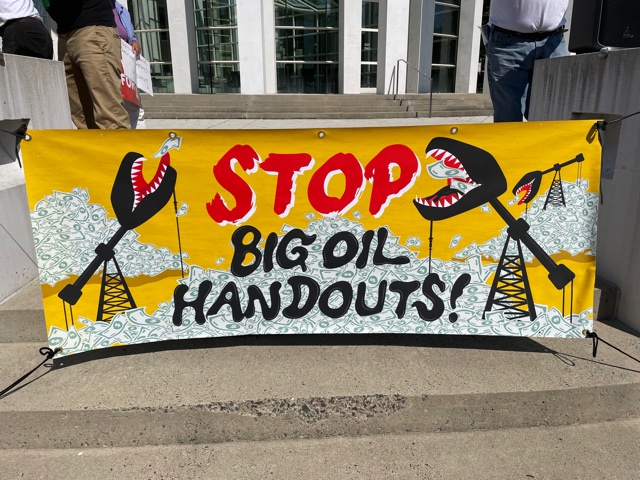
Today I spoke at a rally on the front steps of Northampton’s City Hall. Pulled together in less than 48 hours, this public witness drew almost 30 people eager to express support for five young climate activists in the Sunrise Movement who, as part of their campaign “Nothing to Lose,” began a hunger strike today in front of the White House. The five Sunrisers intend not to eat until Democrats pass climate policy that matches the urgency and scale of the climate emergency. People who support their demands for bold climate legislation were invited to carry out a 24-hour fast.
This is a crucial week in the fight to include strong climate policy initiatives in the $3.5 trillion Build Back Better Act, including the Civilian Climate Corps (CCC) and the Clean Electricity Performance Program (CEPP). Fifty Republicans and the corporate Democrats most captive to the fossil fuel industry – Senators Joe Manchin (West Virginia) and Kyrsten Sinema (Arizona) – are pushing to gut the most significant climate legislation this country has ever tried to pass. Not incidentally, coal mining, oil and gas, and gas pipeline companies gave more to Manchin during the current election cycle than to any other member of Congress. Unless the U.S. passes meaningful climate legislation shortly, its leadership and credibility at the upcoming U.N. climate summit in Glasgow, COP26, will be substantially weakened.
I invite readers to phone the White House (888/724-8946) and urge President Biden to stop fossil fuel projects, including Line 3. I also invite my clergy colleagues to preach about the climate crisis. This new 20-minute podcast, “The Urgent Need to Preach on Climate,” delivered by my friend and colleague Jim Antal and released by Yale Divinity School, should encourage you.
Below are my remarks from today’s rally.
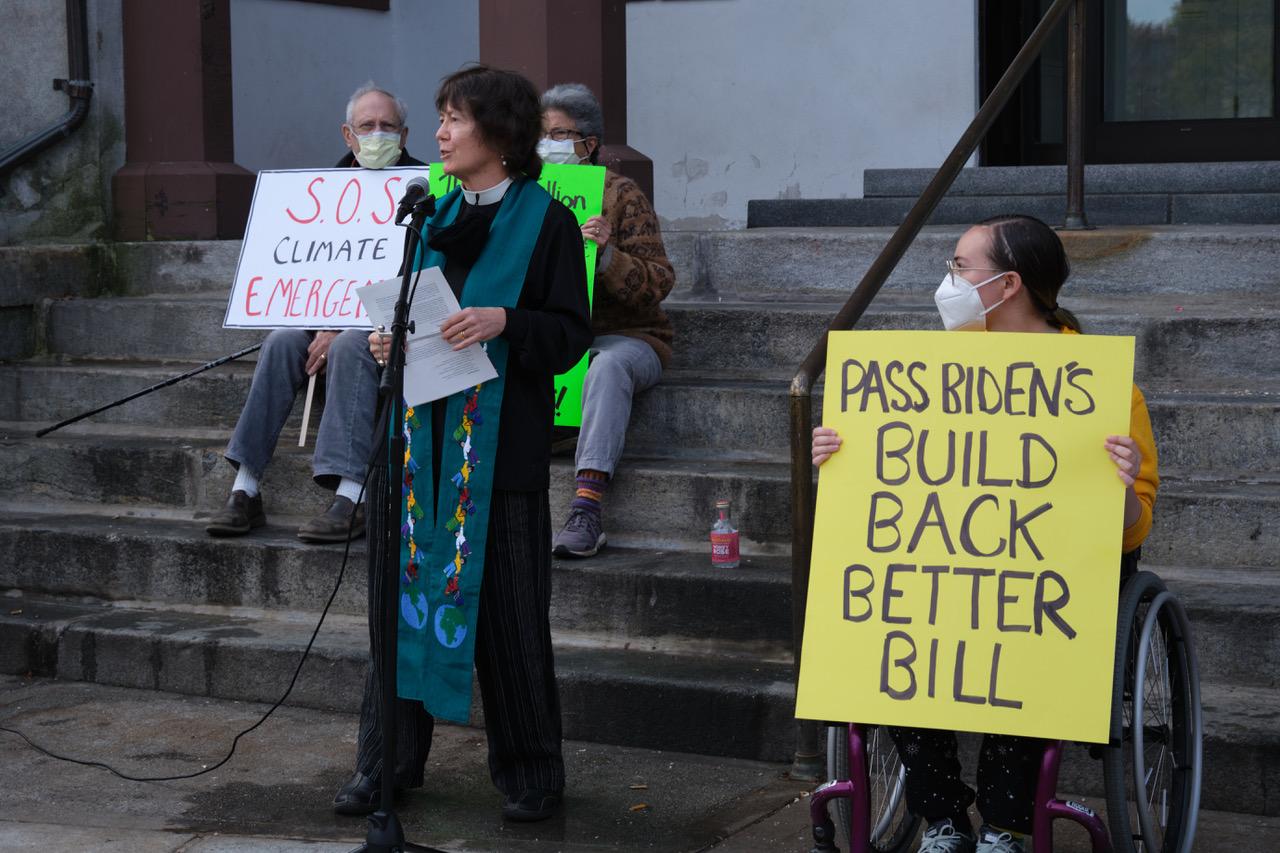
Speaking at the rally. Photo credit: René Theberge
My name is Margaret Bullitt-Jonas. I’m an Episcopal priest who works for the two Episcopal dioceses in Massachusetts and for the United Church of Christ in Southern New England to help build a faith-filled, justice-seeking movement to stop climate change and create a better future.
I am fasting today, as some of you are, too. Fasting or not, all of us are standing with the five resolute young people in the Sunrise Movement who today launched a hunger strike in front of the White House to demand climate action from our government commensurate with the crisis we are in.
So, let’s think about fasting. Fasting is a spiritual practice in just about every religion. Moses fasted. Elijah fasted. Mohammed fasted. The Buddha fasted. Jesus fasted.
The ancient practice of fasting has spiritual and moral power and has played a part in many non-violent struggles for social change.
Why do we fast today?
We fast to break through the habits and routines of daily life and to say that something matters more than business as usual. Business as usual must stop.
We fast to break through the paralysis of disengagement and despair.
We fast to purify ourselves, to open our hearts and steady our minds, so that we can ground ourselves in the love that wants to be the center of our lives.
We fast to express repentance and remorse for whatever ways we have participated in, colluded with, and benefited from a system that is killing life.
And we fast to protest – to express in and through our bodies our deep grief and our moral outrage that corporate and political powers are driving this country – and this planet – to the brink of climate catastrophe.
We fast to proclaim that another world is possible. We can move beyond fossil fuels. We can create a society that lives more gently and more justly on God’s good Earth.
After the rally. Photo credit: René Theberge
To our friends in the Sunrise Movement, we say: we stand with you. We stand with climate activists everywhere who hunger for justice.
We stand with everyone who is hungry, especially those whose stomachs are empty because of poverty, injustice, or a changing climate, where drought or heat have withered your crops or where extreme storms and rising seas have destroyed your homes.
We join our hunger to yours. And we join our hunger to the hunger of every living being, human and more-than-human, that hungers for life and a healthy, habitable planet.
Our hunger pangs invite us to hunger for what really matters.
Today we re-commit ourselves to the struggle to fight for a society that invests in our families, our communities, and our future.
Let’s get it done! Let’s Build Back Better. Thank you.
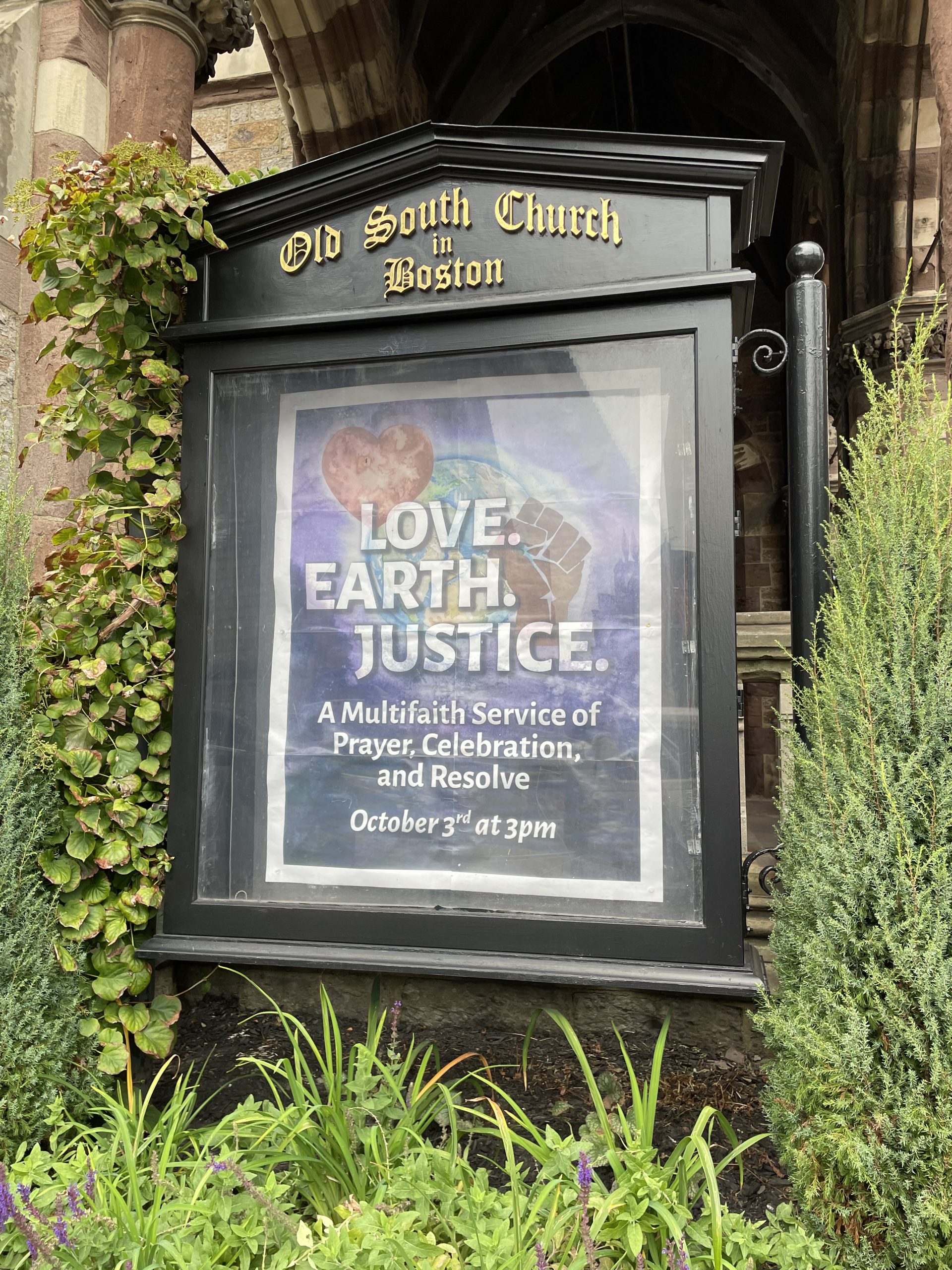
On October 3, 2021, I helped to lead a multifaith service of prayer, celebration, and resolve at Old South Church in downtown Boston. Organized by Rev. Fred Small, Policy Director of Massachusetts Interfaith Power & Light, “Love. Earth. Justice.” brought together representatives of indigenous, Jewish, Muslim, Hindu, Buddhist, Protestant, and Roman Catholic communities. Near the beginning of the service, I spoke about climate grief; at the end, I offered a blessing.
Lament for Creation
Friends, I want to acknowledge the courage and the tenderness in this room. Courage, because it takes courage to see clearly what human beings are doing to our precious planet. It takes courage to hold a steady gaze and to witness the melting glaciers, the bleaching coral reefs, the withered fields and bone-dry reservoirs, the flash floods and massive downpours, the record waves of heat. It takes courage not to look away but to hold a steady gaze as climate change makes sea levels rise and islands disappear, as oceans grow acidic and full of plastic, and as vast populations of our fellow creatures disappear.
Thank you for your courage, and thank you, too, for your tender heart. Thank you for all the moments – and maybe this is one of them – when you allow yourself to feel your emotional response to what we have lost and are losing as climate change accelerates and as governments in the thrall of the fossil fuel industry fail to take decisive, meaningful action to address the crisis.
Here in this quiet space and with the support of each other’s company, virtually and in person, I want to honor our tender hearts. Grief is the normal, healthy response to loss, but the culture we live in doesn’t handle grief well. Have you noticed that? Maybe we sidestep our grief because we’re afraid of looking weak, sentimental, morbid, or pathetic. Or because we’ve taken in the constricting message, “Big boys don’t cry” and “Nice girls don’t get angry.” And some of us avoid thinking about climate change because we fear that our emotions will overwhelm us.
Are we willing – can we allow ourselves – to take a moment, or maybe more than a moment, to feel our grief, fear, and outrage as parts of the world become too hot and humid for humans to survive, as children choke from asthma in our inner cities, as millions of climate migrants are displaced from their homes, or as the great redwoods burn, those ancient trees that survived for thousands of years and through hundreds of fires and could now disappear because of forest mismanagement and a changed climate?
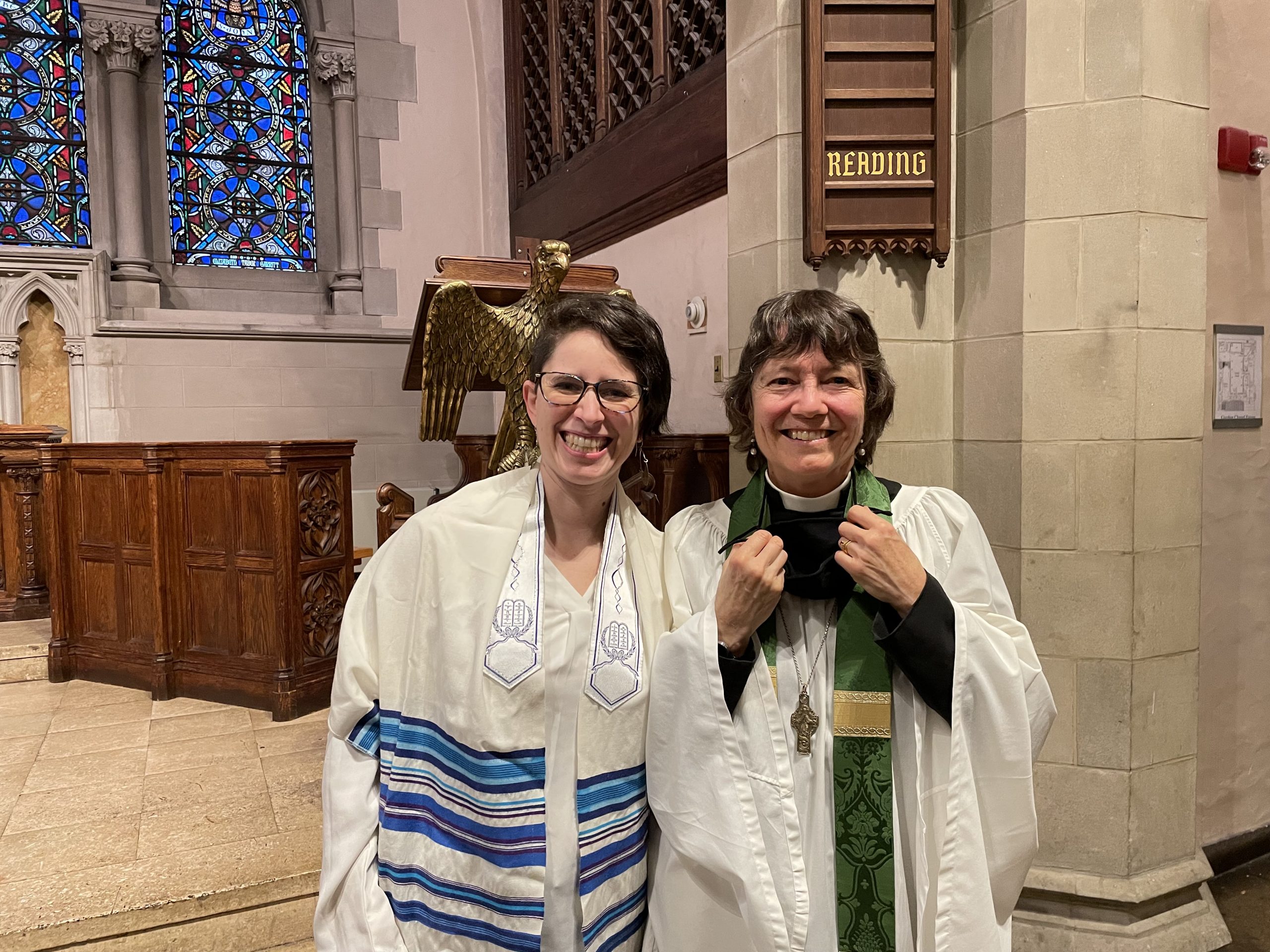
Rabbi Shoshana Meira Friedman and Rev. Margaret before the service, briefly maskless
Are we willing – can we allow ourselves – to take a moment, or maybe more than a moment, to mourn the loss of the ivory-billed woodpecker, which once thrived in swamplands down South and this week was officially declared extinct? According to the Washington Post, it earned the nickname “The Lord God Bird” “because it was so big and so beautiful that those blessed to spot it blurted out the Lord’s name.” Actually, every creature, every species, is a manifestation of God. As Thomas Berry says [The Dream of the Earth], “To wantonly destroy a living species is to silence forever a divine voice.”
And now “The Lord God Bird” is dead.
Can we feel it? Can we pause for a moment and feel it?
We are blessed that many faith traditions provide rituals and practices for accessing and processing grief. In my own tradition, lament is an ancient form of prayer found in the Book of Lamentations, in the Psalms, in the Prophets, and in the words and actions of Jesus. He wept at the death of Lazarus, he wept over the city of Jerusalem, and he cried out to God on the cross, using the lament of Psalm 22. Lament can’t be dismissed as just self-pity or whining. Lament is a deep outpouring of sorrow to God. It means daring to share our anguish with God. It means daring to feel what is breaking God’s heart.
The image on the cover of the worship leaflet was designed by Jamie Garuti, Director of Multimedia, Old South Church
And lament can be empowering. Theologians from Abraham Heschel to Walter Brueggemann (and many more) point out that lament is the beginning of criticism of an unjust social order. The powers-that-be would much prefer that we stay too busy, too distracted and numb to feel our emotional responses to what unjust systems are doing to human beings and to the planet on which all life depends. What Brueggemann calls “the capacity and readiness to care, to suffer, to die, and to feel”1 is the enemy of any society built on refusing to hear the cry of the Earth and the cry of the poor. Grieving is how we begin to challenge an unjust social order, cultivate hope, and open a space for bold actions commensurate with the crisis we are in.
So, let’s dare to lament! Let’s tell the truth. Our hearts are breaking, because that’s how fiercely we love this beautiful world that God entrusted to our care.
Where do you feel the ache of the Earth? What is breaking your heart?
“Praise the Lord from the earth, you sea-monsters and all deeps;Fire and hail, snow and fog, tempestuous wind, doing his will;Mountains and all hills, fruit trees and all cedars;Wild beasts and all cattle, creeping things and winged birds…Let them praise the Name of the Lord.”
(Psalm 148: 7-10, 13)
Friends, it’s a joy to be with you this morning and to celebrate one last outdoor Eucharist at St. John’s as we mark the end of Creation Season. Today is Creation Season’s grand finale and we honor St. Francis, whose feast day is tomorrow, and bless all creatures, large and small.
I’m going to keep this short, for we gather in the company of some favorite animals and even the most eloquent of preachers will not impress them. Besides, the living world around us provides sermon enough.
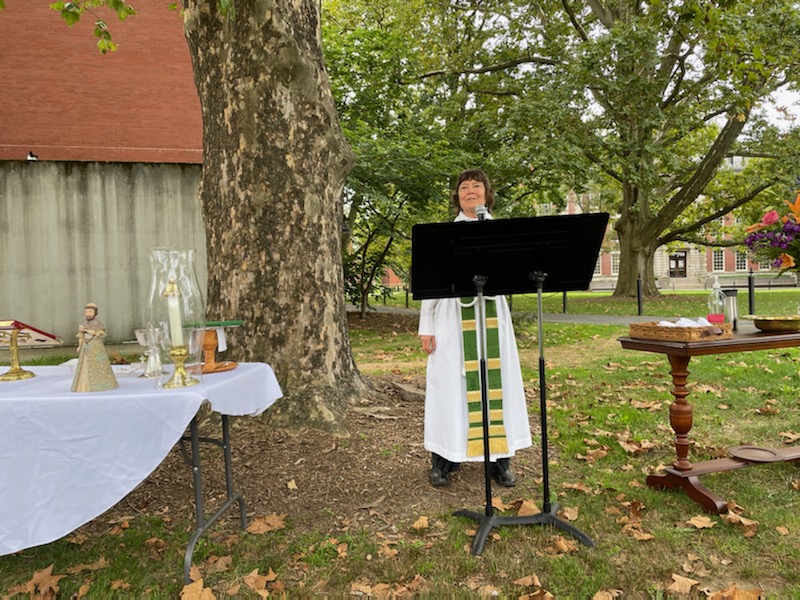
Preaching under the sycamore tree. Photo by Annemarie ChapdeleineHere we are, gathered at the foot of this big old sycamore tree, sheltered under its great canopy and breathing into our lungs the oxygen that this tree and all other trees and green-growing things are freely offering us. As we breathe out, the trees and plants in turn take up the carbon dioxide that we release. Simply by sitting here in the company of trees, we are giving and receiving the elements of life, praising God together.1
And here are our solid bodies, as solid as the earth beneath our feet. Can you feel the place where your body meets the body of Earth? Here she is, beneath our feet, holding us up, giving us support with every step. Every time we walk mindfully, paying attention, with every step we can bless the Earth. At the end of our lives, we will give our bodies back to earth, ashes to ashes, dust to dust. Earth and we Earthlings belong to each other, and together we praise God.
Let’s take a moment to be aware of the inner motions within our bodies. Maybe you are aware of gurgling in your belly or the throb of your beating heart. Maybe you sense the circulation of blood as it moves through your body. Most of the weight of our body comes from water, just as most of our planet’s surface is made of water. Our blood is mostly water, and the saltwater content of our blood’s plasma is the same as the saltwater content of the sea. It is as if within our bodies we are carrying rivers, lakes, and the ocean. Let’s celebrate our bodies’ kinship with all fresh waters, and with the sea. We are praising God together!
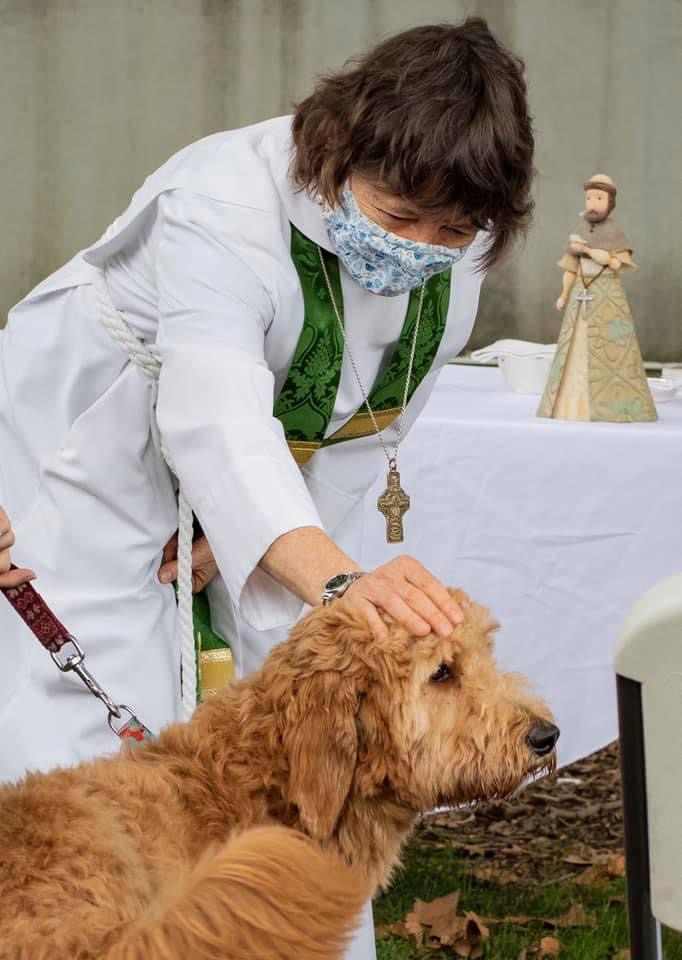
Blessing the animals. Photo by Annemarie ChapdeleineEverything around us is alive and relating to us. We are a part of everything, and everything is praising God. That’s what the psalmist conveys in those exuberant lines that we hear in Psalm 148.
Jesus knew all about this, too. He lived close to the Earth. He seems to have spent a lot of time outside. We see him climbing mountains, spending weeks in the wilderness, walking along the shore, crossing a lake, walking dusty roads. When he talks about God, his parables and stories are full of images of nature: seeds and sparrows, lilies, sheep, rivers, vines, branches, rocks. Jesus was deeply aware of the sacredness of the natural world.
Francis followed in the footsteps of Jesus, spending much of his time outdoors – he lived in such intimate relationship with the elements and creatures of the natural world that he spoke of Brother Sun, Sister Moon, Brother Wind and Air, Sister Water, Brother Fire, Sister Earth, our Mother. He experienced himself as kin with everything – he didn’t imagine that human beings were separate from the rest of the world that God created, much less that humans were “above” or “better than” the other creatures that God cherishes, or that we had any right to dominate or oppress them. Francis is known for his beautiful “Canticle of Creation,” which echoes today’s psalm.
It turns out that our identity doesn’t stop with our skin. We have porous and permeable boundaries. My body is part of the Earth. The Earth is part of my body. God is giving God’s self to us in and as the sun, the moon, the stars, the wind, the air, the trees, the bird, the pets we love. We live in a sacred world of interrelationship and interdependence. We belong to each other. We depend on each other. Nature is not just so-called “resources” supposedly put here only for human beings to extract and exploit.
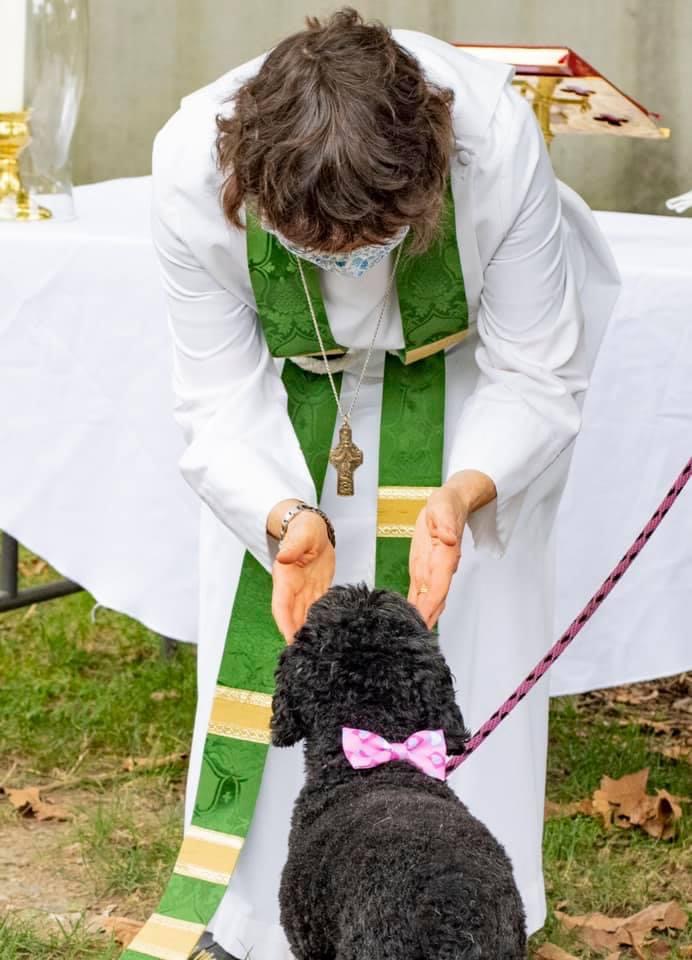
More blessings. Photo by Annemarie ChapdeleineIt’s easy to romanticize and sentimentalize Francis, but in an increasingly degraded natural world, what would it mean to take our place as humans who experience this kind of intimate connection with wild creatures and plants and all the elements that together create a balanced and healthy eco-system? Now is the time to reclaim the ancient understanding (which was never lost by indigenous peoples or by so-called ‘pagans’) that the natural world is sacred, that it belongs to God and is filled with God. Now is the time to reclaim our partnership not just with our human fellows but also with all living creatures.
That’s the urgent task before us. The life-systems of the Earth are deeply compromised. The web of life is unraveling before our eyes and we risk ecological collapse. More than half the populations of all wild creatures have disappeared in the past 50 years. Human beings have wiped out 60% of the world’s mammals, reptiles, amphibians, birds, and fish since 1970. Because of the relentless burning of fossil fuels, the global climate has become increasingly disrupted and unstable and we have only a short amount of time in which to avert climate chaos.
There is so much we can do, as individuals and as members of society, to heal and protect God’s Creation as we work together to keep fossil fuels in the ground, where they belong, and to push for a swift and just transition to an economy based on clean, renewable energy like sun and wind. I hope that in the next day or two you’ll visit our diocesan website and look at the web pages about Creation care, which are full of suggestions for how to pray, learn, act and advocate for this beautiful, aching, and God-drenched world. I hope you’ll sign up for my monthly newsletter.
For now, we praise God with Sister Sycamore, with Brother Wind and Air, with Sister Earth, Our Mother. We give thanks for Jesus, who is “gentle and humble in heart” (Matthew 11:29) and whose Spirit we breathe in every breath. We give thanks for Holy Communion, in which Jesus comes to us in the blessed bread and wine, reminding us that the natural world is filled with his presence.
____________________________________________________________________________________________
This paragraph and the two that follow are based on a longer meditation, “Kinship with Creation,” in Rooted and Rising: Voices of Courage in a Time of Climate Crisis, ed. Leah Schade and Margaret Bullitt-Jonas (Lanham, MD: Rowman & Littlefield, 2019), 76-77.
Looking for guidance as you prepare pastoral and prophetic sermons about the climate crisis? Here is a short list of resources for preachers that was assembled in September 2021 by the Rev. Dr. Jim Antal (Special Advisor on Climate Justice to UCC General Minister and President) and the Rev. Dr. Margaret Bullitt-Jonas (Missioner for Creation Care [Episcopal Diocese of Western MA & Southern New England Conference, UCC] and Creation Care Advisor [Episcopal Diocese of MA]). We may update the list from time to time. If you have additions or corrections, please email mbj@revivingcreation.org. To download a pdf, click here.
(updated 2/19/24)
Climate preaching resources from Jim & Margaret:
Jim’s website, JimAntal.com, posts news & thought about the interfaith climate movement, upcoming events, information about his book, and ways to take action. His website includes a 3-page pdf of climate crisis resources for congregations and clergy that is packed with information and contains links to many UCC resources, resolutions, newsletter, etc.
Margaret’s website, RevivingCreation.org, includes about one hundred lectionary-based sermons about climate change and Creation care, plus blog posts, articles, upcoming events, videos, and books. Sign up for her monthly newsletter, Creation Care Networkhere.
Jim Antal, Climate Church, Climate World (Lanham, MD: Rowman & Littlefield, 2018, rev. 2023), especially the chapter, “Prophetic Preaching,” 121-135. The book includes study questions and can be used for group study as well as individual reflection. Visit Jim’s Website to see what people like Bishop Desmond Tutu, Prof. Walter Brueggemann and Bill McKibben have to say about it.
Leah Schade and Margaret Bullitt-Jonas, ed. Rooted and Rising: Voices of Courage in a Time of Climate Crisis(Rowman & Littlefield, 2019). This anthology of 21 essays on courage and spiritual resilience from a range of faith traditions includes stories and insights useful for climate preaching, plus study questions and spiritual practices. It can be used for group study as well as individual reflection. For a 30% off discount, buy it from the publisher and use the code RLFANDF30.
Margaret Bullitt-Jonas, “Climate Change, Addiction, and Spiritual Liberation,” Religions (September 2021). Drawing from her long-term recovery from addiction and her decades of ministry as a climate activist, the author reflects on how understanding the dynamics of addiction and recovery can inform our efforts to protect the web of life and bear witness to the liberating God of love. Topics include, among others, climate grief, denial, and “Is climate change my fault?”
Margaret Bullitt-Jonas, “Preaching When Life Depends on It: Climate Crisis and Gospel Hope,” Anglican Theological Review (Vol. 103, 2), pp. 208–219. The author reflects on the power of sermons to awaken moral courage and considers six ideas for preachers: how to frame the climate emergency in terms of Christian theology; how to approach the lectionary; how to be adequately informed about climate science; how to connect climate change with other issues, such as coronavirus and racial and economic justice; why and how to infuse sermons with the empowering love of God; and individual and collective actions to encourage.
Margaret Bullitt-Jonas, “Preaching Resilience: Cultivating Climate Justice from the Pulpit.” In this presentation for Creation Justice Ministries on March 24, 2022, the author discusses nine things she tries to do when preaching about climate emergency, from pushing back against helplessness and providing opportunities for emotional response to offering a moral framework and building hope by taking action. A recording of this conversation, along with CJM’s other workshops on climate resilience, is available on their YouTube channel.
PreachingforGodsWorld: This ecumenical website features weekly, lectionary-based climate justice and creation justice preaching notes based on the New Revised Common Lectionary. You can sign up for weekly notes delivered to your email inbox.
Leah Schade, Creation-Crisis Preaching: Ecology, Theology, and the Pulpit (Chalice Press, 2015)
EcoPreacher 1-2-3: In an effort to encourage clergy to preach and teach on Christian ecology at least once a month, The Interfaith Center for Sustainable Development and the Rev. Dr. Leah Schade have partnered to develop a new free resource called EcoPreacher 1-2-3. Drawing from Eco Bible, a Jewish ecological commentary on the Hebrew Scriptures, Dr. Schade provides sermon preparation for preaching about caring for God’s Creation that is short, accessible, and based on a solid biblical foundation. EcoPreacher 1-2-3 offers a brief “eco-exegesis” for interpreting a Hebrew text from the Revised Common Lectionary for the coming Sunday, followed by one “eco idea” for the basis of the sermon, two “eco questions” to go deeper, and three “eco actions” to choose from to help a congregation put their faith into action. With this resource, preachers can use the sermon ideas in their own context and make it relevant for their congregation. For information and to subscribe to weekly emails, click here.
Subscribe to InsideClimateNews.org (the weekly newsletter from a Pulitzer Prize-winning, non-profit, non-partisan news organization) and/or to Climate Nexus’s daily newsletter (send an email to: info@climatenexus.org) and/or for GRIST (either daily or weekly).
To learn about your region’s environmental concerns, contact your local chapter of Sierra Club. To view climate risks and clean energy opportunities in each of the 50 states, visit Climate Nexus.
Other faith-based resources: Web
Christianity and Climate Change is a nine-part video series for small groups featuring Katharine Hayhoe, the internationally renowned climate scientist and Evangelical Christian. The videos are only six minutes long, leaving plenty of time for discussion:
• What the Bible says about the natural world,
• Climate change is a poverty issue,
• How to persuade others to care about climate change,
• What we can do as a church,
• Speaking to other Christians about climate change,
• Grateful for fossil fuels but time to move on,
• Climate change is a threat multiplier,
• There can be a better future, and
• It is not too late.
Episcopal Diocese of Western Mass. provides Creation-care resources in four areas: Pray, Learn, Act, and Advocate. The Website also includes links to many Episcopal resources.
Ellen F. Davis, Scripture, Culture, and Agriculture
Pope Francis, Laudato Si – Praise Be to You: On Care for Our Common Home (2015) and Laudate Deum (2023)
Sally McFague, A New Climate for Theology: God, the World, and Global Warming
Other helpful resources:
National Issues Forum Institute has materials on controversial issues (e.g., immigration, policing) and a short video about how to moderate “deliberative forums,” in which people deliberate with each other on a variety of difficult public issues.
Eco-America/Blessed Tomorrow recently (2021) released four two-page action sheets. The front includes “What You Need to Know,” and the back includes “What You Need to Do.”
Lighten your carbon load Inform your congregation about ways to reduce their carbon footprint – e.g. https://blogs.ei.columbia.edu/2018/12/27/35-ways-reduce-carbon-footprint/
For instance:
Eat low on the food-chain – moving toward a plant-rich diet is one of the most immediate and effective ways we can reduce carbon emissions. Eat local. Eat organic. Waste less food.
Buy less stuff. Get an energy audit of your home, so that you can identify ways to be more energy-efficient and perhaps save money (if possible, tell your congregation where to get an energy audit).
Drive less. Walk, take public transportation, carpool, rideshare or bike to your destination, when possible. If possible, purchase a hybrid or electric car. Fly less. If you must fly, buy carbon offsets (e.g., www.terrapass.com/).
Join the climate justice movement Pushing for systemic change is more important than making personal changes. Get politically engaged. Vote! … Join 350.org, the global grassroots network to stop all new coal, oil, and gas projects and build a clean energy future for all … Join ThirdAct.org, environmentalist Bill McKibben’s new initiative seeking to harness the wisdom and resources of elders (people over 60) to assure that we leave a fair, stable planet for future generations… Stand alongside marginalized, vulnerable communities in your area that are fighting environmental racism.
Restore the land and grow food Support local land trusts and farms. Cultivate a landscape that sequesters carbon and provides food for the homeless and low-income households. Launch projects such as composting, tree planting, habitat restoration, permaculture gardening, and growing produce for food pantries. Join the Good News Gardens Movement.
I invite you to join me in a moment of silence as we remember those who lost their lives on 9/11, and as we pray for peace and healing… (silence)Gracious God, you love nothing so much as the person who lives with wisdom. Guide us with your wisdom and fill us with your love. May only your word be spoken and only your word be heard. Amen.
What a joy to be with you this morning! Thank you, Harvey, for inviting me to preach. It was just brought to my attention that you are celebrating ten years as rector of this parish, so it’s a special day to be with all of you. As you know, I serve as Missioner for Creation Care in our diocese and in the United Church of Christ in Southern New England. I travel from place to place, speaking about God’s love for our beautiful, precious planet and about our call as faithful followers of Jesus to rise up together to restore the web of life that God entrusted to our care. If you’d like to know more about this ministry, please visit my Website, RevivingCreation.org.
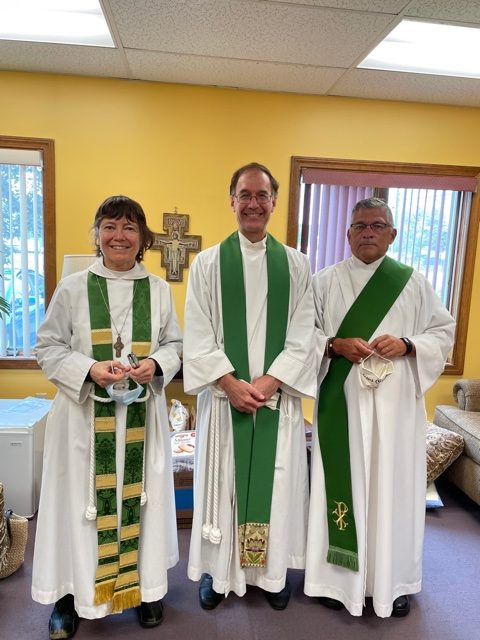
The Rev. Dr. Margaret Bullitt-Jonas, the Rev. Dr. Harvey Hill, & the Rev. Terry Hurlbut at St. David’s, AgawamSo – let’s give a shout-out to your “green team” – your Creation Care team. Thank you for your leadership. I want to thank all of you for celebrating Creation Season. As you know, the season begins on September First with the World Day of Prayer for the Care of Creation and ends on October 4, with the feast day of St. Francis. During this 6-week period, millions of Christians around the world lift up our prayers and voices on behalf of what our prayerbook calls “this fragile Earth, our island home.”
Now, a friend of mine who cares deeply about the fate of the Earth and the future of life on this planet sometimes grumbles to me, “Why do we need a Season of Creation? Isn’t every day a good day to care for creation?” Well, of course, that’s true. He’s right. But just as we mark the seasons of Advent, Christmas, Epiphany, Lent, and so on, knowing that it’s helpful to set aside some time to look carefully at a particular aspect of our Christian faith, so it’s likewise helpful to set aside a season to focus on how faith in God affects our relationship with the natural world.
For a couple of reasons many of us may be especially glad to participate in Creation Season this year. For one thing, at the height of the pandemic many of us learned again how much solace and comfort we experience in connecting with the natural world. I know many people who during the lockdown deliberately spent daily time outdoors, feeling the wind on their face and savoring the trees and the open sky. I know a man who bundled up every morning, stepped outside, and to his amazement actually learned to love winter, and I know a woman who spent the pandemic happily exploring every trail she could find. What’s more, some of us may have been lucky enough this summer to visit an especially beloved place in nature – maybe a lake, a mountain, or a beach. So, I wouldn’t be surprised if we arrive at Creation Season this fall with a fresh appreciation of the natural world and a deeper gratitude for the ways it conveys the presence of a loving God.
Monarch butterfly, summer 2021. Photo credit: Robert A. JonasIn a turbulent and stressful time, nothing may quiet our minds and refresh our spirits so much as spending time beside a lake, watching the sun dance across its sparkling waves, or sitting down somewhere to listen to birdsong or rainfall or the sound of wind in the trees. Creation Season invites us to come to our senses and to renew our felt connection with the living world around us, maybe to go out for a quiet walk and to bless the Earth with each step. Even a small tree in a city park can speak to us of the larger living world that surrounds us, and even if the night-time glare of a city conceals them, the shining stars still wheel overhead. “The Earth is the Lord’s and all that is in it” – so says Psalm 24. And for that we give thanks in this Season of Creation. God loves the world that God made, and so do we.
A second reason we may come to Creation Season with particular fervor this year is because, after this past summer, many of us are aware, as perhaps never before, how deeply imperiled the natural world is and how a changing climate threatens everything we hold dear. Across the country this summer – and around the world – we witnessed massive wildfires, record floods, historic drought, extreme storms, unprecedented heat. In some places, people drowned in their basement apartments or were washed away in their cars by flash floods. In other places, families lost their homes, livelihoods, or lives as uncontainable fires raged. Out West, farmers stared at empty reservoirs and withered crops. Back East, regions soaked in record rain. Nearly a third of Americans live in an area where a federal disaster was declared sometime in the last three months.
The summer of 2021 will go down in history as the hottest on record in the United States, exceeding even the Dust Bowl summer of 1936. All seven of the warmest years on record were the last seven, and 19 of the 20 warmest years occurred since the year 2000. The climate is increasingly unstable, and if we continue with business as usual – if we keep on burning coal, gas, and oil, keep on filling the atmosphere with heat-trapping gases, keep on cutting down forests – we will leave our children and our children’s children a hot, unstable world that is very difficult to inhabit.
So, to Creation Season this year we bring our uneasiness, our grief and fear, perhaps even our alarm. We may identify with that poignant image in the reading from Proverbs, which portrays Wisdom as a woman wandering the streets and public squares, crying out in search of someone who will listen to her counsel and warning that calamity will surely follow if the wayward and complacent refuse to listen (Proverbs 1:20-33). Today, wisdom tells us that we have only a short span of time in which to change course, make a swift transition to clean renewable energy, and avert the most catastrophic level of climate change.
At this hinge-point of history, when the choices we make are so decisive, will we choose life? Will we listen to the voice of wisdom? Today’s Canticle picks up the theme in a lyrical passage that brings a message of hope: “In every generation Wisdom enlightens holy souls, making them friends of God, making them prophets; for God loves nothing so much as the person who lives with wisdom” (Wisdom of Solomon 7:27b-28).
I give thanks for the holy souls who listen to Wisdom’s call and who join the struggle to create a safer, healthier, more just and livable world. I give thanks that just a few days ago, for the very first time, three of the world’s top Christian leaders – Archbishop of Canterbury Justin Welby, Pope Francis, and Ecumenical Patriarch Bartholomew – issued a joint statement on climate change and made an urgent appeal for the future of the planet. In this extraordinary statement, the leaders of the Anglican Communion, the Roman Catholic Church, and the Eastern Orthodox Church called on people – called on us – to pray for world leaders ahead of the U.N. climate change conference (COP26), which will be held in November. And these Christian leaders called “on everyone, whatever their belief or worldview, to endeavor to listen to the cry of the earth and of people who are poor, examining their behavior and pledging meaningful sacrifices for the sake of the earth which God has given us.”
I give thanks for their clarion call, and for all the followers of Jesus who are rising up with people of faith and goodwill to mobilize a response that is commensurate to the crisis. You probably know that earlier this year, the Episcopal bishops in Massachusetts declared a climate emergency. Our two dioceses have begun to work together in a more coordinated way as we discuss how we can pray, learn, act, and advocate on behalf of God’s Creation. Our diocesan Website on Creation care is loaded with ideas about ways we can make a difference. Some actions are simple, like eating less meat and moving to a plant-based diet, recycling more, driving less, protecting trees, and reducing our use of fossil fuels in every way we can. Other actions are bigger and bolder and address systemic change. That’s important, because the scope and speed of the climate crisis require more than changes in individual behavior – they require massive, collective action and a push for policies that help us move away quickly from fossil fuels, encourage clean renewable energy like sun and wind, and ensure that historically marginalized and low-income communities – which are those hurt first and worst by climate change – are protected.
I invite you to join me at 11 o’clock tomorrow in a rally at the Springfield office of Congressman Richie Neal, Chairman of the House Ways and Means Committee, as we urge him to fully fund the reconciliation package that some economists say “may well be our last chance to take serious action against global warming before it becomes catastrophic.” A number of faith groups are pressing Congress to pass this legislation as a moral imperative. I will be speaking at the rally not as a Republican, not as a Democrat, but as a follower of Jesus who believes deeply that God is calling us to live in harmony with Earth and with each other. I hope that you will stand with me or will pray for the rally’s success and for passage of this legislation.
Archbishop Desmond Tutu says that the “supreme work” of Jesus Christ is to reconcile us to God, to each other, and to all of God’s creation. Can we do that together? Can we support each other to make the swift, bold changes we need to make in our own lives and in society as a whole? These are the questions confronting every community of faith as we clarify our vocation in a time of climate crisis. I hope you will subscribe to my monthly newsletter, Creation Care Network e-news, so that we can stay in touch and encourage each other.
Thank you for the ways you bless the Earth. Thank you for honoring Creation Season, and thank you, as my friend says, for making every day a good day to care for God’s creation.
___________________________________________________________________________
A note: After the service, I spoke with a number of you about ThirdAct.org – a brand-new initiative by environmentalist Bill McKibben to bring together people over 60 – Baby Boomers and the Silent Generation – who care about climate change and social injustice. If, like me, you’re over 60, please sign up! Welcome to our third act.