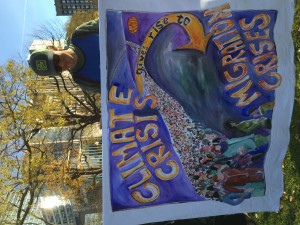
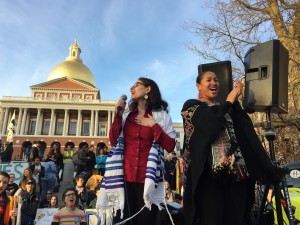
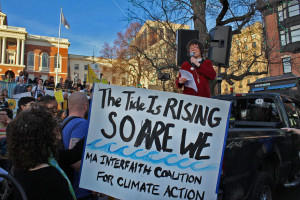
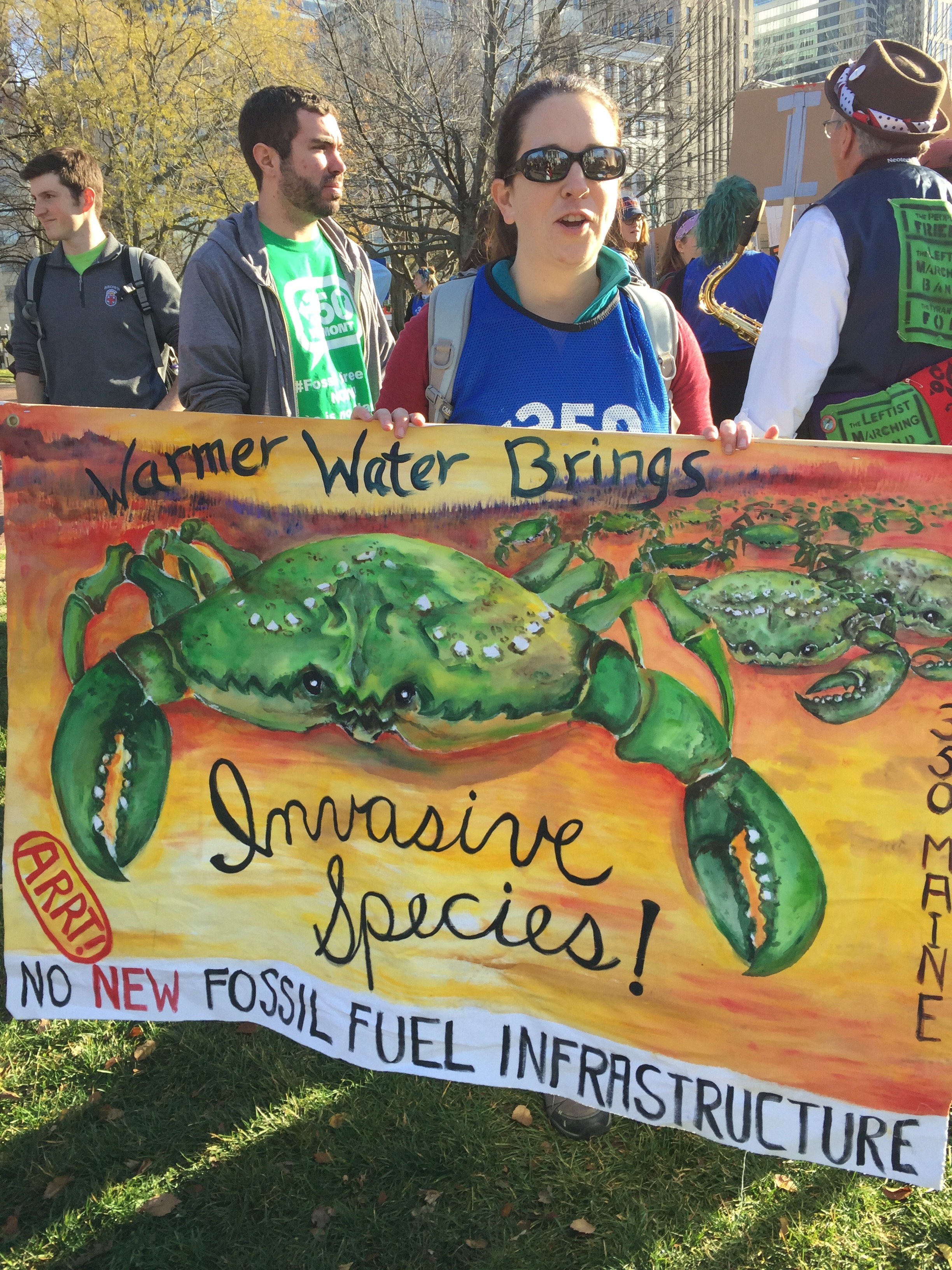
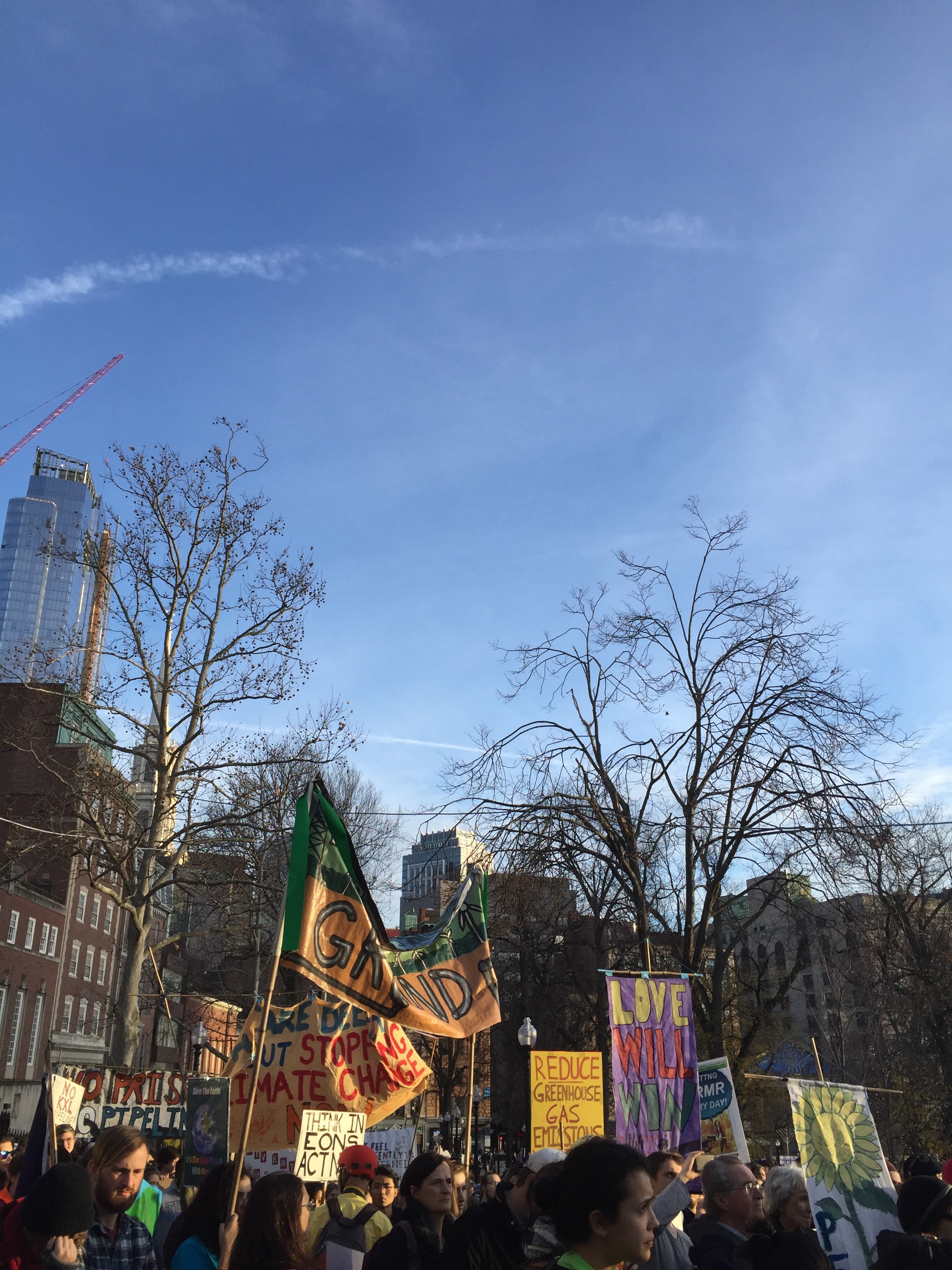
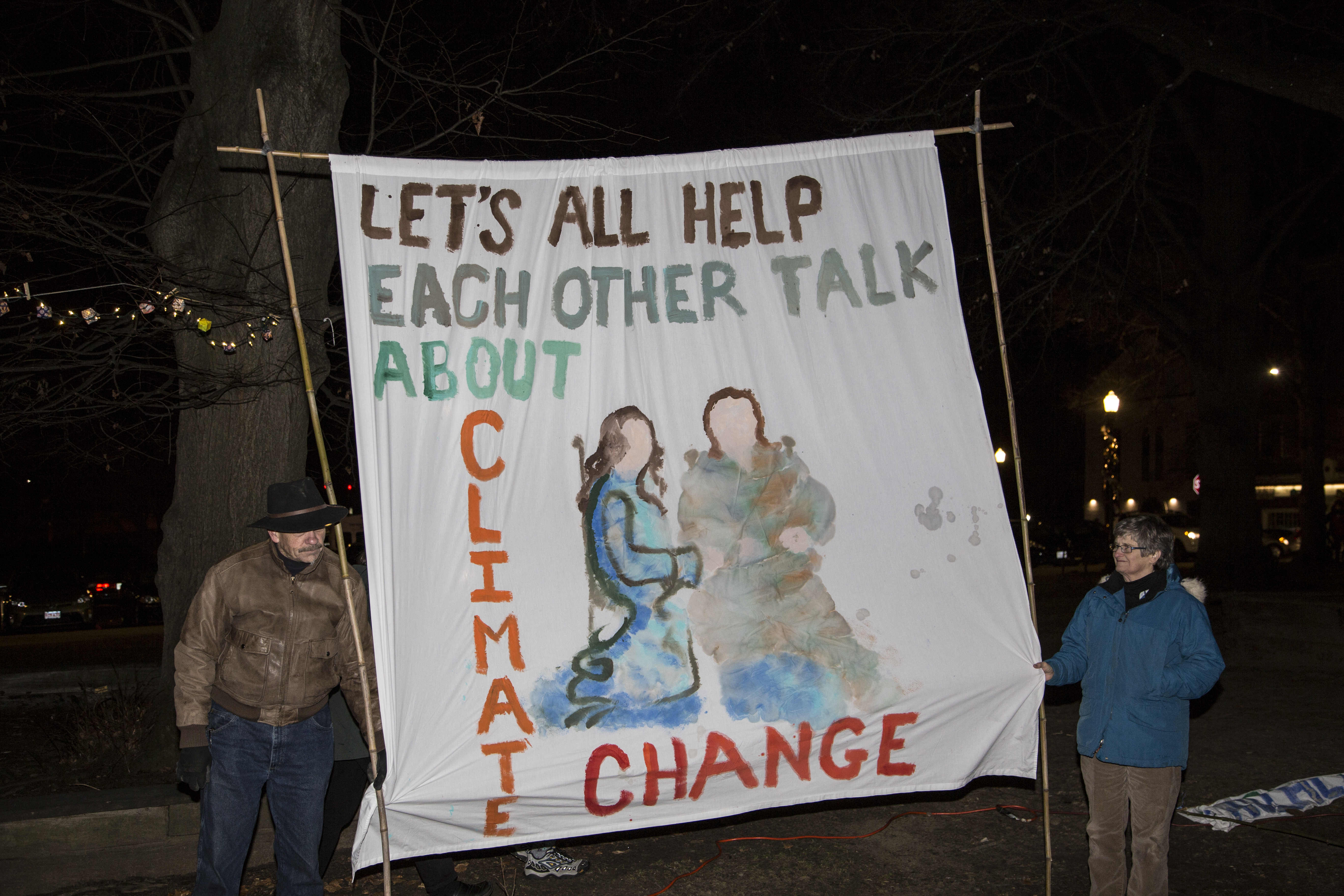
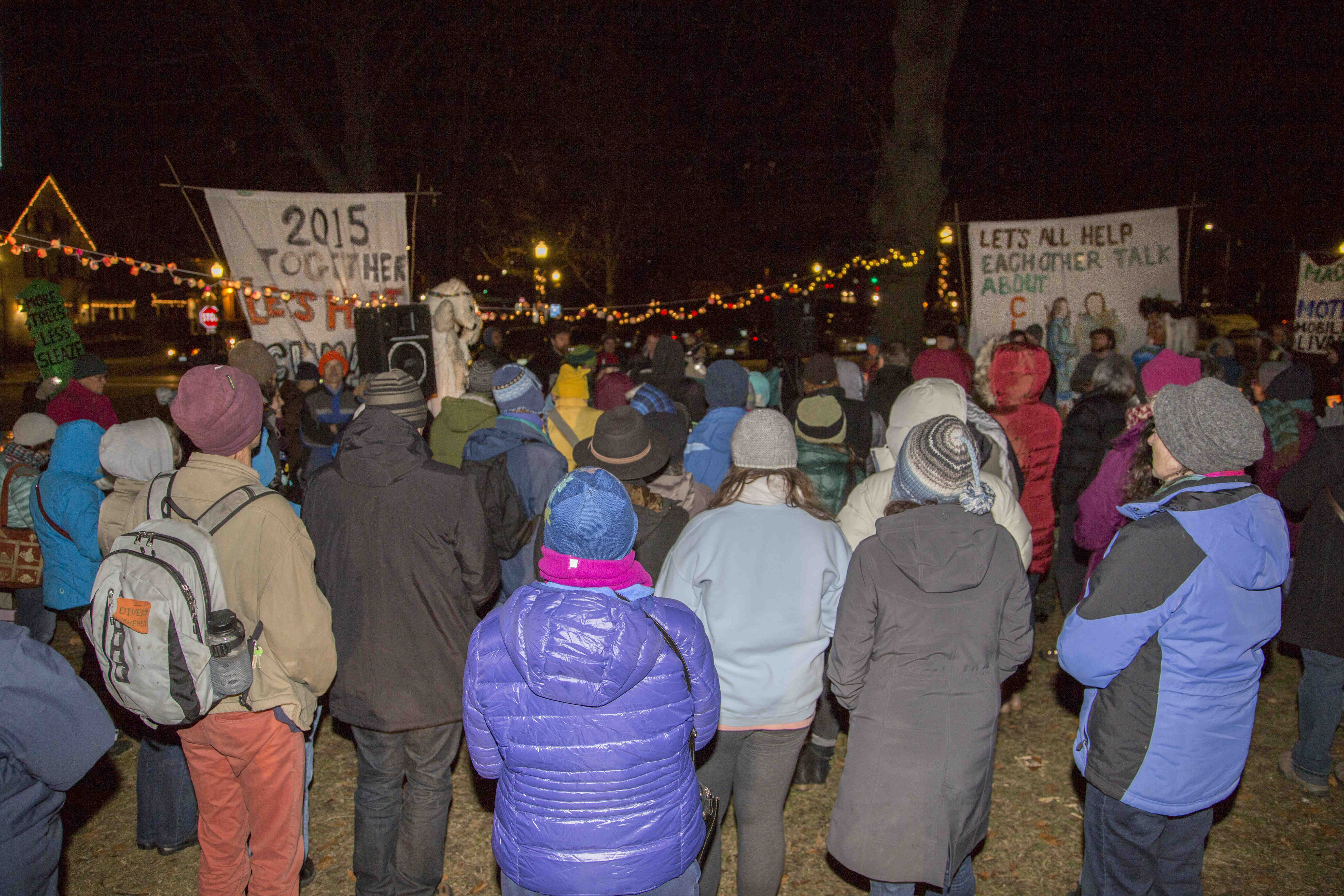
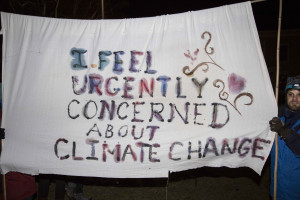
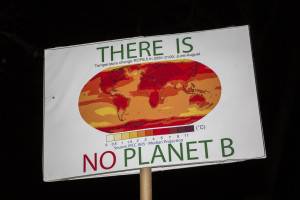
On the eve of the U.N. climate talks in Paris, hundreds of thousands of people worldwide took to the streets to join the Global Climate March. Here in western Massachusetts, 200 people gathered in Amherst and an even larger group assembled nearby in Northampton, all of us calling for decisive international action to keep 80% of current fossil fuel reserves in the ground.
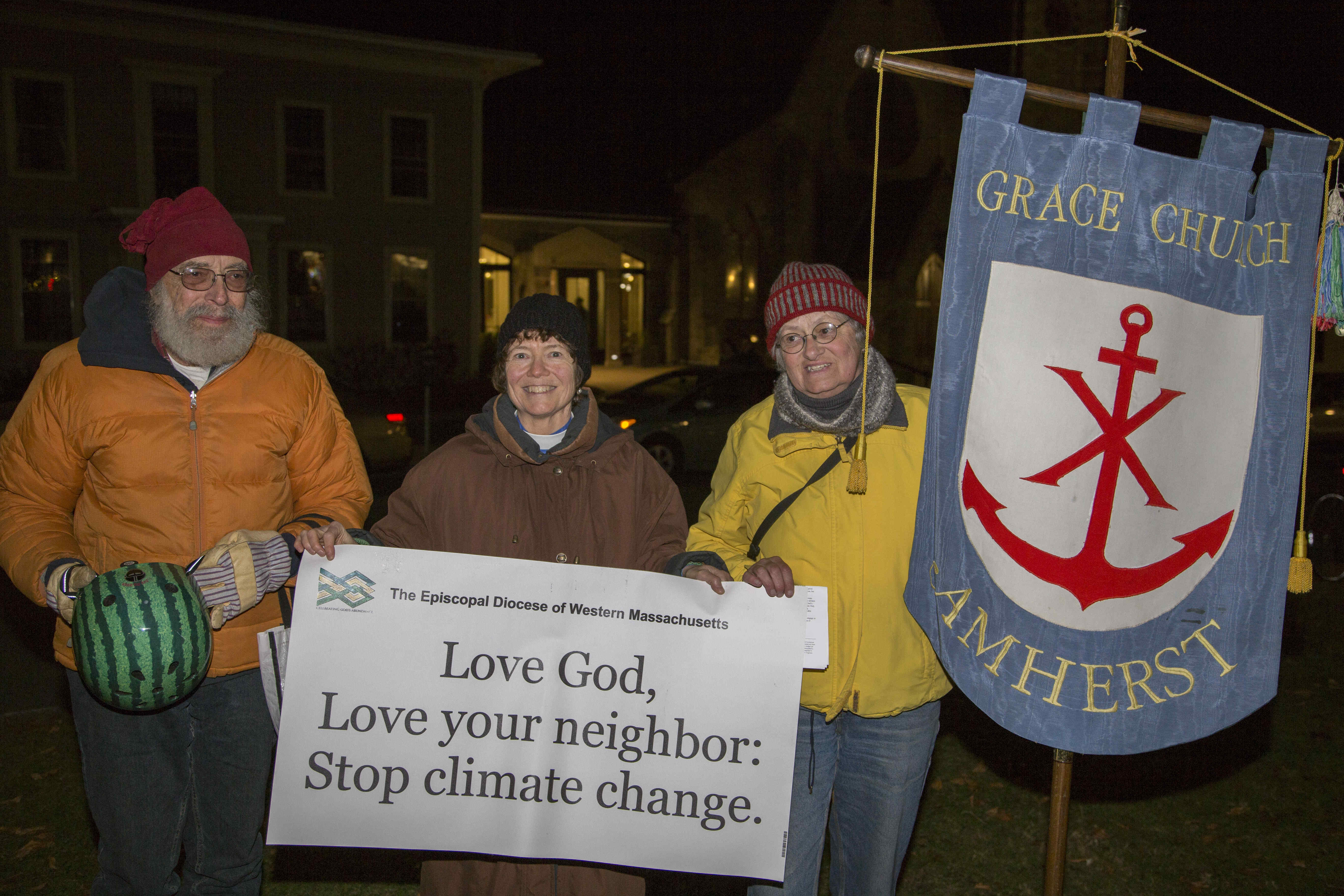
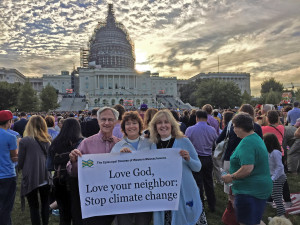
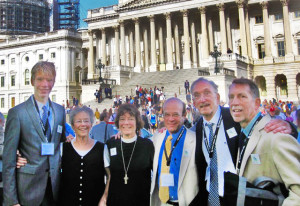
With Philip and Betsy Mathews on the Amherst Common, in front of Grace Church; photo c) Robert A. Jonas
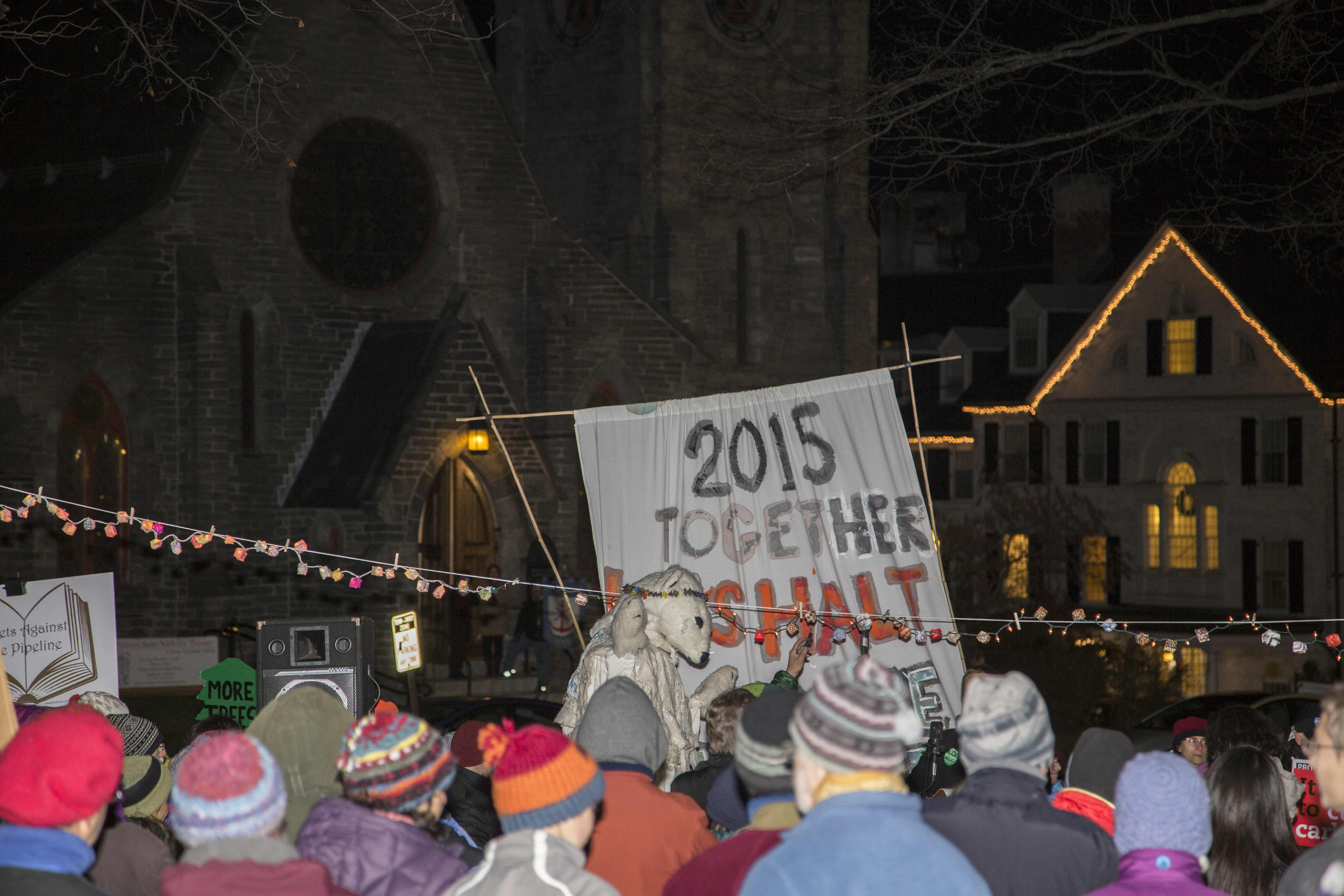
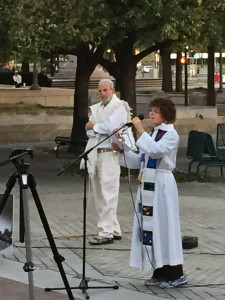
I was the opening speaker at the November 29 rally on the Amherst Common. The crowd included young and old, families, college students and retirees, an 8-foot tall Polar Bear puppet and a little boy in a brown bear suit. We shivered in the cold night air, but our energy was high and our resolve was strong.
A much bigger, regional rally is planned for the day after the conclusion of the U.N. talks. Please join me on the Boston Common on Saturday December 12, 1:00-3:00 p.m. for a Jobs, Justice, and Climate Rally that will bring together a wide range of interests – labor, immigrant rights, faith, racial justice, economic justice, and climate justice groups – as we build an unstoppable grassroots movement to stabilize the climate and create a more just and sustainable society.
Below is what I said last night at the Amherst rally.
Photo c) Robert A. Jonas
I am filled with gratitude as I look into your faces. We stand together tonight in the center of town, under the stars, to express our longing for a safe, just, and sustainable future. All eyes are on Paris tonight. West of here, across the river, another group has assembled in Northampton. South of here, down the road, other people gathered this afternoon in Springfield. East of here, across the state, a group is gathering in Boston. Around the world, in every direction, from Beirut to Barcelona, from Ottawa to Melbourne, thousands of events are in progress, as people from every walk of life turn their hearts and hopes to the U.N. climate negotiations that begin tomorrow in Paris.
Photo c) Robert A. Jonas
We know that the situation is urgent. We have only a short amount of time in which to avert a level of climate disruption that would render the world ungovernable and possibly uninhabitable within the lifetimes of our children and our children’s children. To cite just one example of where we’re headed if we don’t change course, a few weeks ago the World Bank – hardly a leftist organization – warned that unless we rein in greenhouse gas emissions quickly, climate change will drive 100 million people into extreme poverty – extreme poverty – within the next 15 years. Just think about the human suffering and social upheaval that this would engender worldwide.
We know we can do better than that. And we refuse to stand idly by and to let business as usual continue to destroy human communities and unravel the web of life.
Photo c) Robert A. Jonas
So tonight we join with people around the world to pray for a climate deal in Paris that is ambitious, one that finally gets the world on track to stabilize and lower its carbon emissions.
We also hope for a deal that is fair, one that protects the most vulnerable and low-income populations from the most devastating effects of climate change.
But you know what? This is not just about Paris and it’s not just about tonight. The agreement that comes out of Paris is not going to be enough, by itself, to keep the world below a 2 degree centigrade rise in temperature above preindustrial levels, which we need in order to avert catastrophe.
That’s where you and I come in. Whatever happens in Paris, we’re here for the long haul. We’re not going away. We’re going to keep fighting for a future that runs on clean energy like sun and wind. We’re going to keep fighting for a society and an economy that leave no one out. We’re going to keep building political will and moral pressure until we get this right. As Pope Francis reminded us in his encyclical, the cry of the Earth is intimately connected with the cry of the poor. We hear that cry. We share that cry. And we intend to answer it, by divestment and direct action, by voting and lobbying, by making personal changes in our lifestyle and, perhaps, by engaging in civil disobedience.
A new world is on the horizon, a world that is safe, just and sustainable. We intend to act like midwives, helping that new world to be born. We pray tonight for the climate talks, but those talks are just the beginning. Those talks are just the start.
“You will show me the path of life; in your presence there is fullness of joy, and in your right hand are pleasures for evermore.” (Psalm 16:11)
I am blessed to be with you this morning. Thank you, Thomas, for inviting me. I serve the other diocese in Massachusetts as the Missioner for Creation Care, so I travel from church to church, preaching the Gospel and speaking about our Christian call to protect the Earth. This morning I must begin with a word about the violence in Paris and in Beirut. Our hearts go out to everyone affected by these acts of terrorism, to the people who were wounded and to the innocents who died, to the families who mourn, to the first responders, and to everyone who is playing some part in weaving these two rattled, frightened, assaulted cities back together into a place of security and peace.
These tragic events shock us. They move us to anger, fear, and grief, for we feel a visceral connection with our French brothers and sisters across the Atlantic, with our Lebanese brothers and sisters across the Mediterranean, and with people everywhere who are subject to acts of violence and terror. We share their human vulnerability. We, too, are mortal. Like it or not, we too live in a world of danger, violence, and uncertainty.
Jesus also lived in such a world, and every year, in late November, as the cycle of the church year draws to a close and we start to head into Advent, we hear Scripture readings that turn our attention to the end times, giving us images of breakdown and distress. In today’s Gospel passage, just as Jesus is coming out of the temple one of his disciples admires how solid the building is, how large it is, how grand. Surely it will last forever! But Jesus turns to him and says, “Do you see these great buildings? Not one stone will be left here upon another; all will be thrown down” (Mark 13:2). All will be thrown down. He goes on to predict natural disaster and social unrest, “wars and rumors of wars” (Mark 13:7a). “Nation will rise against nation,” he says, “and kingdom against kingdom; there will be earthquakes in various places; there will be famines” (Mark 13:8).
Christianity is bracingly realistic about the human condition and the reality of natural disaster and human-caused disaster. Today Jesus predicts suffering and turmoil, and he says, “All will be thrown down.” Yet in the very same passage, in practically the very same breath, he also says: “Do not be alarmed” (Mark 13:7). “Do not be alarmed… This is but the beginning of the birth pangs.” (Mark 13:8).
Birth pangs? It seems that Jesus was so deeply rooted and grounded in the love of God, so attuned to God’s dream for the world, so open to God’s creative Spirit and power, that even in the midst of suffering and war, even in the midst of violence, terrorism, and death, he could see beyond everything that was passing away and stand fast in the unshakable, ever-new, ever-abundant love of God. Jesus trusted in God’s abiding presence and in God’s vision for the future. He trusted in God’s dream that human beings can find peace within themselves, with each other, and with the whole creation. Jesus knew that even in the midst of death, something new and holy is being born, and he offered himself to that birthing process as a midwife, a healer and peacemaker. He showed us the path of life and he invited us to walk it with him.
I wonder what it would it be like to share so consciously in Jesus’ mission of justice, compassion, and hope that we, too, thought of ourselves as midwives helping a new world to be born. I wonder what it would be like to throw our selves into birthing that new world with the same ardor that Hannah felt as she prayed to conceive and give birth to a child. As we heard in today’s first reading, Hannah prayed so ardently to be a generator of life that the priest who was watching her accused her of being drunk!
May we all get drunk like that! Heaven knows that our beautiful, suffering world needs people who are wholeheartedly committed to the struggle to safeguard life as it has evolved on this planet and to conceive and bring forth a compassionate, just, and life-sustaining society. We know what we’re up against. The terrorist attacks in Paris and Beirut are linked with other deadly threats, such as climate change. Researchers tell us that ISIS, the Islamic State, arose partly because of climate change, which caused an extreme drought in Syria between 2006 and 2009. When crops failed, as many as 1.5 million people were forced to migrate from rural areas into cities. Social unrest escalated into civil war and eventually into the multifaceted conflict that now affects many millions of people.
Of course climate change is not the only cause of terrorism, but it’s what the Pentagon calls a “threat multiplier.” Earlier this week the World Bank – hardly a leftist organization – warned that unless we change course quickly and rein in greenhouse gas emissions, climate change will drive 100 million people into extreme poverty – extreme poverty – within the next 15 years. We don’t have to be expert analysts in order to grasp how much suffering, upheaval and conflict that would engender worldwide.
When I look around, I see a planet at risk of catapulting into runaway climate disruption because of an ever-expanding economic system that depends on fossil fuels. I see terrorism and poverty, rising seas and melting glaciers, and I see people so locked in fear, anger, or despair that they are unable to imagine, much less to create, a better future. It’s as if we’ve fallen under a spell and made what U.N. Secretary General Ban-ki Moon has denounced as a “global suicide pact.”
But I also see this: person after person reaching deep into their souls and then standing up to offer their energy and time to the shared struggle to re-weave the fabric of life and to create a just and sustainable future. I see a wave of religious protest and activism rising up around the world, propelled in part by the release of Pope Francis’ groundbreaking encyclical, Laudato Si, which makes a powerful connection between the cry of the earth and the cry of the poor. I see people rising up for life, refusing to settle for a killing status quo, and proclaiming with one voice that climate change is a spiritual and moral issue that must be tackled without delay.
Just think of all the signs we see of a new social order being born. We see people blocking the path of new fracked gas pipelines and being arrested for civil disobedience as they read aloud from Pope Francis’ encyclical. We see people lobbying for a fair price on carbon, so that we can build a clean green economy that provides decent jobs and improves public health. We see our own Episcopal Church deciding – miracles of miracles! – to divest from fossil fuels, since it makes no financial or moral sense to invest in companies that are ruining the planet. We see new coalitions being formed and new alliances forged, as people realize that the environmental crisis is closely connected with the social crises of poverty, income inequality, and racial injustice. Just this week I spent a day lobbying at the State House with a new interfaith coalition that is dedicated to climate justice right here in Massachusetts. Together we are fighting to keep fossil fuels in the ground and to accelerate a transition to clean, safe, renewable sources of energy, such as sun and wind, that are accessible to all our communities, including low-income. As climate activist Bill McKibben has pointed out, “The fight for a just world is the same as the fight for a livable one.”
The Church was made for a time like this – a time when God calls human beings to know that we belong to one Earth, that we form one human family, and that God entrusted the Earth and all its residents to our care. We may live in a society where we’re told that pleasure lies in being self-centered consumers who grab and hoard everything we can for ourselves and the devil take the hindmost, but we know the truth: our deepest identity and joy is found in being rooted and grounded in love and in serving the common good. With the psalmist, we turn to our Creator, Redeemer, and Sustainer, and say: “You will show me the path of life; in your presence there is fullness of joy, and in your right hand are pleasures for evermore” (Psalm 16:11).
Some people named the week beginning September 21, 2015, the Week of Moral Action for Climate Justice. Others called it Pope Week. I want to call it Watershed Week: the week when Americans streamed to Washington, D.C., New York City, and Philadelphia, like rivers pouring through a watershed, eager to hear Pope Francis speak about our call to love each other and all Creation. The week was a watershed in another sense, too: a turning point where everything changed.
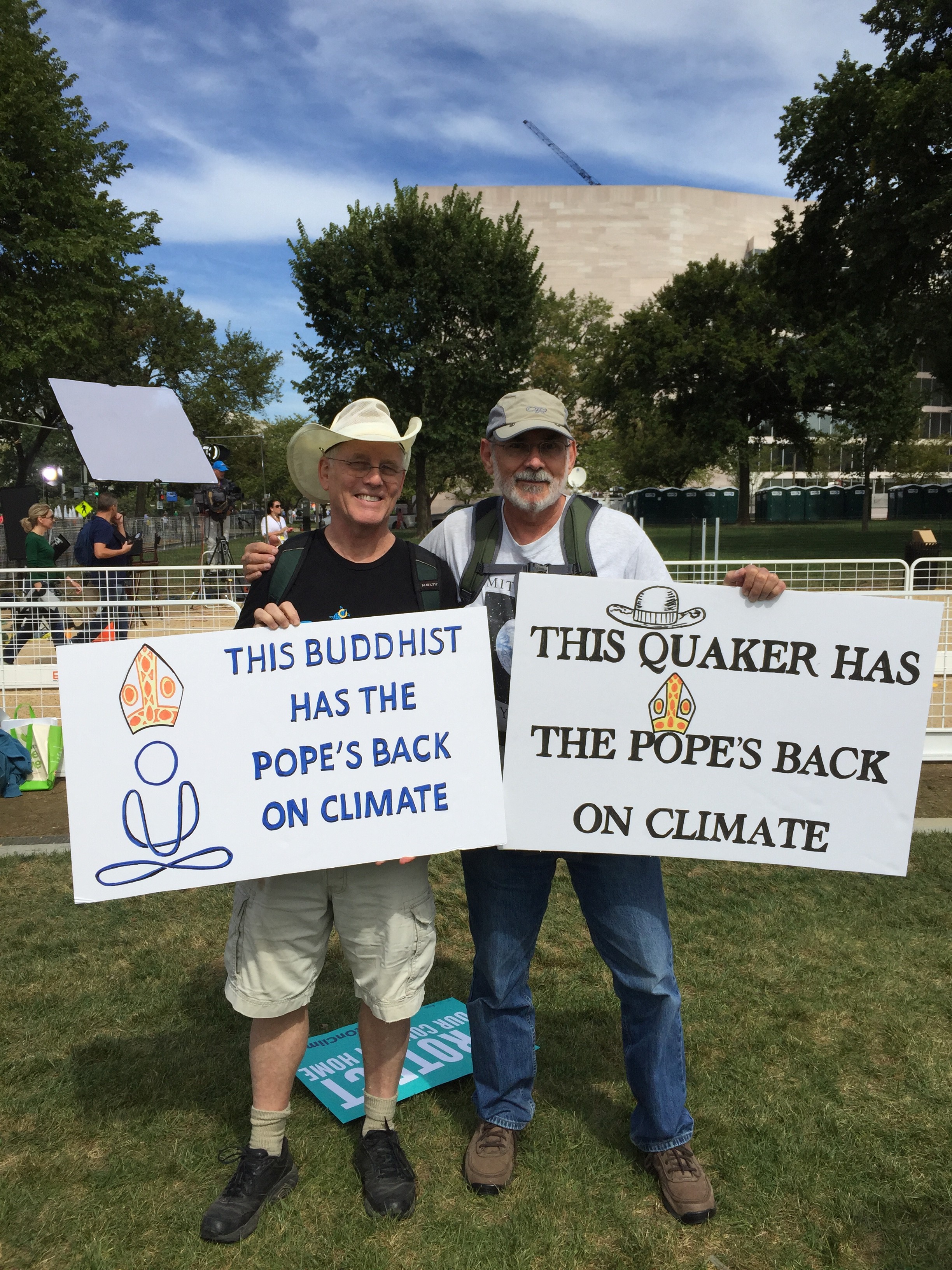
Doug Hendren and Dave Pruett express the spirit of the climate rally on the National Mall
I spent most of that week in D.C., swimming through crowds and participating in prayer vigils, concerts, strategy sessions, and rallies. On Monday I gave the opening prayer at the National Prayer Breakfast on Creation Care, an annual event organized by the National Religious Coalition on Creation Care (NRCCC). NRCCC is composed of members of all the major religious groups in America, including Catholics and Protestants, Jews and Muslims, Evangelicals and Orthodox Christians. Joined in prayer, and united with people of every religious tradition, we advocate for a right relationship to God’s creation.
The Open Letter to President Obama focuses on actions he can take without approval of Congress, such as becoming an advocate for a carbon tax, modifying the Trans-Pacific Partnership, rejecting the Keystone XL Pipeline, and rejecting new coal leases on public lands. The letter urges the President to adopt the language of “emergency” whenever he speaks about climate change, and “to mobilize the nation with the same focus and determination with which we mobilized during World War II, so that we reach 100 percent renewable energy in two or three decades.”
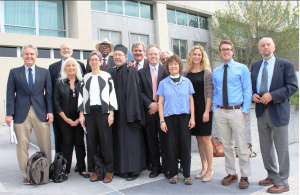
The NRCCC team gathers for a meeting at the State Dept.
We were gratified to hear from the Council on Environmental Quality that the letter was shared widely with the White House climate team. Maybe it will make some waves.
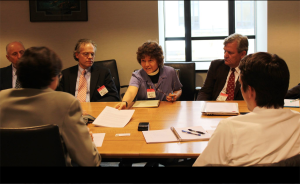
On Tuesday a group of NRCCC members headed to the State Department to meet with Karen Florini, Deputy Special Envoy on Climate Change, and Amy Willis, in the Secretary’s Office for Religion and Global Affairs. With only two months to go until the crucial international climate talks in Paris, we wanted to express in the strongest possible terms our desire for bold leadership by the United States. Ms. Florini welcomed our faith-rooted advocacy – she herself is a person of faith – and we talked about how to push for effective climate action both at home and abroad in the midst of an obstructionist Congress. As she put it, “We are under active political assault.” (Learn more about the visit here.)
Sharing our Open Letter to President Obama with Ms. Karen Florini
From the State Department we headed to the Senate Building to meet with the legal counsel of Senate Majority Leader Mitch McConnell. We gave him an earful about the moral mandate to tackle the climate crisis, citing science and Scripture, ethics and economics. In turn, we listened to his concerns about unemployment in Kentucky and the future of coal. A member of our group pointed out, “Coal is over.” So the question becomes: can Republicans and Democrats work together to make a swift and just transition to a new economy based on clean energy? That is something to work and pray for.
Wednesday began with an interfaith coalition of climate leaders meeting over breakfast with the staff of ecoAmerica. EcoAmerica has been instrumental in developing best practices for climate communication, and its Blessed Tomorrow campaign is mobilizing faith communities to engage in the struggle to stabilize the climate. The offices of ecoAmerica happen to be directly across the street from St. Matthew’s Cathedral, where Pope Francis spoke for one hour to Roman Catholic bishops and cardinals. We relished having the chance to see the Pope as he entered and left the sanctuary.
Praying at Multi-faith Prayer Vigil, with Rabbi Mordechai Liebling
On Wednesday night I joined a large group on the steps of John Marshall Park near the National Mall to mark the end of Yom Kippur. At the start of Yom Kippur the night before, Rabbi Mordechai Liebling had delivered a powerful sermon that called for atonement – At-One-Ment – with the Earth and each other, a watershed moment that can only take place when we “feel in our hearts and know in our guts that what happens to the oceans, to the forests, to other species, to other people is also happening to us.”
A multi-faith prayer vigil completed the marking of Yom Kippur, and I gave the opening prayer, lifting up Jesus’ cry from the cross as the cry of the Earth-community.
“Why have you forsaken me?” We hear that cry
in the din of collapsing glaciers as they tumble into the sea,
in the crash of forests as they are felled,
and in the blast of mountaintops as they are blown open for extraction of
coal.
“Why have you forsaken me?” We hear that cry
in the murmur of refugees searching for water in lands scorched dry,
in the diminishing bleats and roars and chirps worldwide as species go extinct,
one by one,
and in the silence of dying coral reefs as they bleach in acid seas.
At the foot of the cross, we hear the cry of all humanity, and especially the poor, as the climate crisis unfolds around us.
We hear the groaning of all Creation: “Why have you forsaken me?”
The prayer ended with an appeal for divine mercy, asking God to empower us not to forsake each other, but instead to stand with the vulnerable, the poor, and the living world around us. Receiving God’s forgiveness and accepting our interconnection with all Creation can be a watershed moment. The dusk drew shadows around us; above us, the stars began to shine. (The complete prayer is here. )
Rev. Dr. Jim Antal, Rev. Dr. Margaret Bullitt-Jonas, Rev. Stephanie Johnson
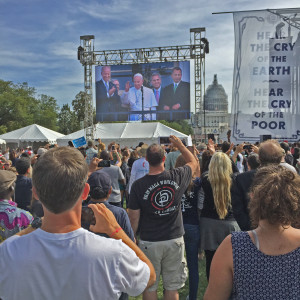
On Thursday morning, I joined thousands of people at a reserved area on the lawn in front of the Capitol Building, to listen and watch on large screens as Pope Francis addressed a joint session of Congress. Eventually I moved further back on the National Mall to participate in the Moral Action on Climate Justice Rally, which featured lively music, speakers, and a diverse throng of activists. On either side of the stage stretched two long banners in English and in Spanish, quoting from the papal encyclical: Hear the cry of the Earth. Hear the cry of the poor.
A hush settled over the crowd as the Pope began to speak. In a world where so many leaders speak rapidly and evasively, bending the truth to suit their needs and using their words to dominate opponents, defend a narrow, partisan agenda, and push for power, it was rare and sweet to hear a leader speak slowly, truthfully, and from the heart, excluding no one and welcoming everyone. Here was a person whose humility evoked our own basic goodness as human beings, reminding us that in fact we are connected to each other, we do care about the Earth and each other, we do have the capacity to be good, we do have the power to work together and to do the right thing. Was I the only listener moved to tears? I doubt it.
Pope Francis stands at the balcony
After the Pope left Capitol Hill, I lingered for a while at the rally to meet with friends, old and new. Activist and writer Ted Glick was on the penultimate day of an 18-day, water-only Fast for New Permits, organized by Beyond Extreme Energy. The fast targeted the Federal Energy Regulatory Commission (FERC), which essentially rubber-stamps approval for gas pipelines. Ted, looking tired but resolute, cited Gandhi’s insight that “fasting is the sincerest form of prayer.”
That night I made my way on foot to the National Cathedral (forget driving – roads were closed because the president of China was on his way into town). “Coming Together in Faith on Climate” brought together Christian, Jewish, Muslim, and other national religious leaders to express interfaith and ecumenical support of the Pope’s call to action on climate and Creation care. The Episcopal Church’s Presiding Bishop spoke eloquently, and, with the other faith leaders, committed to five initiatives to address global climate change.
I’ve been part of the religious climate movement for many years, but I’ve never experienced as deep and wide an awakening to the urgent call to stand up for life as I did last week. In order to give our children a livable planet, we need the vision and passion of people of faith – people who can see the long view, not just short-term quarterly or annual reports; people who care about the homeless, hungry, and poor, not just about elites; people who understand that the web of life is a gift to be protected, not a commodity to be exploited and destroyed; people who place their hope not in the promise of success but in the faithfulness of God.
People like that are rising up on every side. The image of a watershed may fit this moment in history, but, so, too, does the image of a rising tide. I look back on last week as a watershed moment, because around me and within me I sense a rising tide of activism, resolve, and love.
The most inspiring climate song I’ve yet heard was written by Rabbi Shoshana Meira Friedman and Yotam Schachter, and first performed by Rabbi Shoshana and Rev. Fred Small on September 20 – just in time for that pivotal week. They also went on to perform it at the National Cathedral on Thursday night.
The song is called: “The tide is rising and so are we.”
The past 24 hours have stretched my sense of time.
One morning I come across a report that in a far off cave in South Africa, scientists have discovered the bones of a previously unknown branch of the human family. A photo on the front page of The New York Times shows an ancient skeleton, neatly laid out from head to toe. The bones of the feet, according to one scientist, are “virtually indistinguishable” from those of modern humans. The finger bones are “extremely curved,” clearly adapted for climbing, and the skull seems to have sheltered a brain no bigger than an orange – one-third the size of a modern human brain. Named after the Rising Star cave in which the bones were found, these ancestors are called Homo naledi (“star” in the local Sesotho language). They walked the Earth more than 2.5 million years ago.
I don’t know what these distant relatives were like – what they thought about, how they spent their time, what mattered to them. But I imagine that in some ways they were just like us: they searched for food when they were hungry; they wept when they were sad; they looked for shelter and safety in a difficult world; they cared for their nearest and dearest. Scientists note that Homo naledi repeatedly placed the bones of their dead in an inaccessible cave, a fact that makes me want to say “the bones of their beloved dead.”
I bow to my ancestors who lived nearly 3 million years ago. Somehow we are kin.
The big surprise to scientists is that the melting could happen very quickly. Scientists used to think that it would take many thousands of years for Antarctica to melt. It turns out that once large-scale melting begins, half the melting could occur in as little as a thousand years. At that pace, the ocean could rise about one foot every decade, about 10 times faster than it is rising now. The article notes: “Such a pace would almost certainly throw human society into chaos, forcing a rapid retreat from the world’s coastal cities.”
As the lead author, Ricarda Winkelmann, puts it: “To be blunt: If we burn it all, we melt it all.”
What takes my breath away is the list of the world’s regions that would be affected by a sea-level rise of 200 feet. The list of cities lost includes (among others) Miami, New Orleans, Houston, Washington, New York, Amsterdam, Stockholm, London, Paris, Berlin, Venice, Buenos Aires, Beijing, Shanghai, Sydney, Rome and Tokyo.
I read the list of cities printed in The New York Times. I touch my fingers to the page, as if physical contact can help me absorb these facts and make them real. I recall the startling new report from James Hansen and 16 other top climate scientists, which predicts that significant sea level rise could be swift and abrupt. Oceans could rise as much as ten feet in as little as 50 years, which means that we would lose all the coastal cities of the world.
The people living in those ruined cities could include my beloved children and grandchildren. I don’t need to exercise any imagination or empathy to know what these people will be like. They will be just like us. They will search for food when they are hungry, and they will weep when they are sad. They will look for shelter and safety in a difficult world, and they will care for their nearest and dearest.
I know in my bones that we are kin.
That night I go outside and stand barefoot in the backyard. The toes of my feet, not so different from those of Homo naledi, dig into the cool grass. Where am I in time? Behind me, in the past, extend some 3 million years of human evolution. Ahead of me lies a human future that could be unimaginably chaotic and short. Here, in this precious, passing instant of time, I stand on the place where past and future meet.
That place is on fire with love.
Surging through the dark night air and rising up from the earth beneath my feet are gratitude for the priceless gift of life, grief for what we’ve lost, anger at what we’ve done, and a love that knows no bounds. I feel an urgent call to spend my life well, to place it in the service of life.
Next week I will head to Washington, DC, to participate in the Week of Moral Action for Climate Justice (Sept. 21-25). Pope Francis is coming to DC to address a joint session of Congress, and people of all colors, creeds, and faiths will converge on our nation’s Capitol to amplify his unequivocal call to humanity to create a just and sustainable future. All eyes are on the U.N. climate talks that will be held in Paris this December, which we fervently hope will chart a course to a low-carbon world.
The Pope’s encyclical, Laudato Si’(Praise Be to You), draws from the best of the Judaeo-Christian tradition. As Wen Stephenson points out in a fascinating cover story in The Nation, the encyclical reclaims the once-marginalized terrain of liberation theology and offers a radical critique of the economic and social system that drives climate change. Francis highlights the fact that in a world beset by a disrupted climate, those who are poor have the fewest resources and are the least able to adapt. What’s more, the same mindset and economic system that exploit the Earth are the same mindset and economic system that exploit the poor. The cry of the Earth and the cry of the poor form a single cry and should evoke an integrated, comprehensive response.
For too long humanity has been caught in a trance of greed, resignation, and shortsightedness, as if we have no choice but to keep drilling and fracking, keep plundering the earth and keep plundering the poor. We stand at the brink of disaster. U.N. Secretary General Ban Ki-moon has called it our “global suicide pact.”
But maybe we will start to apprehend the mystery of time, a sacred mystery that extends far beyond our own little lives. We belong to something much greater than ourselves. After all, human beings were born from stars. Members of Homo naledi are not the only Star People – we all are. We exist within a great sweep of Milky Way time. Yet we are also faced with the fact, as Martin Luther King, Jr. once said, that “…tomorrow is today. We are confronted with the fierce urgency of now.”
In the short span of a lifetime each one of us has countless opportunities to bear witness to what Dante called “the love that moves the sun and other stars.” That love is moving through us, too, and in the brief time we Homo sapiens have left in which to save life as it has evolved on this wondrous planet, it is our call and privilege to do everything we can, because we love our natural world and our descendants, those born and not yet born. They are our future and we are their past.
So we reach out to the ancestors who came before us and to the descendants who, God willing, will arrive long after we have vanished from Earth and are only bones in the ground. We reach out to our human neighbors, to children and the elderly, to the vulnerable and poor, to the countless refugees already on the move as seas rise and drought spreads. We reach out to the living world around us – to all that has been desecrated, to the blasted forests and dying meadows, to the poisoned, acid-drenched oceans and the convoluted air. We reach out in love to all of you, and we say: I stand with you. I belong to you. I am part of you. I will not let you go. We are in this together. I will join the fight to re-weave the web of life.
The most comprehensive schedule I’ve found for the events going on in DC during the Week of Moral Action for Climate Justice is here.
September 21: The National Prayer Breakfast for Creation Care will begin at 10 AM, at Capitol Hill Lutheran Church, 212 East Capitol St NE, Washington, DC 20003.
September 23: Interfaith Prayer Vigil will begin at 7:00 p.m. near the National Mall at John Marshall Park (at Pennsylvania and 4th Street NW, near Judiciary Square Metro), organized by Franciscan Action Network.
September 24: Ignatian Solidarity Network is helping congregations to organize “watch parties” of the Pope’s historic address to Congress, offering a free step-by-step guide for how to set one up.
Three watch parties are scheduled at 7:00 p.m. in the Pioneer Valley (in Amherst, Northampton, and Longmeadow, MA). Details are here.
At 12:30 p.m. on September 24, the same day that Pope Francis addresses Congress, Springfield Climate Justice Coalition will hold an important rally on the steps of the Springfield, Mass. City Hall, to urge the city to fund and implement a climate action plan. Download a flier here: SpringfieldRallyForClimateJustice2015flyer. Please come if you can!
It’s a pleasure to be with you on this fine mid-summer morning. Thank you, Janet, for inviting me to preach. I am the Missioner for Creation Care in this diocese, so I travel from church to church, preaching the Gospel and speaking about our call as Christians to protect the Earth. This is my first visit to Grace Church and I haven’t met most of you, but already I feel as if I’m among friends. From everything I’ve heard, you are modeling the kind of Christianity we need in the 21st century: a community of people who gather week by week to be nourished by each others’ presence and by the Word and sacraments of God, and who don’t require a big old building that leaves a big old carbon footprint.
I’m told that many of you are gardeners, and that you know how to cultivate the soil, tend flowers, and grow food. I honor you for that hands-on knowledge of the Earth, and I also honor your dedication to sharing what you grow with your neighbors and to feeding a hungry world. Our call as human beings to “till and keep” the Earth (Genesis 2:15) extends outward to political engagement, as well, so I also want to thank those of you who headed off to New York City last year to join the People’s Climate March. What an astonishing event that was – hundreds of thousands of people taking to the streets to proclaim the urgent need to protect and sustain life on Earth! Thank you, friends, for all the ways you bear witness to what Archbishop Desmond Tutu calls the “supreme work” of Jesus Christ: to reconcile humanity not only with God and each other, but also with the whole of Creation.
I know you’ve been reflecting for several weeks on food and faith, and I want to jump right in to our Gospel reading from John. Whenever I read this account of Jesus feeding the five thousand, I feel a wave of affection for the little boy who offered Jesus his five barley loaves and two fish.1 We don’t know very much about that boy – we get only a glimpse of him and we see him only in passing, but we do know that his gift to Jesus opened the door to a miracle, one that the early Church found so significant that, among all the stories of Jesus’ public ministry, only this one is recorded in all four Gospels. After that unknown little boy puts everything he has into the hands of Jesus, the hungry crowds are fed – in fact, they are filled with such abundance that the disciples can gather up the leftover food and pile it into twelve baskets.
Like many commentators, I’ve wondered about the identity of that nameless boy whose generosity made all the difference. I imagine him as being eight, nine, maybe ten years old. Maybe he heard that Jesus was in the neighborhood, and started begging his mother to let him go see for himself the man that everyone was talking about. If I had been his mother, I would have been reluctant to say yes: for one thing, the boy might get lost in the crowds. But maybe he kept pestering her until finally she gave in and packed him a picnic lunch: some barley bread – in those days, the bread of the very poor – and a couple of pickled fish, no bigger than sardines.
What happened next is told in all four gospels. The hungry crowds begin to gather around Jesus – hundreds, even thousands of them – and they have nothing to eat. The sun is hot, their feet are sore, and their stomachs are empty.
One of the disciples, Philip, feels hopeless. “Six months’ wages would not buy enough bread for each of them to get a little” (John 6:7). How easy it would have been for the boy to say to himself: “So many people need food, how can my bit of lunch make a difference? I don’t want to look like an idiot. And I don’t want to give away the little I have and go hungry, myself. Let’s just wait and see. Maybe someone else will figure out what to do.”
We will never know what went through the child’s mind, but obviously that wasn’t it, for something drew him forward. Maybe he tugged at Andrew’s sleeve and showed him the food that he’d brought with him. It seems that Andrew wasn’t particularly impressed. In fact, he sounds quite doubtful as he turns to Jesus to say, “There is a boy here who has five barley loaves and two fish. But what are they among so many people?” (John 6:9).
As I imagine it, Jesus listened quietly to Andrew and then turned to look down at the little boy, standing there in the heat with his outstretched offering of some chunks of bread and two tiny fish. Maybe Jesus looked at him and smiled. He took the child’s gift, blessed it, and gave it to all the hungry people to eat. And they ate, and were satisfied.
This is a story about hopelessness shifting to hope, about scarcity being transformed into abundance, about empty places being filled to overflowing. It’s a story about one small person initiating a miracle by offering what he has, even though it seems very small. It’s a story about the power of generosity – a story about how one small but selfless act can end up blessing everybody.
I relish this story because I cherish that little boy and also because it’s so easy to identify with the crowds of people around him that are hungry, tired, passive, and overwhelmed. It’s easy these days to be agitated by anxiety or paralyzed by despair, for the challenges that press upon us are daunting. In just 200 years – a blink in geologic time – human beings have burned so much coal, gas, and oil and released so much heat-trapping carbon dioxide into the atmosphere that levels of carbon dioxide in the atmosphere are at a level that our species has never experienced before. This spring the National Oceanic and Atmospheric Administration announced that for the first time in human history the global level of carbon dioxide has topped 400 parts per million, reaching a level that hasn’t been seen in about 2 million years. For now the air is still breathable, and for now your life and mine will go on. But what’s so worrisome to scientists is that this process is happening so fast. Already we’ve shot well past 350 parts per million, the safe upper limit for carbon dioxide in the atmosphere, and the amount of carbon dioxide pouring into the atmosphere is accelerating at a record pace, one hundred times faster than natural rises in the past.
If we stick to business as usual and keep to our present course, then within two, three, four generations we could raise average global temperatures to a level that would make the world very difficult for humans and other creatures to inhabit. Already oceans are heating and becoming more acidic; tundra is thawing; ice caps are melting; sea levels are rising; coral reefs are dying; massive droughts are spreading in some places and heavy rains intensifying in others. This summer the West is so dry, even a rainforest is on fire, and so many fires are burning in Alaska that the smoke has drifted through the Midwest and reached all the way down to Texas. The first half of 2015 was the hottest ever recorded, and this year is on track to beat last year as the hottest year on record. We’re on the edge, or even in the midst, of what some experts are calling the sixth major extinction event on this planet.
So when it comes to the climate crisis, it’s not just about polar bears anymore. It’s about saving a habitable world for our children and our children’s children. It’s about finding our moral compass and deciding what kind of world we want to inhabit. Like the little boy caught in the midst of a hungry and restless crowd, we rifle through our pockets, wondering what gift we have to offer and whether one person can possibly make a difference.
When I look around, I see a planet at risk and masses of people who are tormented by denial, fear, anger, or despair. But I also see this: person after person bravely standing up to offer his or her vision and skills, energy and time to the shared struggle to re-weave the fabric of life and to create a just and sustainable future. As a Christian, I believe that if we put what we have, whether it’s a little or a lot, into the hands of Jesus, miracles can happen and blessings can emerge that no one could possibly have predicted. As we heard in the Letter to the Ephesians, if we stay “rooted and grounded in love,” we will discover a “power at work within us [that] is able to accomplish far more than all we can ask or imagine” (Ephesians 3:17, 20).
As I look around this summer I see people rising up for life and refusing to settle for a killing status quo. I see people blocking the path of new fracked gas pipelines and being arrested for civil disobedience as they read aloud from Pope Francis’ groundbreaking encyclical on the environment. I see people lobbying for a fair price on carbon, so that we can build a clean green economy that provides decent jobs and improves public health. I see our own Episcopal Church deciding – miracles of miracles! – to divest from fossil fuels, since it makes no financial or moral sense to invest in companies that are ruining the planet. I see new coalitions being formed and new alliances being forged, as people begin to realize that the environmental crisis is closely connected to the social crises of poverty, income inequality, and racial injustice.
The worldview that allows the Earth to be exploited and trashed is the same worldview that allows the poor and vulnerable to be exploited and trashed – which means, as Bill McKibben has pointed out, “The fight for a just world is the same as the fight for a livable one.” On September 24, one year after the People’s Climate March in New York City, people will be gathering in Washington, D.C., and in New York City to welcome the Pope as he addresses a joint session of Congress and then a meeting at the United Nations. This is a defining moment as we head toward the international climate talks that will be held in Paris this December.
But you don’t have to leave Massachusetts to join the climate justice movement. We are fortunate to have a strong grassroots climate group right here: 350Mass. for a Better Future. It has nodes across the state, including one here in Berkshire County. If you sign up to receive the weekly newsletter from 350Mass., as I hope you will after the service, you will find friends and allies in the struggle to keep fossil fuels in the ground and to accelerate a transition to clean, safe, renewable sources of energy, such as sun and wind. I can almost promise that in doing so you will receive a wave of hope that will nourish your soul.
The Church was made for a time like this – a time when human beings need to remember that we belong to one Earth, that we form one human family, that our life is a gift, and that God entrusted the Earth and all its residents to our care. Despite what our culture tells us, we are not called to be self-centered consumers who grab and hoard everything we can for ourselves, but rather people who find our deepest identity and deepest joy in serving the common good and in being rooted and grounded in love. I think that’s what the little boy in today’s Gospel story discovered when he gave his bread and fish to Jesus and realized, lo and behold, that somehow his gift was enabling the whole community to be fed.
I like to imagine how that day ended. I like to imagine that at the end of the day, the boy practically ran all the way home, burst through the door, and told his astonished mother, “Just guess what happened! Just guess what Jesus and I did together today!” Who knows what God in Christ will be able to do through you, today and in the days ahead, as you offer your gift to a yearning and hungry world?
1. I am indebted to a commentator who imagined this scene many years ago. I can’t remember where I read his account, but I want to give him credit and extend my thanks.
Margaret speaks on the radio about the Episcopal Church’s divestment from fossil fuels, for Bill Newman’s morning show, “The Rev. and the Rabbi” (WHMP, FM 96.9), on July 9, 2015. Listen to an MP3.
The Episcopal Church voted to divest from fossil fuels.
I write that sentence and lean back in my chair, beaming in amazement. I’ve been working toward this moment for a long time, and lo, it is here. I can hardly believe it.
Other faith groups are also moving forward on divestment. To cite some examples, last year the World Council of Churches, which represents half a billion Christians worldwide, decided to divest from fossil fuel companies. In January, the United Methodist Church announced that its $21 billion pension fund would divest from coal. The Church of England is divesting from coal, and Anglican churches and dioceses in New Zealand, Australia, and the United Kingdom have divested from fossil fuels.
So far the Episcopal Church is the largest denomination in the U.S. to divest from all fossil fuels, and surely it won’t be the last.
The decision made by the Episcopal Church’s 78th General Convention on July 2, 2015, came as a surprise even to the most ardent supporters of the divestment resolution. Several members of our grassroots network of activists, Episcopalians for Fossil Fuel Divestment and Clean Energy Reinvestment, attended the convention, which was held in Salt Lake City. A friend tells me that shortly before the House of Deputies took the vote that sealed the deal, she and another activist exchanged a look of amazement and confessed to each other their tentative hope: Maybe the resolution will actually pass!
Not only did the resolution pass – it passed by an overwhelming margin of 3-1.
I had the sweet responsibility of informing Bill McKibben. It turns out that one of the greatest satisfactions in the life of a climate activist is to be able to give Bill McKibben some good news.
Bill called the Episcopal Church’s decision “unbelievably important.” He added: “The Episcopal Church is putting into practice what the Pope so memorably put into words. It’s an enormous boost to have communities of faith united on the most crucial question facing the planet.”
Why is this decision such good news? Because the Episcopal Church is sending a powerful message to the world: it makes no financial or moral sense to invest in companies that are ruining the planet.
Divesting from fossil fuels and investing in clean energy will accelerate the transition to a just, healthy, and low‐carbon future. Engaging in stockholder activism isn’t good enough – not when an industry’s core business model needs to change. Changing light bulbs isn’t good enough – not when an entire social and economic system needs to be transformed. Waiting, watching, and wringing our hands isn’t good enough – not when the Earth cries out for healing, and when the poor, who are affected first and hardest by climate change, cry out for justice and mercy.
Averting climate catastrophe requires that at least 80% of known fossil fuel reserves remain where they are, in the ground. The only way to keep them there will probably be some combination of carbon pricing, governmental regulation, and strong international treaties. How can we build the spiritual, moral, and political pressure to accomplish that? We can divest from fossil fuels. We can align our money with our values. We can make it clear that fossil fuels have no place in a healthy portfolio if you’re hoping for healthy kids or a healthy planet.
I don’t know to what extent the release of the Pope Francis’ encyclical several weeks ago affected the divestment decision that was made by the Episcopal Church, but I do know that countless people the world over have been inspired the Pope’s bracing reminder that the climate crisis is not just a scientific, political, or economic concern, but also an issue that raises fundamental moral and spiritual questions.
What kind of world do we want to leave our children? What does it mean to live with reverence for the living, intricate, beautiful biosphere into which you and I were born? What responsibility do we have for ensuring that the web of life continues intact for generations yet to come? What responsibility do we have for the poor? How can we possibly love God and our neighbor if we scorch and desecrate the world that God entrusted to our care, and dislocate, drown, and starve our neighbors, beginning with the poorest?
The Episcopal Church resolution commits more than $350 million for divestment, and it urges all parishes and dioceses in the Church to engage the topic of divestment and reinvestment within the coming year, potentially unlocking an additional $4 billion in assets. The pension fund, which manages $9 billion, was not included in the final version of the resolution. Episcopalians for Fossil Fuel Divestment and Clean Energy Reinvestment looks forward to ongoing conversations with the pension board, recognizing that all of the Church’s assets are called to serve God’s mission and that the Episcopal Church is now on record in recognizing that restoring Creation is at the center of God’s mission today. (For more discussion of the resolution, here is an interview I gave to our local newspaper.)
Sometimes it seems that human beings are determined to careen toward catastrophe. Oddly enough, it gives me hope when I consider that no one knows whether or how we will save ourselves from disaster. I keep thinking of a piece of wisdom that has been attributed to Mahatma Gandhi: “Whatever you do will be insignificant, but it is very important that you do it.” Not knowing what, if anything, will make humanity change course gives me energy to be persistent and creative, even if my efforts seem insignificant. Maybe this letter to urge divestment, this phone call, this lobbying for carbon pricing, this climate rally, this campaign to stop new pipelines, this vegetable garden, this decision to walk rather than drive, this willingness to borrow rather than to buy – maybe each small effort will combine mysteriously with other people’s efforts and suddenly we will surprise ourselves and society will shift to a life-sustaining path. I can’t argue with a remark that country music singer-songwriter Naomi Judd once made: “A dead end street is a good place to turn around.”
Unexpected changes, shifts, and transformations happen. Call it chaos theory. Call it an expression of “punctuated equilibrium,” Stephen Jay Gould’s term for the way that a system can look completely stable even though an unseen tension or energy is secretly building up. Suddenly it bursts forth, producing a new species, moving tectonic plates apart, or generating abrupt, rapid, and unforeseen changes in society. (For a wonderful essay that develops these ideas, see David Roberts’ “For a Future to Be Possible: Hope & Fellowship.”)
History is like that: non-linear and full of surprises. So, too, is the Holy Spirit. She blows where she wills, opening minds and touching hearts, making all things new.
The prophet Isaiah was right. Awakened to the presence of a merciful, dynamic, and ever-living God, Isaiah heard God say: “Do not remember the former things, or consider the things of old. I am about to do a new thing; now it springs forth, do you not perceive it?” (Isaiah 43:18-19).
We just saw it happen: the Episcopal Church voted to divest from fossil fuels.
Want to know what will happen next in the ever-expanding, unpredictable, and non-linear movement to save the planet? Find out. Jump in and join the struggle. Do what you can, even if it seems insignificant. And get ready to be surprised.
Citizens Climate Lobby 2015, Capitol Building
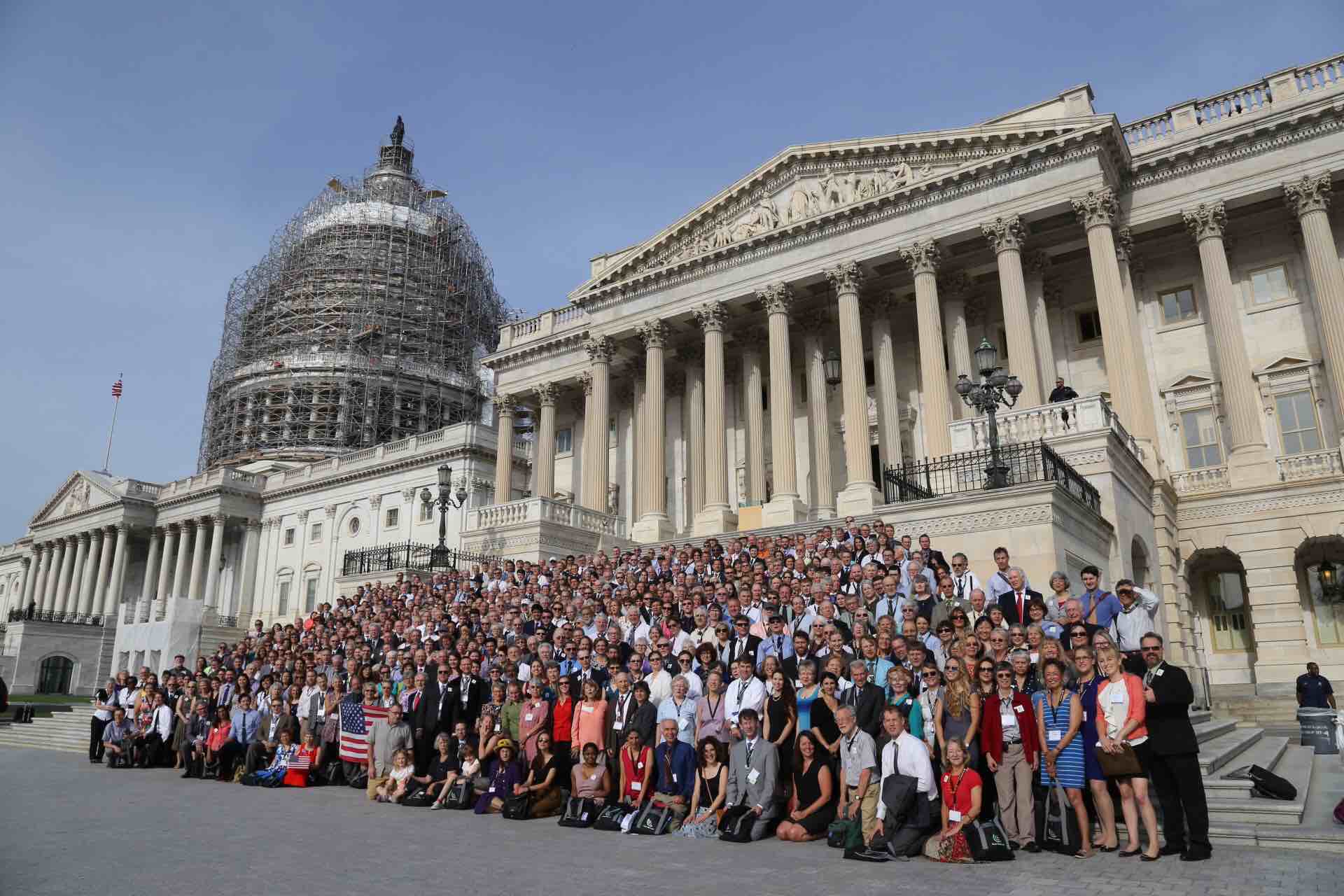
On a sultry summer morning this week, with the temperature already climbing past 97˚ and a heat index of 102˚, I paused on the steps of the Capitol Building to pose for a quick photograph. As volunteers with Citizens Climate Lobby (CCL), nearly one thousand people had traveled from near and far to lobby for a carbon fee and dividend in Washington, D.C.
Being a first-time volunteer, I had recently attended CCL’s basic training in how to lobby members of Congress about climate change. Here is how I usually prepare to lobby, especially when facing people whom I consider adversaries: Do research. Assemble talking points. Brace for confrontation.
By contrast, here is what Citizens Climate Lobby advises: Do research. Assemble talking points. Search for connection.
The group from Ashfield, MA included Allen Gabriel, Kate Stevens, Margaret Bullitt-Jonas, Ron Coler, Bruce Bennett, and Richard Prée
This is harder than it sounds. As I surveyed the voting records of the four Republican members of Congress to whom I’d been assigned, my heart sank. What connection could I possibly have with these conservative men? I am an ardent, long-time climate activist who lives in Northampton, a particularly liberal city in liberal Massachusetts. These House members hail from Kentucky, Florida, Illinois, and Texas, all of them states that have a strong interest in protecting the coal, gas, and oil industries. Just about everything these men had voted for, I was against. Just about everything they had voted against, I was for. Politically, we stand on opposite sides of the aisle. In one portfolio or another, I read phrases like these: Supports fracking and Keystone XL pipeline. Prohibits use of funds by the Administration to conduct a climate change agenda. Opposes and votes against any effort to increase taxes. Voted to gut the E.P.A’s ability to limit carbon pollution from power plants. Voted to open the Outer Continental Shelf to oil drilling.
To my consternation, it turned out that CCL asks its volunteers not to browbeat members of Congress but instead to build relationships and to find common ground. CCL maintains that if you can’t find something to respect and admire in a politician’s life or work, then you should not lobby that person. So I forced myself to slow down. I looked more carefully at the voting records and I tried to exercise some empathy and imagination. What could I appreciate about each person? What did this person seem to value, and why? How might I connect with him?
Spiritual traditions tell us that human beings are essentially inter-related. When we are spiritually awake, we can see the dignity, even the beauty, of each person. Despite whatever may divide us, in fact we are more similar than different. For starters, all of us are mortal, all of us we want to be happy, and all of us want to love and to be loved. It is easy to forget such basic truths when you are caught in the heat of political struggle. It is easier to demonize than to humanize, easier to seek safety behind the walls of righteous judgment than to meet ones “enemy” with an open heart.
This does not give us license to be naïve and sentimental – far from it. Jesus urges us to be “wise as serpents” as well as “innocent as doves” (Matthew 10:16). Yet if we are to love our enemies and to pray for those who persecute us (Matthew 5:44) – to say nothing of praying for those whom we want to persecute – then we must stay grounded in a transcendent love that embraces all beings, even the person we might want to condemn as a villain or a fool.
Who knew that lobbying could be a spiritual practice? Not I.
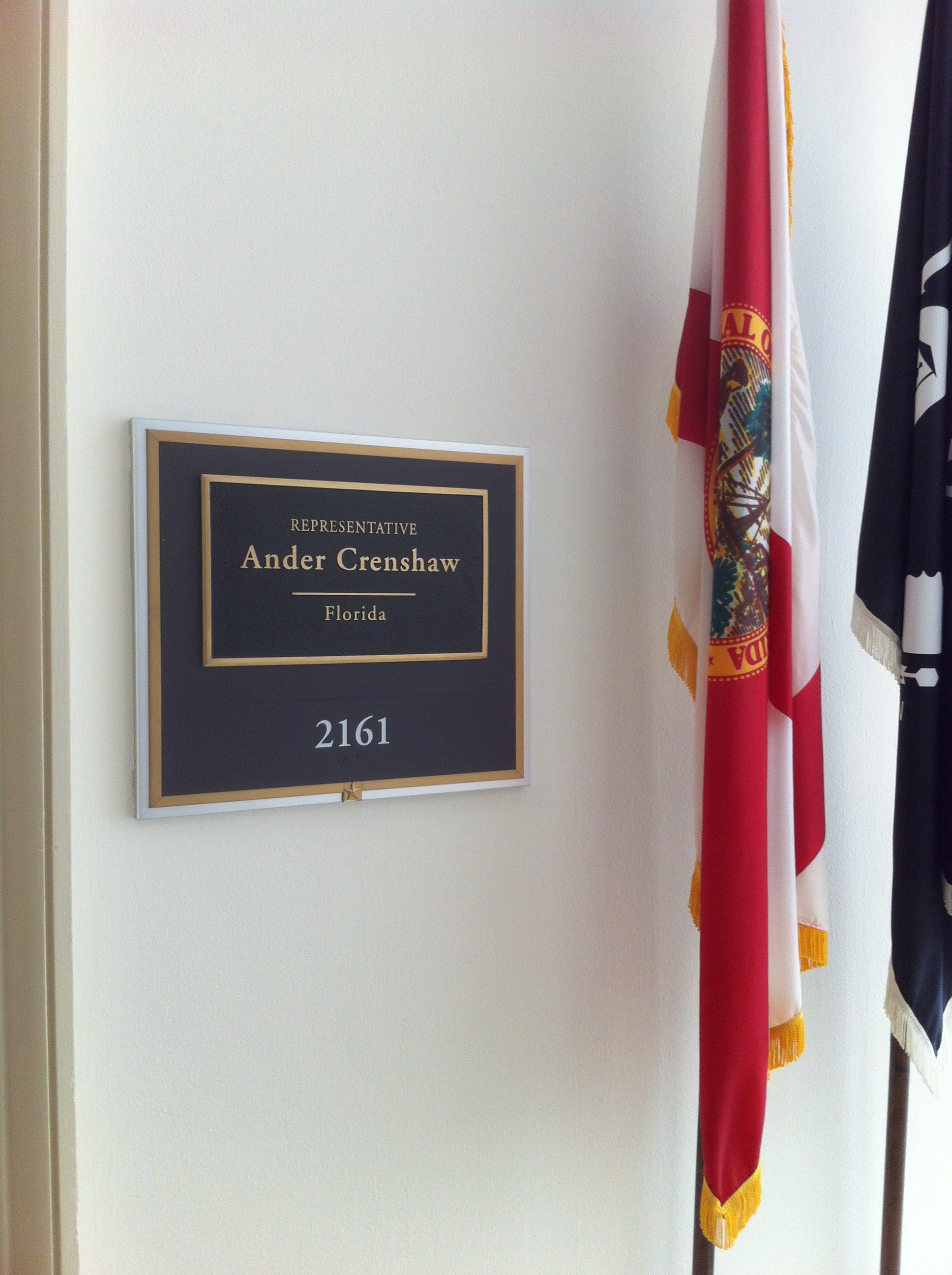
Office of Rep. Ander Crenshaw
My first meeting was with an aide to Representative Ander Crenshaw, an Episcopalian from Florida. I introduced myself as an Episcopal priest who believes that climate change is the great spiritual and moral issue of our time. I told the staff member that I’d left parish ministry in order to focus all my efforts on building a wave of religious activism to address climate change. She listened politely, courteous but reserved. I could feel the distance between us.
Pressing ahead, I said that I appreciated Rep. Crenshaw for working tirelessly – for eight long years – to secure passage of the ABLE Act, a significant piece of legislation that protects disabled Americans. I said that I appreciated his concern for the vulnerable, his persistence in accomplishing something difficult, and his capacity to stay focused on an issue to which he was passionately committed. By now the aide was smiling, and I was smiling, too. I was surprised by my own happiness as we looked at each other: it is a pleasure to express and to receive sincere appreciation. It is like striking a chord of kinship: we feel the resonance. Dimly or clearly, we remember our shared humanity.
I went on to propose that, just as the representative was a champion for the disabled, maybe he could also become a champion for the poor, who are affected first and hardest by climate change. Maybe he could apply his passion, his persistence, and his capacity to get a difficult bill passed, to becoming a leader on tackling climate change. The aide listened and took notes. By the end of the meeting, after everyone on our team had had a chance to speak, to listen, and to share some facts about CCL’s proposal, I sensed the possibility that Rep. Crenshaw might now see a way to take effective action on climate change in a way that is consistent with his own values.
I left the meeting with renewed hope that people on opposite sides of the aisle can come together – before it’s too late – in the race to stabilize the climate and to create a just and habitable future. That vision is not just pie in the sky. The carbon fee and dividend proposed by CCL is a way of pricing carbon that has potential to unite people of very different political persuasions. According to an independent study conducted by REMI (Regional Economic Modeling, Inc.), CCL’s plan to place a steadily-rising fee on the carbon dioxide content of fuels at the source (such as a well, mine, or port of entry) and to return all revenue to American households on an equal basis would cut carbon emissions by half within 20 years while adding 2.8 million jobs to the economy. Under this plan, about two-thirds of all households would break even or receive more in their rebate checks than they would pay in higher prices due to the fee, which means that low-income and middle-class folks would be protected.
If you hate taxes, the CCL proposal should be acceptable: the fee is not a tax, since revenue is not spent by the government but instead is returned directly to the people. Nor does this carbon-pricing plan add layers of bureaucracy or additional regulation. It simply allows the free market to do its work, because carbon-based fuels would become increasingly expensive, and clean, renewable sources of energy, such as sun and wind, would become increasingly cheap. This process would unleash entrepreneurial energy and investment in clean energy.
The CCL proposal is no magic wand, but it has power to bridge the political divide and to appeal to our shared desire for economic prosperity, a healthy environment, and homegrown, affordable energy production. It’s an approach to stabilizing the climate that is embraced not only by Dr. James Hansen, the renowned climate scientist, but also by George Schultz, Secretary of State during the Reagan Administration. Both of them serve on CCL’s Advisory Board, along with Bob Inglis, who spent 12 years in the U.S House as a Republican representative from South Carolina, and Dr. Catharine Hayhoe, an atmospheric scientist and evangelical Christian. (For a 2-minute video about carbon fee and dividend, visit here.)
Those four days of CCL training and lobbying have changed me. I am still an ardent climate activist. I am still prepared to go to jail to stop the Keystone XL pipeline. I am still convinced that we need a complete overhaul of how we live on Earth, and that Pope Francis and Naomi Klein are on target when they call for the deep transformation of our social, political, and economic systems. I still want to build a powerful grassroots movement to address the climate crisis, to re-weave the web of life, and to protect a habitable world for future generations. As Jonas Salk once said, “Our greatest responsibility is to be good ancestors.”
What has changed is that I have found a fresh path forward. I am excited about CCL’s proposed carbon fee and dividend, which I believe is an idea whose time has come. What’s more, thanks to my training with CCL I also feel a renewed commitment to constructive dialogue and to the spiritual discipline of moving beyond “them” and “us.” My experience with CCL draws me to prayer, especially to the prayer for the human family that is found in the Episcopal prayer book. I pray that God will “look with compassion on the whole human family; take away the arrogance and hatred which infect our hearts; break down the walls that separate us; unite us in bonds of love; and work through our struggle and confusion to accomplish your purposes on earth…” (Book of Common Prayer, p. 815)
If anyone asks what I learned this week in D.C., here is what I will reply: together we can build a low-carbon future, and, when carried out in the right spirit, lobbying can be work that is good for the soul.
P.S. To participate in workshops that teach you how to open up a space for “constructive dialogue where conflicts are driven by differences in identity, beliefs, and values,” visit Public Conversations Project. To see how this kind of approach is being put into action internationally, visit Karuna Center for Peace Building.
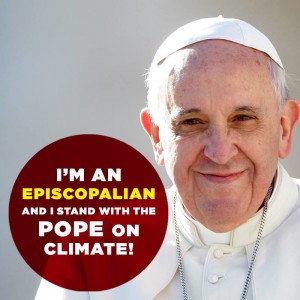
The Pope’s encyclical on the environment was officially released today, and I am relishing the response from both the secular and the religious climate movement. Surges of enthusiasm are rolling across the Internet like waves across the sea, and rivulets stream into my email inbox. Pope Francis’ landmark encyclical was addressed not only to Roman Catholics, nor only to Christians, but also to “every person living on this planet.” And all sorts of groups far and near are responding with invitations to Stand With the Pope. Hands down, the best invitation was extended by Forecast the Facts: name your identity and take your stand beside the Pope on climate. I’m a Mormon and I stand with the Pope on climate! I’m Buddhist and I stand with the Pope on climate! I’m a Republican… a pagan… an atheist… a Sikh… a Jew… a non-church-going Catholic… a Humanist… a parent… an Earthling… and I stand with the Pope on climate!
Guess what? It turns out that preserving a habitable world, caring for the forgotten and the poor, and honoring the Earth and its inhabitants, human and other-than-human, are values that resonate deeply with the human spirit, whatever our faith tradition may be and despite the lies that are peddled to us daily by the fossil fuel industry and by an extractive, exploitative, and consumerist culture. Climate change presents humanity with a decisive spiritual and moral crisis, and the papal encyclical has added precious momentum to messages that cut through the fog of inertia, denial, and political impasse and rouse the human family to unite in tackling the crisis before it’s too late.
It will take some time to absorb the comprehensive thinking that went into the encyclical, and I am grateful for the excellent analysis that some writers have already provided, such as James Martin, S.J.’s helpful essay on “Top Ten Takeaways from ‘Laudato Si.’”
Springfield Climate Justice Coalition meeting
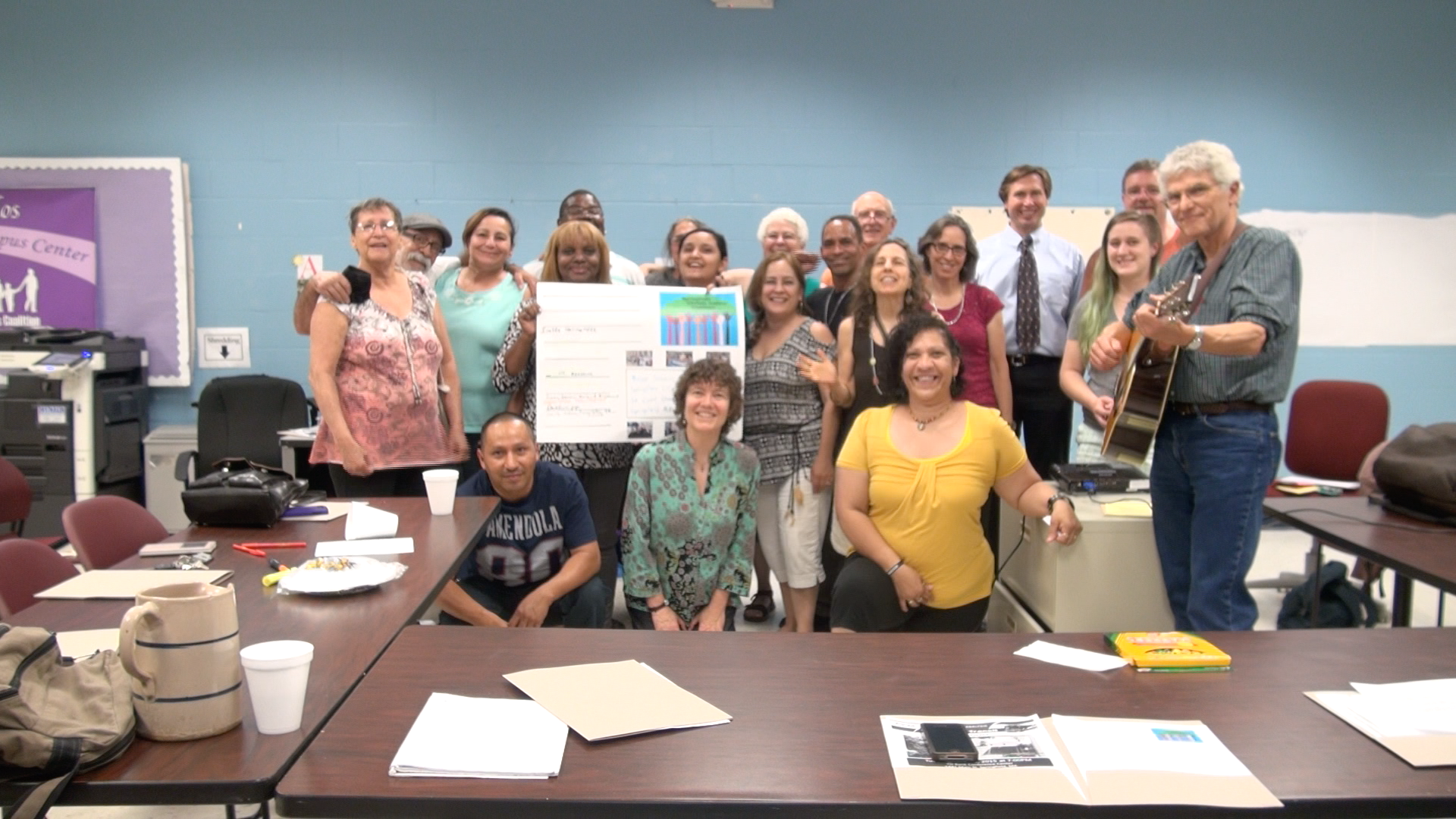
Meanwhile the urgent work to build a sustainable, just and peaceful world goes on. Last night I sat with a group of Springfield, Mass. residents who are acutely aware of the health impacts of climate change on their struggling city, and the particular burden that is carried by the poor. Across boundaries of race, class, and religious and ethnic background, this growing band of men and women is organizing to resist environmental injustice and to promote sustainability, resiliency and equality for all Springfield residents. Last night none of us in the Springfield Climate Justice Coalition had read the Pope’s encyclical, but tonight we can all take heart from the Pope’s understanding of the “immense dignity of the poor” (158).
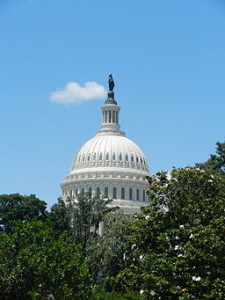
Capitol Building, Washington, DC
On Sunday I will travel to Washington, D.C., and will join about 900 other citizen volunteers – including a host of faith leaders – to lobby Congress for action on climate change. Our goal is to advance carbon fee and dividend as a solution acceptable to Democrats and Republicans alike. The Citizens Climate Lobby has made 3200 assignments, which means that every member of the House and Senate should receive a visit. How will it go? I have no idea. I’ve been assigned to meet with Republican politicians from Florida, Texas, Kentucky, and Illinois. It’s no secret that many conservative Republicans are staunchly opposed to regulating carbon emissions, and some of them began objecting to the papal encyclical even before it was released (I am grateful for the strong witness of my bishop, Doug Fisher of the Episcopal Diocese of Western Mass., who takes issue with their stance and speaks cogently about how Christians connect care for the Earth with care for the poor).
To prepare myself for lobbying on Capitol Hill, I inhale deeply, and breathe in the presence and power of the Holy Spirit. I ground myself in the love of God. I am strengthened when I recall the Pope’s thoughtful critique of unfettered capitalism, especially when it harms the poor. “Profit,” says the Pope, “cannot be the sole criterion” of our decisions (187). Christianity has a long tradition of advocating for economic justice, and I intend to carry that message forward.
Today the Pope released a groundbreaking document that urges reverence for all Creation, and justice and mercy for all its residents. Tomorrow men and women around the world will get out of bed with a renewed commitment to fight the good fight – to divest from coal, gas, and oil, to keep fossil fuels in the ground, to build a society based on fairness and generosity, and to provide a habitable world for our children, grandchildren, and generations yet unborn. I hope that one day we will look back and remember the Pope’s encyclical as the electrifying moment when humanity finally grasped that we have the power to bear witness to love, and the responsibility to protect the Earth upon which all life depends.
“We have been called to heal wounds, to unite what has fallen apart, and to bring home those who have lost their way.” — Attributed to St. Francis of Assisi
Pope Francis, Korea Haemi Castle (Commons.wikimedia.org)
We welcome the strong prophetic witness on climate change offered this week by His Holiness Pope Francis in his encyclical “Laudato Si’.”
Pope Francis addresses this encyclical to people everywhere: “Now, faced as we are with global environmental deterioration, I wish to address every person living on this planet…. In this Encyclical, I would like to enter into dialogue with all people about our common home.” We hope that indeed people of all faiths will heed his words and take action. As the Pope affirms, climate change is largely human-caused. In keeping with his commitment to the marginalized and vulnerable, Pope Francis emphasizes that climate change has especially devastating effects on the poor. Addressing climate change is an essential aspect of ethics. As individuals we must reduce our personal consumption of fossil fuels; as citizens, we must push for effective governmental and international action.
As ordained clergy and as members of the Better Future Project Board of Trustees, we applaud Pope Francis’ call to action. Since its founding in 2011, Better Future Project has been a leader in the climate action movement, empowering grassroots organizing through 350 Massachusetts and leading campaigns for divestment from fossil fuel companies, carbon pricing, and a shift to renewable energy in Massachusetts.
We believe that taking swift and responsible action to address climate change is an urgent moral imperative. Last September we walked with faith communities in the People’s Climate March, joining 400,000-plus people in the streets of New York. You might call it a kind of flood — not Noah’s flood, not the flood of a monsoon or hurricane, but a flood of loving determination, a flood of witness and hope for action on climate change. The climate movement is a flood of people calling for systemic change: for sharply reduced greenhouse gas emissions and for a swift transition to clean, safe renewable energy; for the protection of poor and vulnerable communities, for an end to fossil fuel subsidies, and for a strong international climate agreement in 2015.
Today we must choose between two floods: the flood of rising seas, or the flood of hopeful and courageous change. As Professor Mercy Oduyoye, an African theologian, has said, unless we take care of each other, we will lose our humanity; unless we become earth-keepers, we will be homeless.
Ban-Ki Moon, the U.N. General Secretary, has asked people of faith to urge bold action on climate change and to “provoke, challenge and inspire political leaders.” We celebrate the release of the Pope’s encyclical, which has done just that. We recommit ourselves to the struggle to provoke, challenge, and inspire political leaders and to mobilize a wave of religious activism to stabilize the climate, heal the Earth, and chart a course to a just and sustainable future.