I dreamed this week that our son Sam – now a vigorous young adult – was a baby again. He was only a few weeks old, a small babe lying on a bed, and I was bending over him, delighting in the sight of his soft skin, his tender face. Nearby, a rambunctious older child was roaming about, looking for trouble. The toddler boy was careless, clumsy, indifferent. I feared that Sam was in danger, and sure enough – the boy knocked Sam hard. Angry, I reached out quickly to protect him, but Sam was growing smaller before my eyes. He was shrinking. Now the older boy was clutching something like a rolled-up napkin in his fist. I pulled the napkin out of his hand, opened it, and saw that Sam, now tiny, had been crushed in the boy’s fist. Sam was barely alive and badly hurt. Overcome with horror and grief, I threw back my head and wailed.


I woke up wailing. I lay in bed and wept with a nameless, piercing sorrow. What was its source? Present-day Sam was fine – in fact, at that very moment he was participating in a triathlon. But dream-world Sam, the helpless baby, had been squeezed and squashed. My tears wouldn’t stop. I let them flow. I asked Jonas to hold me.
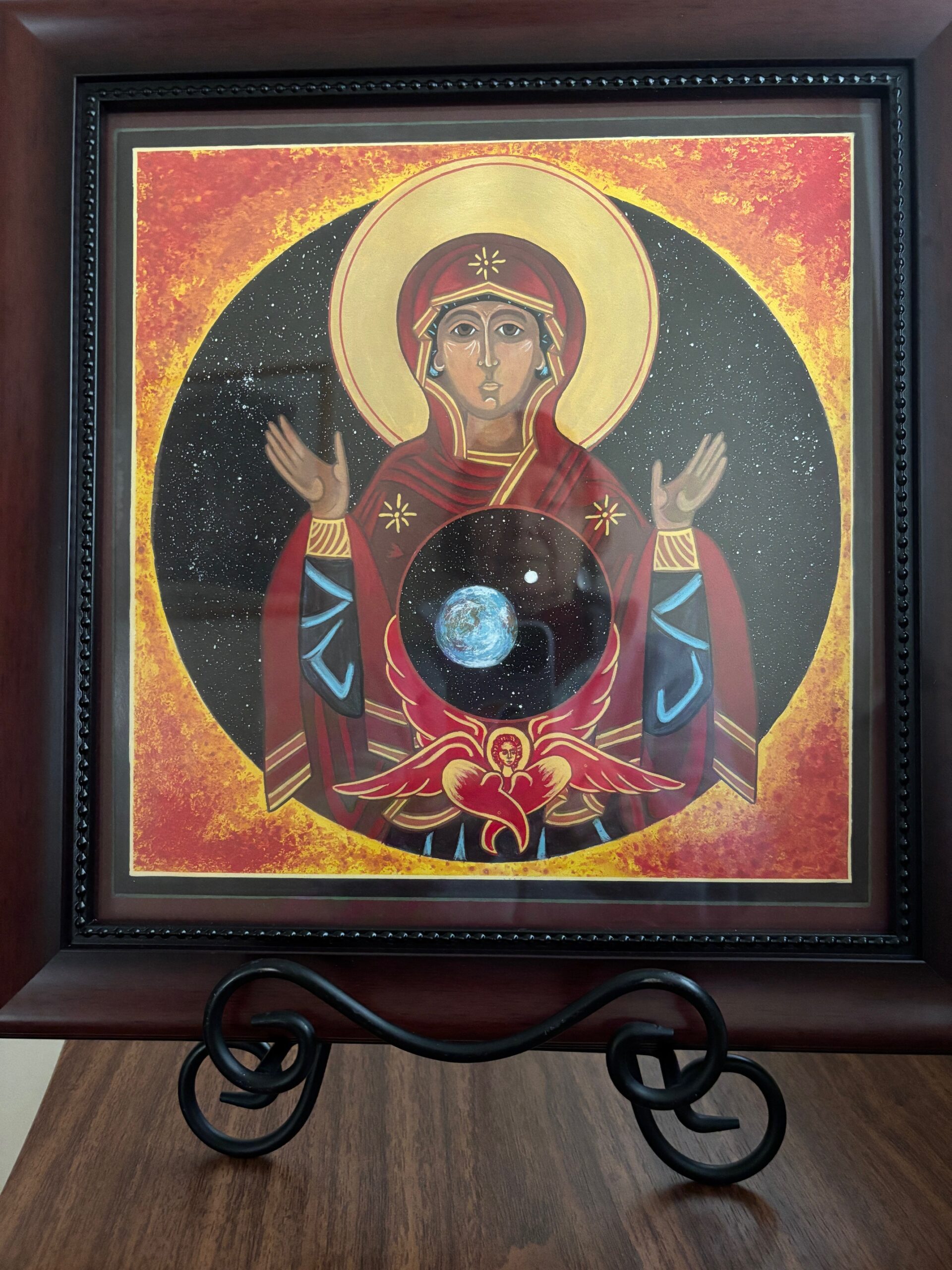
Mary of the Cosmos, by Sr. Bernadette Bostwick, sgm

Into a single great river of sorrow flowed all the small rivulets of grief I’d been trying to escape. I’d been bracing against the endless headlines – the unmitigated assaults on decency, honesty, and kindness, the wrenching-apart of human communities, and the efforts to scrape, burn, pierce, and suck dry every corner of the Earth.

As far as I know, there has never been a President who cares less about the natural world than this one does. Evidence arrives day by day: the announcement that the Boundary Waters (where I paddled as a teenager) are open to mining; the push to open millions of acres of the Gulf of Mexico to drilling; the push to auction off for drilling more than a billion acres of land across the country. In its haste to tear Earth apart and to squeeze every dollar into a few greedy hands, the administration is squeezing human beings into ever-smaller areas of habitable land and squeezing the life out of countless vulnerable humans and more-than-human beings. The Big Baby toddler – in all his careless, wanton destructiveness – is on the prowl.

Broken open by the dream, I lie in bed, weeping, and accept the sorrow of a mother whose child – and the innocence and sacredness that the child embodies – is being destroyed.

*********

I want to see the world with a mother’s eyes. An article in the New York Times describes how Pete Hegseth – who prefers to be called not secretary of defense but secretary of war – came to see moral purpose in war as weakness. Retribution and rage are his signature stances in the war against Iran, a war with no coherent goal and no exit strategy. Perhaps traumatized by his own experience of war, Hegseth simply wants, he says, to unleash “death and destruction from the sky all day long.” Near the end of the article is an image that took my breath away. A woman in a black chador stands alone on a desolate ridge with her back to the camera. She is looking at a churning landscape of smoke after a US-Israeli strike in Tehran. What Hegseth claims to see – that moral purpose in war is weakness – is completely different from what this woman sees.

I am reminded of the grieving women who watch as Jesus is crucified and who don’t run away. I print out the photograph and put it on my altar.

*********

In times of trauma, everything splinters and falls apart. We are destabilized, fragmented, broken to bits. I notice that my desk has become cluttered with little notes to myself: people to call, books to read, ideas to remember, quotes to save, bills to pay, tasks to finish, next steps to take. Helter-skelter, I preside over a confusion of bits. Where should I start, when everything needs to be done and everything needs to be healed? Where do I begin?

Before doing a thing, I must gather everything up – all these people and all these concerns – and hold them close to my heart. I remember Jesus’ lament over Jerusalem and how he longed to gather up the rebellious, wayward city as a mother hen gathers her brood under her wings (Luke 13:34).

Mother Jesus! Come to our assistance! Weave us together again as individuals, as a human community, and as humans who take their proper place in the larger community of life!

*********
In prayer I often sit these days with the icon Mary of the Cosmos, an image created by Sr. Bernadette Bostwick, a member of Sisters of the Earth Community at Green Mountain Monastery. The icon resonates with Pope Francis’ words in Laudato Si, “Mary, the Mother who cared for Jesus now cares with motherly affection and pain for this wounded world.” I consider how the universe flows through her, how she lifts up her arms in prayer, how she meets the viewer with a steady gaze. Above all, I notice how she embraces Earth and moon, holding everything together – our violence and pain, our longing and hope. There is nowhere we can go where her love does not go with us.

In the strength of her presence, we do what we can to love this Earth and to care for the vulnerable. Maybe we send hundreds of postcards to voters in Pennsylvania, Georgia, and North Carolina. Maybe we reach out to neighbors and build trust and connections. Maybe we exchange friendly words with the person at the checkout counter or strike up a conversation with the stranger waiting in line behind us. Maybe we create a family gathering or reach out to someone who is lonely or bereft. Surely, we prepare to join an event on Saturday, March 28, No Kings Day.

And when we grieve, we share in the Mother’s tears, letting our hearts open to the love that will never let us go.
Sermon for the Fourth Sunday of Advent                  December 20, 2020 Delivered by the Rev. Margaret Bullitt-Jonas for Grace Church, Newton, and Episcopal Diocese of Western Massachusetts Luke 1:26-38

                                   I put my trust in you

“Then Mary said, ‘Here am I, the servant of the Lord; let it be with me according to your word.’”   (Luke 1:38)  

Friends, I want to tell an Advent story1 that took place fifteen years ago.  In 2005, two massive hurricanes, strengthened by the unusually warm waters of the Gulf, slammed into Louisiana and Mississippi.  Millions of Americans were forced from their homes; within hours, most of one city lay in ruins. Soon after Katrina, some members of the wonderful church I served, Grace Church in Amherst, began organizing a service trip to Mississippi.  I was planning to go, but then I received an invitation to join a delegation of interfaith religious leaders at the upcoming United Nations’ climate change conference in Montreal.

The trips overlapped, and I couldn’t take both. I decided to head to Montreal, since I wanted to urge world leaders to address global warming before it was too late. So, for several days in Advent I met with representatives of the World Council of Churches; I listened to speeches, wrote editorials, and marched with seven thousand people through the city streets.  It was the most vigorous celebration of Advent I’d ever experienced, for the signs and banners sounded the urgent themes of the season: Now is the time to wake from sleep.  Now is the time to clean up our act, to sort out our lives, to cast away the works of darkness and put on the armor of light. That exuberant march was one of the gifts I received that Advent, a glimpse of the growing worldwide movement that draws upon humanity’s deepest reserves of hope.  The other gift came as a surprise, when I was alone in my hotel.  By then I was steeped in the stark reality of climate change.  I had studied the aerial photographs of Mount Kilimanjaro without snow; listened to climate reports from the Arctic to Argentina; heard survivors of Katrina describe the vulnerability of the poor.  As for my government, it seemed unable to take the issue seriously. After a restless night, I woke up gasping with sorrow and anger, needing badly to pray.  I pulled a chair to the window and let my anguish spill out before God – grief for what is irreparably lost, rage at the inertia that kills with such abandon.  I felt helpless.  Dear Lord, what can I do?  What can anyone do?  Then I heard something. I put my trust in you.
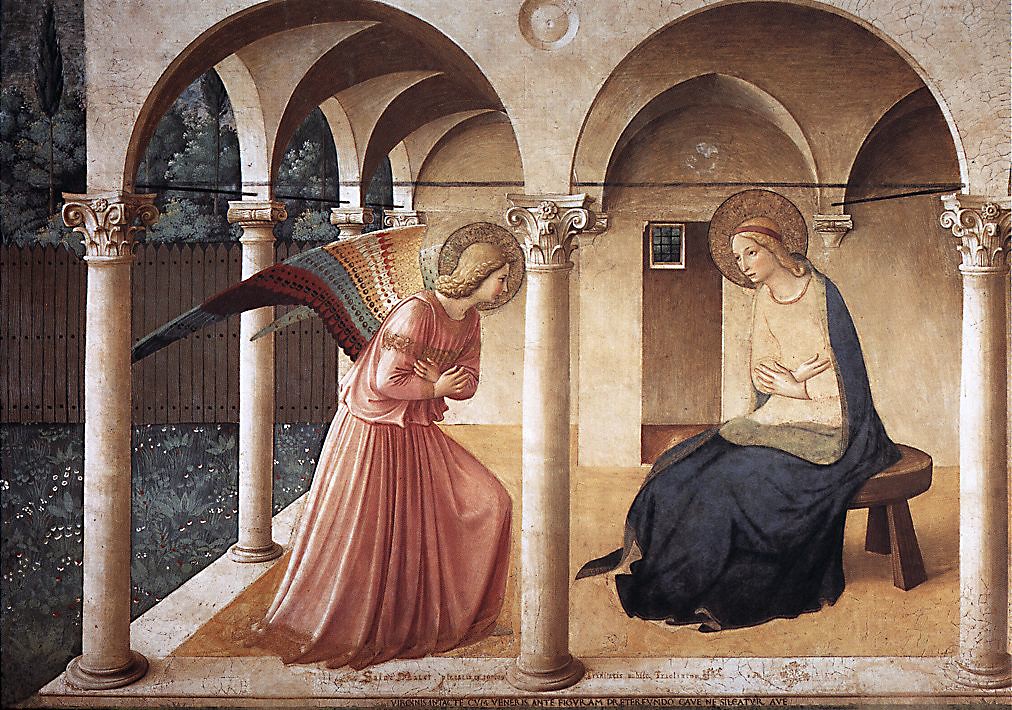
“ANGELICO, Fra Annunciation, 1437-46” by carulmare is licensed under CC BY 2.0
Startled, I opened my eyes and looked around.  Who said that?  I often say those words to God, but now the message seemed addressed to me.  Its meaning was: Fear not.  Keep going.  I am with you. How bizarre.  Was there some mistake?  I had a choice: to accept or reject that assurance, to believe it or blow it off.  What I heard came as a complete surprise, just as God’s message to Mary was surely a surprise: you will conceive by the Holy Spirit; your son will be the savior of the world. Absurd!  Yet God’s hope for the future hung on Mary’s willingness to consent.  Maybe it hangs on our willingness, too.  Who knows how many messages God delivers daily to the countless faithful of every religion, and of none?  Trust the good, wherever you find it.  Trust the truth.  Trust love.  Trust yourself.  Let my life be born in you.  Who knows what power will be released in us when we dare to believe those unseen encounters that offer a word of love? Here on the Fourth Sunday of Advent, we know that climate change is intensifying, causing wetter, stronger and more destructive storms.  We know that we endured a historic hurricane season in the Atlantic this year, with an unprecedented number of named storms and with Hurricane Eta and Hurricane Iota crashing one after another into Nicaragua and Honduras.  We know that record concentrations of greenhouse gasses are filling the atmosphere and that 2020 is on track to be the hottest year on record. We know that we also face a host of other challenges, including protecting our democracy, establishing racial and economic justice, and solving the pandemic. But we know this, too: There is a love that wants to be born within us and among us, a love that knows no bounds. Right here, in the midst of our lives exactly as they are, Christ longs to be born again, perhaps at a deeper level than ever before. Christ yearns to make a home in you, in me, and in us all.  The birth of that divine love is what will give us the strength and courage to meet whatever comes with creativity and clarity and kindness. Still, when love draws near, we may feel an urge to hold back. We may hesitate, wondering: “What will happen if I give myself fully to that love?  What will I do?  Who will I become?”  We may say to ourselves, “Really, I do want God to come into my life, but let’s not get carried away!  I’m kind of used to being who I am. There’s something to be said for staying in control.  It’s risky to let go.  I’m not sure.  Let me get back to you.” Can you feel the pull between attraction and fear, between trust and hesitation?  Like every love song, the love song between God and the soul is about longing and resistance, about desire and holding back.  If we could put words to it, the conversation might go something like this.  Here is a poem (“Covenant”) by Margaret Halaska, a Franciscan nun:                             The Father                 knocks at my door    seeking a home for his son:             Rent is cheap, I say.  I don’t want to rent, I want to buy, says God.             I’m not sure I want to sell, but you might come in to look around. I think I will, says God.             I might let you have a room or two.  I like it, says God.  I’ll take the two. You might decide to give me more some day.             I can wait, says God.             I’d like to give you more, but it’s a bit difficult.  I need some space for me. I know, says God, but I’ll wait.  I like what I see.             Hmm, maybe I can let you have another room.             I really don’t need that much.  Thanks, says God.  I’ll take it.  I like what I see.             I’d like to give you the whole house             but I’m not sure — Think on it, says God.  I wouldn’t put you out. Your house would be mine and my son would live in it. You’d have more space than you’d ever had before.              I don’t understand at all. I know, says God, but I can’t tell you about that.              You’ll have to discover it for yourself. That can only happen if you let him have the whole house.             A bit risky, I say. Yes, says God, but try me.              I’m not sure –              I’ll let you know. I can wait, says God.  I like what I see. You’ll notice that God does not force or compel, because that is not the language of love.  God simply waits and longs and asks to draw close.  When we dare to say Yes, Christ is born again. Two thousand years ago God entered human history and became one ­of us, one with us. God came then, and God comes now, because God longs to join us on our journey, in our daily life and relationships, in our pain and worry and hope. In these turbulent times, when so much hangs in the balance, will we consent to God’s birth within us?  Like Mary, will we say, “Here am I, the servant of the Lord; let it be with me according to your word”? I invite you to close your eyes and to join me in praying to the Holy Spirit: “Come.  Come into my life, just as it is, and help me find my way to You.  Help me step through my fear, my anxiety, my worry, my need to be in control.  Help me find You in my ordinary, everyday living.  I trust You more than I trust myself, and I thank you for your trust in me.” Amen. ___________________________________________________________________________________________________
  1. For a longer version of this story, see Margaret Bullitt-Jonas, Joy of Heaven, to Earth Come Down: Meditations for Advent and Christmas (Cincinnati, OH: Forward Movement, 2012, 2013), 54-60.