Faith and fear duke it out
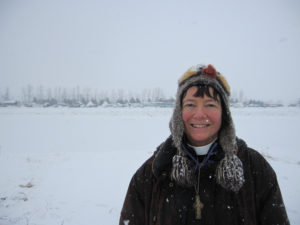
I am not a brave person. In fact, I am quite familiar with anxiety. I know what it’s like to wake up wide-eyed in the middle of the night, imagining the future with dread. Deciding to go to Standing Rock was not easy.
I heard in late November that Chief Arvol Looking Horse was urging people of faith to travel to Oceti Sakowin Camp for a day of prayer on Sunday, December 4, 2016. I considered this a holy invitation. It spoke to my conviction that the Earth is sacred. It spoke to my desire that we learn to live in peace with each other and with the Earth on which all life depends. It spoke to my longing to bear witness to our God-given hope that life and not death will have the last word.
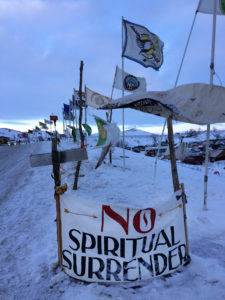
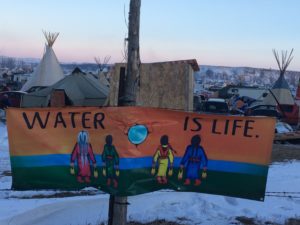
I knew that the protest against the Dakota Access pipeline was historic. An extraordinary wave of solidarity was sweeping the world, as hundreds of once-estranged tribal nations and jurisdictions stood with the Standing Rock Sioux and proclaimed with one voice that water is sacred; water is life. Thousands of Native and non-Native people had already come to the camps near the Missouri River to resist construction of a pipeline that would endanger the river, Native lands, and the whole of Mother Earth.
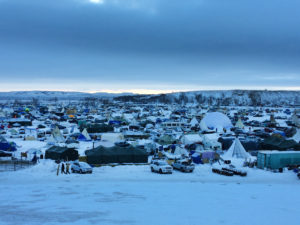
What’s more, a showdown was now at hand. Energy companies had invested billions of dollars in the project; only one mile of pipeline remained to be built; the year-end deadline for completing the pipeline was just weeks away; and – though the announcement was amended almost as soon as it was issued – December 5 could be the day when the camp would be forcibly evacuated.
Strong emotions and commitments pulled me toward Standing Rock for the Interfaith Day of Prayer on December 4, but anxiety nudged me to say No. I talked it over with a friend – a religious leader and climate activist who had been arrested with me last May in a pipeline protest here in Massachusetts. We agreed that making a trip to Standing Rock was too risky. The brutal North Dakota winter was too cold. The night was too dark. The militarized police were too violent, armed with rubber bullets, guard dogs, pepper spray, and water hoses that the police willingly sprayed in frigid temperatures. Hundreds of unarmed “water protectors” had already been injured,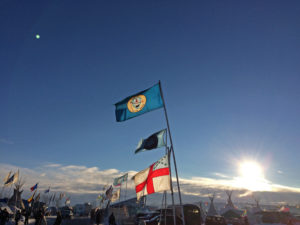
The next morning I got a phone call from another friend, Unitarian Universalist minister and climate activist, Rev. Fred Small. He was going to Standing Rock that weekend. Would I join him?
I didn’t know whether to laugh or groan. Not you again, Fred. Fred is my burning bush. Like the burning bush that stopped Moses in his tracks, Fred has interrupted me several times over the years to invite me to do something righteous but scary. Oh no, not again. I told him I would pray about it.
But I was too anxious to pray. I asked my beloved husband if he would listen to me talk through the pro’s and con’s. In his attentive presence I enumerated the reasons to go, including my desire to bear witness to the sacredness of God’s creation and my desire to stand with non-violent, unarmed people at the place where the struggles for indigenous rights, human rights, economic justice, climate justice and care for the Earth intersect.
In the end, the allure was simple: I wanted to pray. I wanted to pray with Chief Looking Horse and the other Native elders. The call to pray was in my belly, like a fire.
“OK,” my husband said. “The pro’s are clear. How about the con’s?”
To my surprise, a long silence followed. I had nothing to say. The reasons not to go to Standing Rock boiled down to a single one: Fear. I looked Fear over, top to bottom. I was not impressed. Fear did not seem a reliable foundation upon which to base a decision. Besides, compared to the strong, embodied pull to go, the fear that begged me to stay was as flimsy as mist: I could blow it away with one Spirit-filled breath.
I arranged a plane reservation for Bismarck, joined a conference call (hosted by Unitarian Universalist ministers) for clergy going to Standing Rock, and assembled winter gear. I hoped to meet Fred Small on Sunday for the Interfaith Day of Prayer, but the rest of the trip I would make on my own, since my husband did not feel called to come.
I refused to let fear stop me, but fear was still prowling about. I couldn’t chase it away, so I decided to accept it. “Be not afraid” may be one of the great messages in the Bible, but a worried person who is trying to do something difficult may not find these words especially comforting. Fear can’t always be so quickly dismissed. I took greater solace in remembering that Jesus himself felt anguish before his crucifixion (Luke 22:44), yet did not flee. He managed to pray through the fear and to keep his heart steadfastly fixed on what he felt led to do. Audre Lorde got it right: “When I dare to be powerful, to use my strength in the service of my vision, then it becomes less and less important whether I am afraid.”
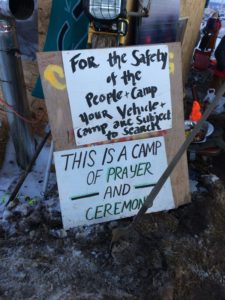
At night I slept as best I could, in fits and starts. A few days before the trip, a man I did not know sent me an email: he’d been on the conference call and knew that I was going to Standing Rock; could we connect on the ground in North Dakota? Sure, I impulsively replied – let’s share the rental car and travel together.
That night I tossed and turned and finally sat bolt upright at 3 a.m. Have you lost your mind? You know nothing about this guy. For all you know, he’s a serial rapist or an ax murderer. I leaped out of bed, turned on the computer, and launched a Google search. Michael Arase-Barham turned out to be an Episcopal priest from California who had received a Doctorate of Ministry in the spirituality of pilgrimage. That seemed a good sign. Plus he had the friendly, bearded face of a Friar Tuck. OK, I would risk it. Jesus sent out his disciples two by two, and I needed an ally along the way.
I packed my bags. I flew to Bismarck.
Faith and doubt duke it out
Michael turned out to be a stellar fellow pilgrim. In the course of the journey, we exchanged supplies: he gave me toothpaste; I gave him hand warmers. He peered into his cellphone and did the 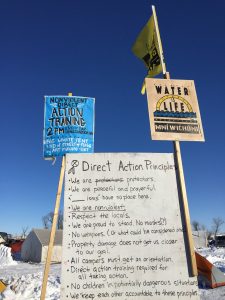 navigating; I peered into the darkness and did the driving. At one point, when the car got stuck in snow on the side of the road, he got out and pushed us to safety. And he loved to pray. I have never met a person more devoted to the daily round of services provided by our Book of Common Prayer. As we drove from Bismarck to Fort Yates (population: 195), he led us in Evening Prayer and Compline. That night, along with other pilgrims from far-away places, we slept on the floor of St. Luke’s Episcopal Church. Early the next morning, on Sunday, December 4, we made our pre-dawn drive to the camp. Michael led us in Morning Prayer.
On the way, I asked him to read the Magnificat (Luke 1:46-55). When a great battle lies ahead or is already underway, nothing is more beautiful to pray than Mary’s song of praise to the God of justice and mercy who scatters the proud in their conceit, lifts up the lowly, fills the hungry with good things, and sends the rich away empty. Mary bursts into song because she is bearing the Christ-child, the one whose long-ago birth we celebrate at Christmas and who is born among us every time we allow divine love to fill us, guide us, and act through us, making all things new.
Michael and I drove toward Oceti Sakowin Camp in the company of a long stream of cars. Rounding a turn, we caught sight of the camp, up ahead: hundreds of tents, tepees, and yurts sprawled across a field of snow, with tall rows of flags lining the dirt road that cuts through the center of the campground. We found a place to park inside the camp, and headed toward the sacred fire.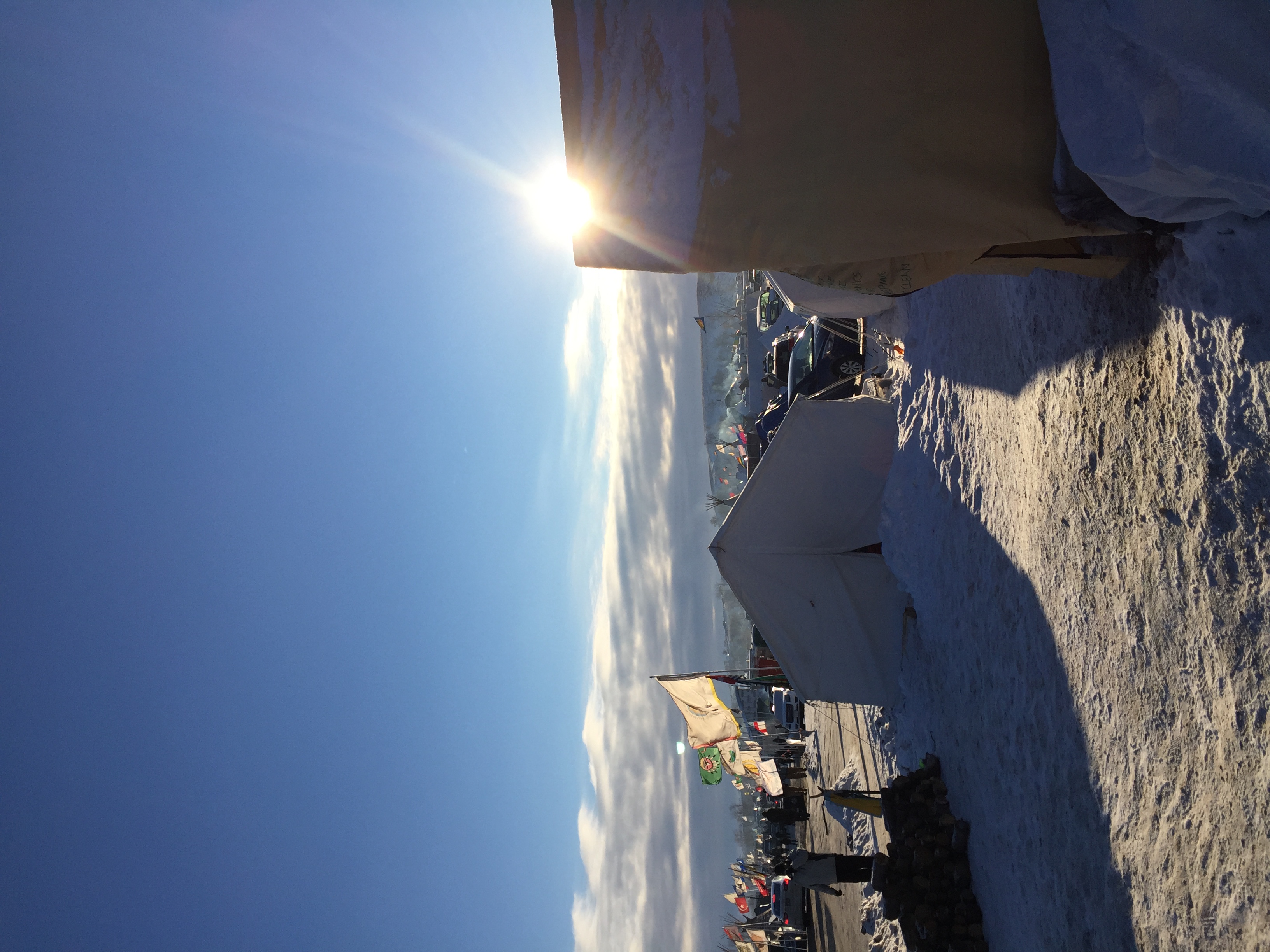
I soon learned that nearly everything of importance at the camp takes place around the fire, which never goes out: storytelling, singing, dancing, drumming and praying. Daily activities are steeped in prayer, rooted in appeals to the Creator and to Mother Earth, the grandmother of everything. As we arrived, Native people were taking turns at the microphone near the fire, welcoming newcomers, offering coffee, and reviewing the painful history of indigenous peoples in this country: devastating wars, land grabs, broken treaties, shattered cultures, murders, betrayals. For these Native people, the weight of the past is palpable, sorrowful, dark, heavy, and immediate. Their current fight to protect sacred lands and water (“blue gold”) and to stop the pipeline (the dangerous “black snake” that legend foretold) is an extension of their long struggle against genocide.
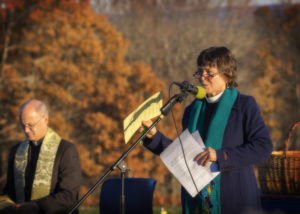
On that Sunday morning the interfaith prayer service began at 10 a.m., attended by a large crowd that included clergy from more than thirty religious traditions. Speaker after speaker came forward to speak or sing or pray. Rev. Karen Van Fossan, a UUA minister in Bismarck, led us in singing a rousing version of “As I went down to the river to pray,” concluding with a prayer to “Give us the courage we need, and the hope that comes from courage, and the courage that comes from hope.”
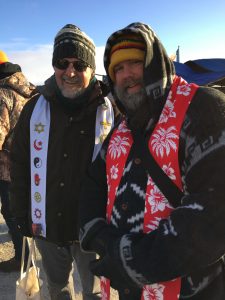
Rev. Victor Kazanjian, Executive Director of United Religions Initiative, came “in a spirit of sorrow,” acknowledging religion’s “atrocities” to the Native peoples, seeking forgiveness, and bringing with him thousands of prayers for the Standing Rock Sioux from 56 countries around the world. He also brought water collected from 167 sacred water sources. He noted that these waters mingled together without separating into ‘higher’ and ‘lower’; in this, he said, they expressed “the beauty of all humanity.” Water is essential to life and to the human body. “The struggle for water,” he said, “is the struggle for the essence of our being.”
Dr. Cornel West spoke with passion about prayer as a form of reverence and a form of resistance. “I call it revolutionary love,” he proclaimed, adding: “Justice is what love looks like in public.” He pointed out that this was an historic moment. The Dakota Access pipeline is a continuation of the war against our indigenous Native brothers and sisters that began more than 520 years ago and that is still underway. He argued that we should never say that the harsh treatment of Black people was America’s Original Sin. “The enslavement of Black people was the second Original Sin.”
Muslims, rabbis, Buddhist and Hindu leaders spoke, as did Methodists, Roman Catholics, members of the Society of Friends, local Native leaders, and Native leaders from distant countries. Lewis Cardinal, Chair of the Indigenous People’s Task Force of the Council for the Parliament of the World’s Religions, spoke for us all when he said, “We stand here together on this day, at this time, brothers and sisters all, and with our Mother.”
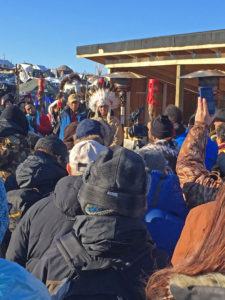
The service went on for hours – urgent and prayerful, scented with wood smoke and sage – yet we could never forget that we were standing in something like a war zone. A helicopter and a small plane kept buzzing noisily overhead, a constant harassment. For now, we ignored these reminders of the police, the corporate powers, and the politicians bought and paid for by the fossil fuel industry: we had our own healing work to do with each other. As one Native speaker put it, the Church had told his people that they were devil worshipers and that they would go to Hell. For now it was enough to absorb the miracle that people of every faith, including members and leaders of many Christian churches, were today standing as one with Native peoples, praying as one, cherishing the Earth as one, greeting each other as equals, as kin, and joining the shared struggle to protect our common home.
Another level of healing was going on, too: Native speakers were welcoming and thanking the thousands of U.S. veterans who had traveled to Standing Rock to stand with the Sioux. It astonished me to imagine the reconciliation of Native peoples with members of the U.S. military. I gasped when I heard a bugle play Reveille and other military calls, the sounds that had once preceded or accompanied attacks on Native communities. The former enemies of Native peoples were now inside the camp, seeking forgiveness, offering support, and no longer intending harm.
Near the end of the service, a Native speaker told the crowd that his grandfather had died in 1890 at Wounded Knee, the brutal massacre of Sioux warriors, women, and children by American soldiers on the Plains of South Dakota. The speaker added: “Crazy Horse said that the Sacred Hoop was broken at Wounded Knee.”
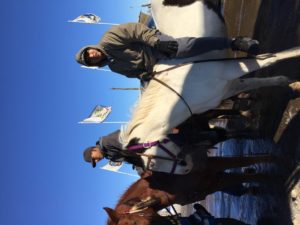
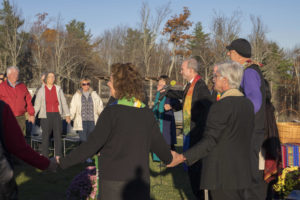
Then Chief Looking Horse stepped forward. It was time, he said, to mend the Sacred Hoop. The original plan for the afternoon had been for clergy to walk up to the police barricade, but now, he said, the plan had changed. Instead, everyone at the camp was going to move clockwise, on foot and on horseback, out to the far edges of the camp. There we would form a great circle, hold hands, and pray. People all over the world would be praying with us.
He pulled out an eagle bone whistle. “I will call the eagle to come.”
He blew the whistle. “We are one heart,” he said. “We are one mind. One prayer. One spirit.”
Half expecting an eagle to appear, I looked up. I wanted an eagle to come upon us like a vision, like a sign, but nothing happened. The sky was empty of life. Instead of hearing the whoosh of wings overhead, or the cry of a bird of prey, all I could hear was the chop of helicopter blades.
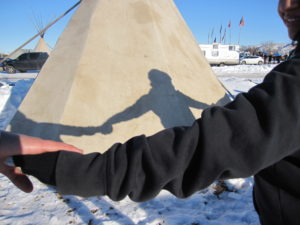
The crowd began to disband. Dispirited, I began walking with Michael toward what I took to be the nearest edge of the camp. I had no clear idea where we were going or what we would do when we got there. Why had the chief entrusted the crowd with this ceremony? And what sort of ceremony could it be? As an Episcopal priest, I was used to leading orderly services carried out indoors with clear lines of authority, assigned seating, and probably a service leaflet. Sounding more disgruntled than I intended, I only half-jokingly muttered to Michael that if this were an Episcopal liturgy, we would hold a rehearsal and figure out in advance where to stand, where to sit, and what to do. By contrast, this thing was completely chaotic. We ran into stragglers who hadn’t heard about the prayer circle. Would they join us? We saw people pausing to stand in line for the Port-a-Potty or to grab a bite to eat. Would they get distracted, forget about the ceremony, and move on to something else? Would enough people stay faithful to our prayerful task or would people simply drift away and let the effort peter out?
I confess it: my doubt sprang not only from discomfort with a spontaneous, disorderly ceremony that involved hundreds of people. It also sprang from not wanting to depend on other people to get the job done. I didn’t want to depend on their goodwill, their capacity to pay attention, or their ability to follow directions. I didn’t think we could complete the ritual. I didn’t think we could pull it off. I had no faith in my fellows. I was filled with doubt.
Doubt is a terrible thing. It undermines hope and resolve. But the only way to get mighty things done is to do them together, learning to trust each other and to suspend our doubts. Fortunately I was as stubborn as I was doubtful. If I didn’t carry out my own part of the mission, why should other people carry out theirs? And if we didn’t finish this task together and today, would it ever be accomplished? Despite my doubts I stubbornly kept on walking, kept on heading to the edge of camp, kept on reaching out for hands to clasp. I wanted this prayer-circle thing to work.
So, it turned out, did everybody else.
It took a number of adjustments. Should we stand close to the Cannonball River or should we stand further away? Were we the only string of people holding hands in this corner of the camp? If so, should we stand still and wait for other people to find us, or should we search for another string of people to meet up with and join?
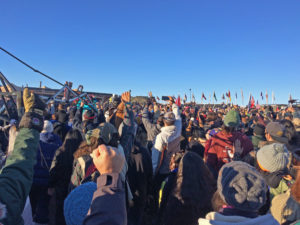
Young Native Americans trotted by on foot, offering words of encouragement, as good at their job as any Verger in an Episcopal cathedral. Don’t let go! We’re almost there! Step this way! No, not that way – this way! To your left! To your left! Don’t let go your hands! We’ve almost got it!
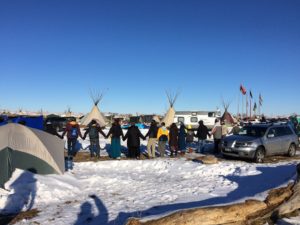
Our line of people stumbled sideways, laughing. We took careful steps backward until our arms were fully outstretched and our hands firmly clasped. Excitement rose. As we waited for other parts of the circle to form, strangers introduced themselves to each other. Here on my right was Michael, and then two Quaker women from upstate New York, both of them long-time activists; here on my left was Allison, a young Native American from Minnesota who was visiting the camp for the third time.
Person by person the circle was woven, until at last we could look out and see a distant line of people holding hands in what seemed like the far-off other side of the world.
We’d done it! The circle was complete! The Sacred Hoop was mended!
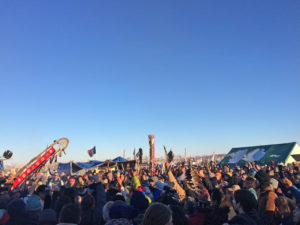
But, as if that weren’t marvel enough, it was just then that a young Native messenger came bounding past. “Denied! Denied!” he yelled. “The pipeline permit has been denied!” He was breathless with joy.
What? We fell into startled silence, looking at each other. Doubt arose. I murmured to Michael, “I need some kind of confirmation before I’m going to believe that.”
Someone else appeared and repeated the good news. Was it possible? What did it mean? Did we dare to trust what we were hearing? We released hands and headed back to the sacred fire, our jubilation growing as we drew closer and heard the drumming and singing that had already begun. The good news was true: the U.S. Army Corps of Engineers had denied the final permit that allowed the Dakota Access pipeline to go under the Missouri River at Lake Oahe.
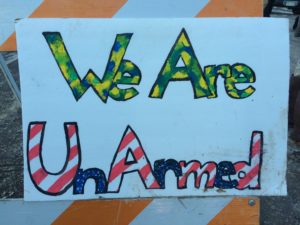
This is what elation sounds like: drumming, chanting, singing. This is what elation looks like: a crowd of people swaying and dancing, with individuals – even strangers – looking into each others’ eyes, wiping away tears, and exchanging an embrace. I joined in the two-step dance around the sacred fire. We danced just as every soul dances when forgiveness, justice, and mercy extend in every direction. We danced because sight had been restored to the blind and captives had been set free. We danced because the mighty had been cast down from their thrones, the lowly had been lifted up, and strangers had become friends.
“My soul proclaims the greatness of the LORD,” sings Mary in the Magnificat. “My spirit rejoices in God my Savior; for he has looked with favor on his lowly servant…”
In between chants, drumming, and songs, Native speakers took turns at the microphone. Repeatedly they thanked the millions of people worldwide who had expressed support, the thousands who had visited the camps, the tens of thousands who had donated time and money to the struggle to stop the pipeline and protect the water.
Someone said, “Never before have we been at an intersection where everyone is here. It is a strange turn of history when the people taking care of us are the military of the U.S. government.”
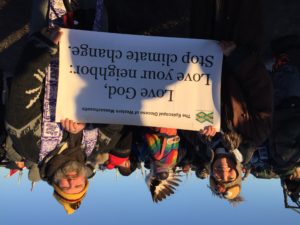
Someone said, “We’ve come to this huge, giant ceremony being hosted by Mother Earth.”
Someone said, “I want to thank the person that loves spirituality. I want to thank the person that loves Mother Earth.”
Someone said, “We still have a lot of praying to do. We are not done yet. We are going to keep fighting. We will pray for the Governor” (and he named other individuals that want to build the pipeline). “They do not seek the Spirit in their hearts yet. We will pray for the ones who want to destroy.”
Someone said, “This is about more than a pipeline. This is the beginning of the world united.”
The celebration went on for hours. We knew that the battle was not over: the company behind the Dakota Access pipeline fully intends to complete the pipeline, and our President-elect seems hell-bent on extracting and burning every last ounce of fossil fuels. But for now it was enough – it was more than enough – to touch the deep truth that we belong to each other and to the Earth – to know in our bones that every person is sacred and every community is sacred, that the web of life is sacred, that the Earth is sacred.
It seems to me that we didn’t just mend the Sacred Hoop that day. We were becoming the Sacred Hoop that was no longer broken.
By the fire
On December 5, what I’d feared might happen – violence, forcible evacuation, even massacre – did not take place. Instead, a second ceremony of healing was carried out: the son of General Wesley Clark stood with the veterans and apologized for the centuries of genocide perpetrated by the U.S. military. Coming, he said, “as the conscience of a nation,” he knelt before Leonard Dog Crow, confessed the military’s sins, and asked for forgiveness. Forgiveness was granted. (A brief video is here.) In these dark times, when fear and doubt threaten to tear so many communities apart, a light shines out from acts of reconciliation like these!
Michael and I returned to the camp that morning. After agreeing to meet again at the sacred fire, we went our separate ways and explored on our own. I wanted first to go up high. Picking my way through patches of ice, I climbed the small hill overlooking the camp and gazed into the distance, looking out over the helter-skelter assortment of teepees and yurts, vehicles and flags. Here we all were – a diverse company drawn together by a fierce and spirited longing for justice and healing.
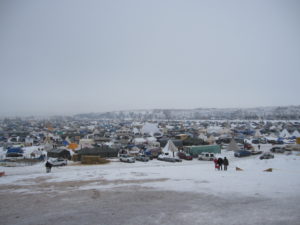
Carrying this image with me, I made my way downhill and walked back to the fire. Small logs were aflame in the shallow, circular pit. A few people were sitting on benches, talking quietly or sitting alone in silent prayer. Bundles of lavender were placed around the rim of the circle, and at the circle’s entrance were bowls of tobacco and juniper sprigs, along with a turtle shell, small skulls, feathers, and sage.
I don’t know the religious traditions of the Lakota Sioux. I was touched that an outsider like me was welcome to participate in their ceremonies. I knelt to take a pinch of tobacco, a bit of juniper. As I cradled these offerings in my palm, a prayer of gratitude gradually collected within me. When the time was ripe, I cast what I was holding into the flames. Then I sat for a while and watched the fire. Gazing down, I could almost see the fire extending deep into the Earth. I could almost see the fire reaching down like roots in every direction and catching up everything it touched. The longer I gazed, the more it seemed as if that strong and living fire could ground our every step on Earth, could be inhaled with every breath of air, and could bring warmth to every human heart.
On our way home
The first flakes of snow were falling. By early afternoon, when Michael and I began our trek back to Bismarck, a ferocious blizzard was beginning to roll in from the Arctic. Eventually the winds would gust up to 50 mph, wind chills would drop to nearly 20 below zero, and the camp would be buried in snowdrifts up to 7 feet deep. For now I simply kept a gentle, wary foot on the accelerator and squinted into the white landscape of driving snow, trying to locate the next piece of highway. When I heard the tires hit one of the rumble strips on either side of the road, I’d hazard a guess: should I make the correction by steering left or right?
“Lord, have mercy. Christ, have mercy,” I silently prayed, my fingers clutching the steering wheel. Which was worse – sliding into a ditch or into oncoming traffic? Sometimes it’s no small thing to keep to your chosen path.
Michael seemed unperturbed. “Shall I read Noon Day Prayer?” he asked, cheerfully, pulling out his prayer book.
“No, thanks,” I answered through clenched jaws. “You go ahead. I’ll just listen this time.”
Threading our way through love and fear, we prayed our way home.
Resources
“Mni Wiconi: The Stand at Standing Rock” is a moving 9-minute video that sketches the root causes of the conflict. Mni Wiconi means Water is Life in the Sioux language.
A few articles about religious aspects of the witness at Standing Rock:
General:
“The Dakota Access Pipeline isn’t just about the environment. It’s about religion,” by Sarah Pulliam Bailey, in The Washington Post (12/5/16)
Episcopal:
— “Water protectors, supporters rejoice over victory for Native Americans; Federal government stops pipeline from crossing Sioux tribe’s water supply,” by Lynette Wilson (12/5/16)
— “Standing Rock ministry stands resolutely with Sioux Nation’s cause,” by Mary Frances Schjonberg (11/28/16)
— Last September, Presiding Bishop Michael Curry traveled to Oceti Sakowin camp and preached that the pipeline protest could become “the new Selma.” (Article and video is here.)
United Church of Christ:
“With Standing Rock: Be the Church,” by Brooks Berndt (11/1/16)
Roman Catholic:
“Finding a Home at the Dakota Access Pipeline Camp,” by Michael J. Shuck, in America Magazine (12/8/16)
Sojourners:
“I witnessed the revolutionary love of Jesus at Standing Rock,” by Shane Claiborne (12/6/16) (Sojourners has provided many good articles about Standing Rock)
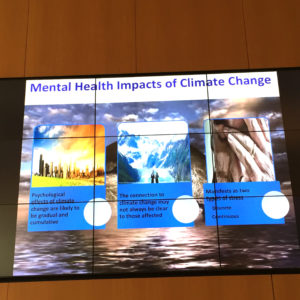
 Each of you probably has your own favorite “go to” strategy for avoiding your feelings. Here are a few popular methods. Some of us get into our heads and give all our attention to mastering the facts – we intend to stay on top of every last fact about the rate of melting ice, every last bit of awful climate news, every single detail about the terms of a Senate bill. Don’t get me wrong: I’m all for mastering essential facts and for educating ourselves and staying informed. But sometimes we can get so busy using our wonderful brains to analyze, memorize, conceptualize, and so on, that we lose touch with our inner landscape. Then we wonder why we’re so short-tempered or why we woke up with insomnia or why we got into a car accident. It’s only when we’re connected with our feelings that we have access to our emotional intelligence, to our intuition and moral imagination. When we get into our heads and lose contact with our greater intelligence, we forget who we are and we act, as Joanna Macy puts it, like “brains on a stick.”
 Serving as your Missioner for Creation Care has not been boring. Not once. The job challenges me, provokes me, and asks me to be creative and resilient and get out of my comfort zone. It keeps me on my knees, depending on the power of the Holy Spirit, and it keeps me on my feet, heading out to do things I’ve never done before.
 These are questions I tackle every day when I preach at churches, large and small; when I offer workshops; when I speak at rallies and prayer vigils; when I write blog posts and articles; when I lobby; when I lead retreats. This past year I’ve sometimes felt like the character in that book by Dr. Seuss, Oh, the Places You’ll Go!. I’ve found myself in all kinds of places.