Faith-based environmental activism can take many forms. Your event could be small: a handful of people gather one evening outside a church, holding candles and praying for upcoming U.N. climate negotiations. Or your event could be large: hundreds of people share a multi-faith worship service at which they sing, preach, and pray about caring for Earth.
Your event could be simple: a panel of speakers from different faith traditions discusses the spiritual foundations of environmental activism. Or your event could be complex, with multiple components: maybe an interfaith crowd will gather to sing, speak, and pray on the steps of your State House, hold a procession inside, carry out more speaking and singing at your Governor’s office, and then spread out for an afternoon of lobbying. Your event could be even more ambitious than that: it could, for instance, launch with an interfaith service and continue with a pilgrimage across your state, pausing as you hold educational events along the way and sleep on the floor of houses of worship; it might conclude with a large, interfaith service indoors, followed by a public rally outdoors.
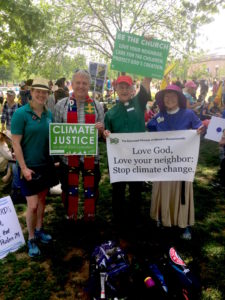
Your faith-based event could be legal or it could include non-violent civil disobedience. It could be a stand-alone action or it could weave itself into something larger, such as the 10,000 people of faith who marched together in the People’s Climate March in 2014, joining a river of hundreds of thousands of people who coursed through the streets of New York City.
Whatever form it takes, your event will require planning. Here comes a list of thirteen steps for carrying out an effective and memorable faith-based environmental action. Please add your own suggestions at the bottom of this post!
1. Gather and tend the seeds
Someone has the seed of a brilliant idea (“Let’s carry out civil disobedience on Good Friday to stop new pipelines in our city.” “Let’s walk across the state to raise awareness of climate change.” “Let’s honor the sacredness of water by paddling downriver, praying all the way.”). Welcome your seeds of inspiration. Gather a group of friends, test and refine your ideas, generate more ideas, and see who has time and energy to join a planning team.
2. Only connect
Who else needs to be included in designing and carrying out the event? How wide a circle do you want to cast? Who are your potential allies? This part of the process may take a good deal of time, thought, and relationship building.
You will need to decide if you want to create an event for people of just one faith tradition, for people of several faith traditions, or for people of all faith traditions. Because so many folks no longer identify with a particular religious tradition, considering themselves “spiritual but not religious,” you may decide to promote your event as being “for all people of faith and good will.”
You will need to decide if you want the event to be led by clergy and other recognized religious leaders, and, if so, if you want those leaders to be locally known and grown or to have a wider following.
You will need to decide if, and to what degree, “your” event is open to being shaped and led by other stakeholders. For example, if you are middle-class and white, are you open to meeting with people of color and to low-income and immigrant communities as you muse on a potential action? Will you listen to their needs and hopes? How will they be included as participants and leaders? Again, if you are middle-aged and older, how will you engage youth as participants and leaders? If you are part of a “mainstream” religion, will you reach out to indigenous religious leaders? How will you take into account the needs of the differently abled, such as those who are deaf or hard of hearing, or those who need an accessible walkway?
Creating an interfaith environmental event provides a precious opportunity to build relationships across boundaries of age, race, and class, and to respect “intersectionality,” that big mouthful of a word that acknowledges that different forms of oppression (such as race, class, and gender) overlap and intersect. As Naomi Klein has said, to change everything we need everyone.
3. Go for ‘now’ time and ‘deep’ time
An event that honors “now” time is an event that is timely. Will you hold your event during the final push to pass important legislation? Will your event try to affect an upcoming election? Will it be held on the eve of an important national or international event, such as Pope Francis’ visit to the U.S. or the next round of U.N. climate talks? Will it be held in the aftermath of an environmental disaster, such as an oil spill, hurricane, or wildfire?
A timely event will also explore the possibility of aligning with the larger climate movement. Can your prayer vigil, procession, pilgrimage, worship service or rally be timed to coincide with other events being carried out around the world? Right now the next big climate mobilization will be held worldwide on September 8, “Rise for Climate.” What better day than this to schedule an interfaith climate action and to uphold the movement in prayer?
Note: to keep track of actions being planned on a global scale, follow 350.org. For climate justice events in Massachusetts, follow 350Mass for a Better Future; in the Pioneer Valley, follow Climate Action Now.
A faith-based event can be timed to connect with a civic holiday such as Valentine’s Day, Mother’s Day, or Thanksgiving. It can also be timed to resonate with the “deep” time of religion. Scheduling your event on a holy day, a day of atonement, or a liturgical season can add to its spiritual, moral, and emotional power. Even if the conjunction is accidental, it can still be meaningful. One of the most dynamic celebrations of Advent I’ve ever witnessed took place in 2011, when 7,000 people, including clergy and faith leaders, marched through the streets of Montreal to support decisive action at the U.N. Climate Change Conference. As I wrote in my book of Advent meditations, Joy of Heaven, to Earth Come Down (Forward, 2012, 2013), the march sounded the ancient themes of Advent:
“The time is high,” said one sign.
“People in power: wake up!” said another.
Now is the time wake from sleep. Repent. Time is short. Prepare for judgment.
Deep time is a good context for holding your event, but here’s a heads up: you will need to be thoughtful in selecting a date that does not create insurmountable obstacles for the faith communities you hope to reach. On Friday, Muslims are encouraged to gather at the mosque for special prayers; Saturday is when observant Jews mark the Sabbath; Sunday (particularly Sunday morning) is when Christians observe a Sabbath day of rest. Clergy may find it relatively easy to attend a weekday or weeknight event, but difficult to do so on a weekend, when they lead services. People with 9 to 5 jobs may find it easier to attend an event that is held on the weekend or at lunchtime or on a weekday evening. Finally, before choosing a date, be sure to check the proposed date against the schedule of special observances of the faith traditions you hope to include.
In selecting the date of an interfaith event, you will almost certainly have to make some hard choices. Still, it’s better to weigh the pros and cons in advance and to make a deliberate and informed choice, offering explanations and apologies as you go, than inadvertently to choose a date that you later discover will exclude a large swath of the people you’d most hoped would participate.
4. Draw from symbol and story
Myths, parables and stories from religious traditions provide powerful ways to re-imagine ourselves and our situation. Because stories speak not just to our rational mind but also to our imagination, feelings, and will, they can be brought to bear to address the climate crisis and can give us courage, guidance, and motivation to act.
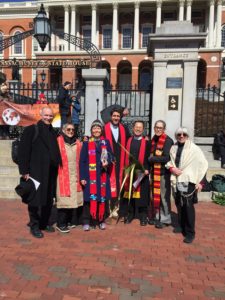
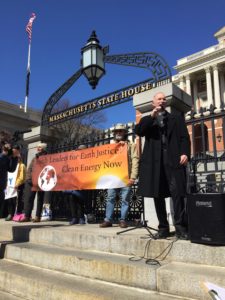
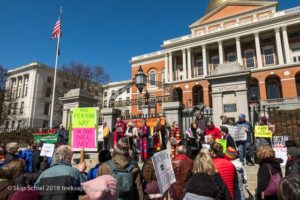
To name a couple of examples from the Judeo-Christian tradition: in Massachusetts, activists fighting new pipeline construction chose the biblical story of Moses confronting Pharaoh and demanding, in the name of God, that the people be set free, as the framework for Exodus from Fossil Fuels, an interfaith witness for climate action that we carried out in Boston in March 2018 during Holy Week (for Christians) and shortly before Passover (for Jews). (For my blog post on this event, click here.)
Similarly, activists fighting to stop construction of a trash-burning incinerator in a low-income community in Baltimore used the story of the theft of Naboth’s vineyard (1 Kings 21:1-21a) to illuminate their own experience of social and environmental injustice and to inspire their own acts of resistance. (For my sermon on this text, visit here.)
Sacred symbols such as water and trees also hold great power in many religious traditions. Is there a symbol around which you would like to organize your event?
5. Create a vision
If this event were “successful,” what would it look like? Hold this conversation early in the planning process. The vision that emerges can serve as a sort of North Star to guide you along the way. Keeping the vision in mind can raise energy, clarify focus, and open the heart. During the planning process, it is good to return to the vision from time to time. Are we still in alignment with the initial vision that so inspired us? Does our vision of the event need to change?
Antoine de Saint Exupery pointed out: “If you want to build a ship, don’t drum up people to collect wood and don’t assign them tasks and work, but rather teach them to long for the endless immensity of the sea.” Simon Sinek makes the same point in his TED talk, “How Great Leaders Inspire Action,” when he says, “Martin Luther King, Jr. gave the ‘I have a dream’ speech, not the ‘I have a plan’ speech.
6. Divvy things up
In other words: get organized. One model for organizing a complex event is to have a steering committee made up of maybe half a dozen dedicated individuals who can devote real time to overseeing the project. Other leaders can form subgroups that are devoted to accomplishing specific tasks (e.g. communications and media; worship service; choreography of civil disobedience; outreach to groups not yet represented). A member of the steering committee can participate in each subgroup and serve as a liaison to the steering committee, reporting on progress made and where more help is needed.
Divvying up responsibilities requires self-awareness (what skills do I bring to the table?), curiosity (what skills do the other people bring?), and clarity (what skills does this event need in order to be successful?). For example, some people may be excellent at generating and maintaining the big vision of the event, whereas other people may be terrific at handling details, creating timelines, forming agendas, and assuring accountability. A successful event will require both sets of skills.
Note: if you are planning an interfaith act of civil disobedience to address climate change, Climate Disobedience Center is an excellent source of support and guidance.
7. Communicate
Craft a clear, simple message for the media and the public.
Let your visuals communicate the same clear, dramatic message. Will a casual passerby grasp the purpose of your event?
Develop a communications plan: make a flyer, figure out how to post it on bulletin boards and share it online, set up a Facebook event page, compose a decent press release, designate your spokespeople, and reach out to press, radio, and TV.
8. Make it beautiful
Music is essential, especially participatory singing that requires no song sheets. When it comes to enlivening an interfaith vigil or rally, songs are more potent than chants. Whether they are fierce or tender, songs can generate warmth and fellow-feeling, compassion and resolve.
Will you create banners? What about oversize puppets? There’s nothing like holding an interfaith rally that is attended by a larger-than-life polar bear or by Mother Earth herself.
Will your event include a ritual such as ripping a cloth (a sign of mourning in Jewish tradition), blessing the crowd with evergreen fronds dipped in water (a Christian tradition), or smudging your neighbor’s outstretched palms with dirt (a ritual of commissioning someone to become a healer of Earth)? What kind of ritual might enrich your event?
Encourage religious leaders to wear vestments or other clothing that represents their tradition. You’re aiming for an event that is dignified, colorful, diverse, and photogenic.
9. Keep it fun
Wherever possible, maintain a spirit of joy. How blessed we are to express our deepest values, to celebrate the sacredness of life, and to do so together!
Bring snacks to planning meetings. Offer your seat to someone. Yield the floor. Enjoy the ride.
10. Pray your way through
As you plan an interfaith event, trust that the initial seed of an idea, and the process of tending, enlarging, pruning, and adapting those ideas, is a gift from Spirit. Aim to stay connected with Spirit all the way through by keeping your meetings rooted in prayer, allowing space for silence, singing, and prayer, as well as for the nitty-gritty work of planning and problem-solving. The only way to reach peace is to be peace along the way.
It’s worth pointing out that people who organize an interfaith climate action are people who care deeply: we feel an urgent desire to preserve the web of life and to create a just and sustainable society. Organizers will not always concur on the best path forward, and strong feelings can lead to disagreements. Expect some misunderstandings and conflict. Keep breathing. Cherish the planning process as an opportunity to use and expand all your skills in non-violent communication. Understand that everything that happens – the bump in the road, a sudden gust of disappointment, the possibility of failure – is part of your own spiritual journey to grow in wisdom, compassion, and discernment.
11. Record & share it
Can you persuade a professional photographer to take video and still photos? Or will you rely on people’s cell phones? Amplify the impact of your event by spreading images on social media, and consider writing blog posts, letters to the editor, and op-eds. Creating a visual and verbal record of your event not only boosts your morale – it also educates other people and encourages them to create their own actions.
Be sure to thank members of the media who covered the story.
12. Plan to follow up
Will this be a one-off event or will it be the start of something? Consider how you will engage people, once your event is over. At the end of your action, consider distributing a short handout of upcoming events and local organizations. Make it easy for newcomers to get involved in the climate movement.
Gather participants’ names and contact information. Keep records.
13. Savor the harvest
Soon after the event, take time with your steering committee to debrief in person or on a conference call. (What did we learn? What were the high points and low points? Name a rose and a thorn. What would we do differently next time? Are we ready to consider next steps?).
If you’re up for it, hold a party.
If possible, protect space in your calendar so that you can now catch up on the responsibilities you probably set aside in order to plan and implement your wonderful event.
Give thanks.




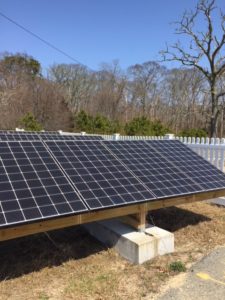
 We’ve shared a lot of words, so, before we pray, I invite us to take a moment in silence to feel the good earth that supports our feet, which we bless with every step and which blesses us with every step… I invite us to take a good deep breath of air, giving thanks for the trees and green things, giving us oxygen…and to feel that warm sun with all its good energy, with which we can power so many things…
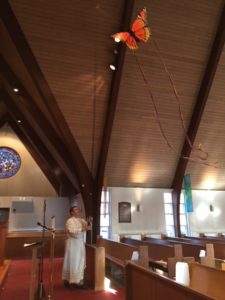
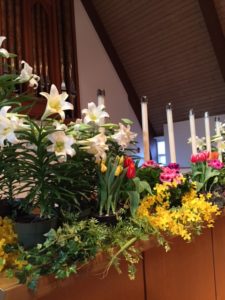 Through the power of resurrection, a great energy has been released into the world, and that power is already at work within us. It springs to new life when we gather to resist the forces of destruction, when we stand up for gun safety or engage in peaceful civil disobedience to stop new fracked gas pipelines. It springs to new life when we gather around the table to break bread in Jesus’ name. It springs to new life when we speak words that are truthful and kind, and when we treat ourselves and one another with compassion and respect. It springs to new life when we refuse to abandon and abuse Mother Earth and when we search for ways to re-weave the web of life.
It’s not enough just to gaze on Christ’s resurrection from afar. This is not only Jesus’ miracle – it is our miracle, too, a miracle that each of us is invited to experience more deeply every day of our lives.
Tonight, in silence, words, and song, in fear and wonder, we welcome into our lives and into our wounded and lovely world the Risen Christ and the power of resurrection.
Jesus Christ has risen to new life, and so have we.
Alleluia! Christ is Risen! The Lord is Risen, indeed! Alleluia!
Through the power of resurrection, a great energy has been released into the world, and that power is already at work within us. It springs to new life when we gather to resist the forces of destruction, when we stand up for gun safety or engage in peaceful civil disobedience to stop new fracked gas pipelines. It springs to new life when we gather around the table to break bread in Jesus’ name. It springs to new life when we speak words that are truthful and kind, and when we treat ourselves and one another with compassion and respect. It springs to new life when we refuse to abandon and abuse Mother Earth and when we search for ways to re-weave the web of life.
It’s not enough just to gaze on Christ’s resurrection from afar. This is not only Jesus’ miracle – it is our miracle, too, a miracle that each of us is invited to experience more deeply every day of our lives.
Tonight, in silence, words, and song, in fear and wonder, we welcome into our lives and into our wounded and lovely world the Risen Christ and the power of resurrection.
Jesus Christ has risen to new life, and so have we.
Alleluia! Christ is Risen! The Lord is Risen, indeed! Alleluia!
 I like all these expressions, but what I want to say, what I want to hear, is “Keep the faith.” We live in a precarious time, a time of turmoil when for all kinds of reasons many of us feel rattled and anxious, and brace ourselves for the next bit of bad news. So how glad I am that today, on the Second Sunday in Lent, we are invited to remember Abraham, our brother in the faith, our father in the faith, “the father of all of us,” as St. Paul puts it in his Letter to the Romans (
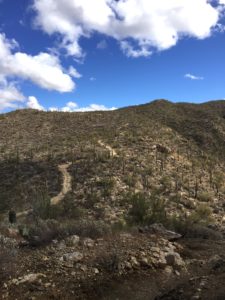 I want to emphasize that last point: he sets out. He walks. Today’s first reading makes it clear that faith is active, not passive: faith is practiced and made manifest in action. What does God say to Abraham? “I am God Almighty; walk before me, and be blameless.” Walk – don’t stand still, don’t get passive, don’t stay stuck and hopeless. Don’t wait for someone else to do something. Get going. Get moving. Take action.
And don’t walk alone. “Walk before me,” says Yahweh, “and be blameless.” It is if God were an unseen presence and power that is always behind us, as if our job were to clear the way for divine love to move through us, freely and fully, like a river that flows through us and out into the world, so that all people and all beings can be blessed and healed and reconciled. Our task in the course of a day is to stay in conscious contact with God, so that as far as possible we are walking before God, not walking alone, not being driven by our ego or by our anxiety. Activists usually depend on people power, but spiritual activists – people who walk in faith – depend on God-power. It is God who energizes and emboldens us, God who gives us power to do more than we can ask or imagine.
We live in a time that cries out for the imagination, determination, and heart of people of faith. The web of life is unraveling before our eyes. Great populations of creatures – even entire species – are rapidly disappearing from Earth. Scientists tell us that a mass extinction event is now underway – what they’re calling a “
I want to emphasize that last point: he sets out. He walks. Today’s first reading makes it clear that faith is active, not passive: faith is practiced and made manifest in action. What does God say to Abraham? “I am God Almighty; walk before me, and be blameless.” Walk – don’t stand still, don’t get passive, don’t stay stuck and hopeless. Don’t wait for someone else to do something. Get going. Get moving. Take action.
And don’t walk alone. “Walk before me,” says Yahweh, “and be blameless.” It is if God were an unseen presence and power that is always behind us, as if our job were to clear the way for divine love to move through us, freely and fully, like a river that flows through us and out into the world, so that all people and all beings can be blessed and healed and reconciled. Our task in the course of a day is to stay in conscious contact with God, so that as far as possible we are walking before God, not walking alone, not being driven by our ego or by our anxiety. Activists usually depend on people power, but spiritual activists – people who walk in faith – depend on God-power. It is God who energizes and emboldens us, God who gives us power to do more than we can ask or imagine.
We live in a time that cries out for the imagination, determination, and heart of people of faith. The web of life is unraveling before our eyes. Great populations of creatures – even entire species – are rapidly disappearing from Earth. Scientists tell us that a mass extinction event is now underway – what they’re calling a “